Mannington's Pearmain
Apple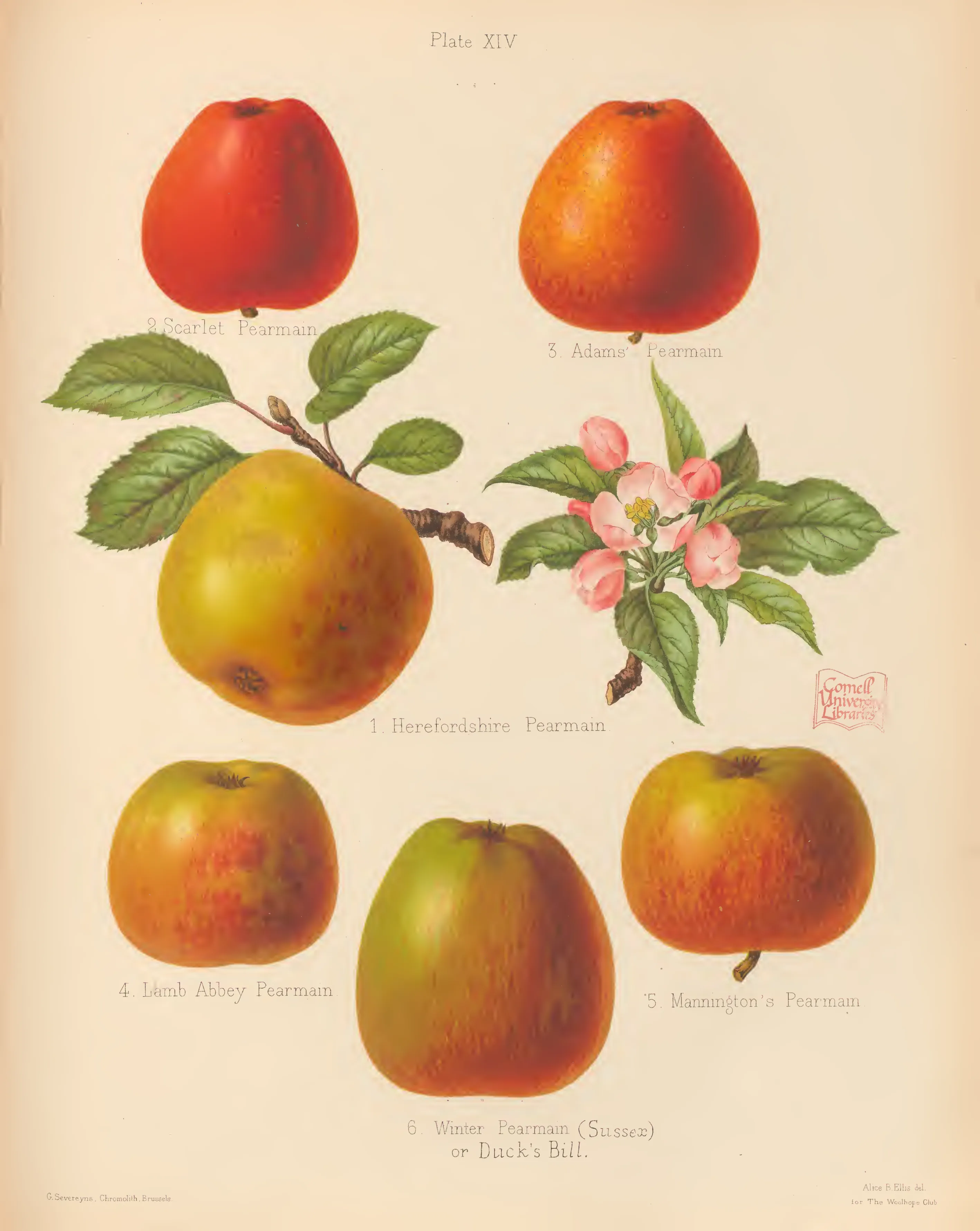
Mannington's Pearmain
Origin / History
Mannington's Pearmain originated about the year 1770, in a garden at Uckfield, in Sussex, England, which belonged at that time to Mr. Turley but was later in the possession of his grandson, Mr. Mannington (Herefordshire Pomona). The original tree grew up at the root of a hedge where the refuse from the cider press had been thrown. The original tree never attained any great size, and died about the year 1820. The great merit of its fruit had been well recognized long before, and grafts had been freely distributed to many persons in the neighbourhood. It does not seem to have been much known beyond its own locality until the Autumn of 1847, when Mr. Mannington sent specimens of the fruit to the London Horticultural Society, where it was pronounced to be a dessert fruit of the highest excellence. It thus received the name from Mr. Thompson of Mannington's Pearmain (Herefordshire Pomona).
Bunyard's Handbook adds that the variety was distributed by Mr. Cameron of Uckfield in 1849. Downing simply gives the origin as Sussex, England, and notes that it is a dessert fruit of considerable esteem abroad, here fully sustaining its foreign character.
The George Bunyard catalog (1914) gives a conflicting attribution, stating the variety was "Raised by a Mr. Morris, Freetorn."
Tree
The tree is very hardy, but does not attain a large size (Herefordshire Pomona); Downing likewise calls the tree hardy. It is an early and excellent bearer, even at two or three years from the graft (Herefordshire Pomona); Downing also notes it as an early bearer. Bunyard's Handbook describes growth as moderate, making a compact well-spurred tree.
Leaf (Bunyard's Handbook): rather small, roundish, pea green, slightly upfolded, undulating, very boldly curved serrate.
Fruit
Size: Sources disagree. The Herefordshire Pomona calls the fruit medium sized. Bunyard's Handbook gives medium, 2½ by 2 inches. Downing describes it as below medium. The George Bunyard catalog (1914) calls it "a fruit of fairly large size." Thomas Rivers' catalogue (1914) gives medium size.
Form: Abrupt Pearmain-shaped (Herefordshire Pomona); roundish conical, truncated (Downing); flattened round, regular (Bunyard's Handbook).
Stem / Stalk: Three quarters of an inch long, obliquely inserted (Herefordshire Pomona); fairly long (Bunyard's Handbook).
Cavity: Moderately deep, with generally a fleshy protuberance on one side of it (Herefordshire Pomona); rather deep (Bunyard's Handbook).
Calyx / Eye: Partially closed, with broad flat segments (Herefordshire Pomona); nearly closed (Bunyard's Handbook).
Basin: Shallow and plaited (Herefordshire Pomona); shallow (Bunyard's Handbook).
Skin: Of a rich golden yellow colour, covered with thin brown russet on the shaded side, but covered with dull brownish red on the side next the sun (Herefordshire Pomona). Yellow, partially russeted, shaded and splashed with red, with prominent, rough, light gray dots (Downing). Dull green-red with russet (Bunyard's Handbook). Yellow with dark cheeks (George Bunyard catalog, 1914).
Flesh / Flavor: Yellow, firm, crisp, juicy, and very sugary, with a brisk and particularly rich flavour (Herefordshire Pomona). Yellowish, crisp, tender, brisk subacid; Very Good (Downing). Crisp, yellow, of fair flavour (Bunyard's Handbook). A very pleasant flavour (George Bunyard catalog, 1914).
The Herefordshire Pomona describes it as "one of the best and richest flavoured dessert apples." Bunyard's Handbook, however, dissents: "The flavour of this variety is only fair and as there are so many better at this season I consider it not worth growing."
Core / Seeds: Core medium (Downing). Seeds not described in source.
Season
In season from November even till March (Herefordshire Pomona); November to March (Bunyard's Handbook); October, December (Downing); Oct.–March (Thomas Rivers catalogue, 1914). The George Bunyard catalog (1914) calls it a good keeper.
The fruit should be allowed to hang late on the tree to secure its richness of flavour, and its good keeping properties, for if gathered too soon it is apt to shrivel. The only objection to this is the difficulty of protecting the fruit from the birds (Herefordshire Pomona).
Uses
Dessert fruit (Herefordshire Pomona, Downing, Bunyard's Handbook). Thomas Rivers' catalogue (1914) notes it as "of the best suited to" (the text is truncated and the intended use is not fully stated).
Subtypes / Variants
Not described in source.
Other
Bunyard's Handbook records the French name: F., Pomme de Mannington, and cites the Herefordshire Pomona, p. 14. The variety is figured in the Herefordshire Pomona at Plate XIV.
Book Sources
Described in 3 period pomological works
Nursery Catalog Sources
Found in 6 catalogs (1900–1917) from England, Illinois
- George Bunyard & Co. , Royal Nurseries, Maidstone, Kent , England — 1900
- Central Experimental Farm , Dominion Department of Agriculture, Agassiz, British Columbia (under test; Bulletin No. 3, Second Series) — 1900
- Benjamin Buckman (personal inventory) , Farmingdale , Illinois — 1901
- James Veitch & Sons , Ltd., Royal Exotic Nursery, Chelsea, London (also Coombe Wood, Langley, and Feltham) , England — 1911
- George Bunyard & Co. , Royal Nurseries, Maidstone, Kent , England — 1914
- George Bunyard & Co. , Royal Nurseries, Maidstone, Kent , England — 1917
View original book sources (5)
— Woolhope Naturalists Field Club, The Herefordshire Pomona (1885)PLATE XIV.
- MANNINGTON'S PEARMAIN.
This excellent apple originated about the year 1770, in a garden at Uckfield, in Sussex, which belonged at that time to Mr. Turley, but which is now in the possession of his grandson, Mr. Mannington. The original tree grew up at the root of a hedge where the refuse from the cider press had been thrown. The original tree never attained any great size, and died about the year 1820. The great merit of its fruit however had been well recognized long before, and grafts had been freely distributed to many persons in the neighbourhood. It does not seem to have been much known beyond its own locality, until the Autumn of 1847, when Mr. Mannington sent specimens of the fruit to the London Horticultural Society, where it was pronounced to be a dessert fruit of the highest excellence. It thus received the name from Mr. Thompson of Mannington's Pearmain.
Description.—Fruit, medium sized, abrupt Pearmain-shaped. Skin, of a rich golden yellow colour, covered with thin brown russet on the shaded side, but covered with dull brownish red on the side next the sun. Eye, partially closed, with broad flat segments, set in a shallow and plaited basin. Stalk, three quarters of an inch long, obliquely inserted in a moderately deep cavity, with generally a fleshy protuberance on one side of it. Flesh, yellow, firm, crisp, juicy, and very sugary, with a brisk and particularly rich flavour.
This is one of the best and richest flavoured dessert apples, in season from November even till March. The fruit should be allowed to hang late on the tree to secure its richness of flavour, and its good keeping properties, for if gathered too soon it is apt to shrivel. The only objection to this is the difficulty of protecting the fruit from the birds.
The tree is very hardy, but does not attain a large size. It is an early and excellent bearer, even at two or three years from the graft.
— A.J. Downing, The Fruits and Fruit Trees of America (1900)Mannington's Pearmain.
Origin, Sussex, England. A dessert fruit of considerable esteem abroad, and here fully sustains its foreign character. Tree hardy, and early bearer.
Fruit below medium, roundish conical, truncated, yellow, partially russeted, shaded and splashed with red, prominent, rough, light gray dots. Flesh yellowish, crisp, tender, brisk subacid. Very Good. Core medium. October, December.
— E.A. Bunyard, A Handbook of Hardy Fruits (1920)MANNINGTON'S PEARMAIN. Her. Pom., p. 14. F., Pomme de Mannington. Dessert, November to March, medium, 2½ by 2, flattened round, regular. Colour, dull green-red with russet. Flesh, crisp, yellow, fair flavour. Eye, nearly closed in a shallow basin. Stem, fairly long in a rather deep cavity. Growth, moderate, making a compact well-spurred tree. Leaf, rather small, roundish, pea green, slightly upfolded, undulating, very boldly curved serrate. Origin, raised at Uckfield, Sussex, about 1770, and distributed by Mr. Cameron of the same town, in 1849. The flavour of this variety is only fair and as there are so many better at this season I consider it not worth growing.
— George Bunyard & Co., George Bunyard Catalog of Fruit Trees (1914) (1914)A fruit of fairly large size, yellow with dark cheeks, and a very pleasant flavour. A good keeper. Raised by a Mr. Morris, Freetorn.
— Thomas Rivers & Son, Thomas Rivers Catalogue of Fruits (1914) (1914)medium size; very of the best suited to - Oct.-March