Marengo
Crab Apple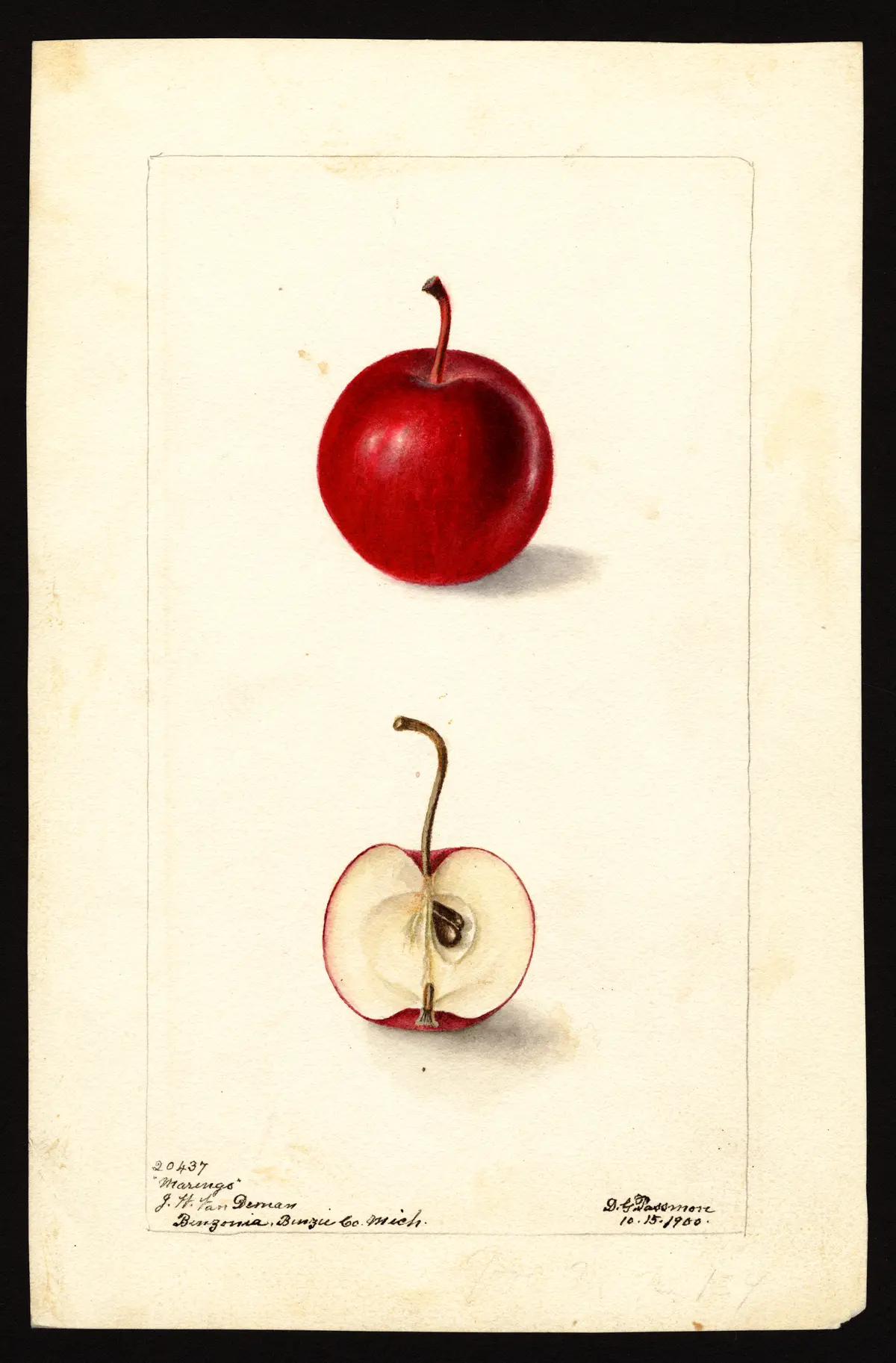
USDA Pomological Watercolor Collection
Marengo
Origin/History
Originated at Marengo, Illinois. The discoverer is attributed to James F. Lester of Marengo, Ill., who found it as a seedling in the rows of an old seedling nursery of apple-stocks. The original tree is thought to have been about eighteen years old at the time of its identification. Its identity as a Siberian Crab — Pyrus baccata as a tree — is also attributed to Lester's observation.
Tree
Of medium size, vigorous, spreading, very hardy, long-lived, and a reliable cropper, usually yielding heavy crops annually. The limbs are very tough and support heavy loads well. The fruit hangs well to the tree until very late in the season. Young shoots vigorous, reddish brown, with the gray specks, bloom, and scaly cuticle peculiar to the Siberian.
Fruit
Size and Form: Large for its class (Downing; Warder, via Beach: "one of the largest of its class"). Thomas describes it as medium. Downing gives the form as roundish, flattened at the blossom end. Warder describes it as globular, truncate, regular, or slightly flattened on the sides.
Skin: Surface smooth. Downing: bright warm red on a yellow ground, with a few scattered gray or light russet dots. Warder (via Beach): yellow, blushed or covered with crimson; dots minute.
Stem: Long, slender (Downing). Long (Warder, via Beach). Set in a narrow cavity (Downing); cavity medium and regular (Warder, via Beach) — sources conflict on cavity width.
Calyx: Small, closed (Warder, via Beach). Closed (Downing).
Basin: Broad, open, corrugated (Downing). Shallow, folded (Warder, via Beach) — sources conflict.
Flesh and Flavor: Downing: yellowish white, crisp, juicy, a little harsh until fully ripe, when it is a mild and pleasant subacid. Warder (via Beach): yellow, firm, rather juicy; flavor subacid, aromatic. Thomas: crisp, subacid.
Core and Seeds: Core large, closed, meeting the eye; seeds few, small, plump, light brown (Warder, via Beach).
Season
Early winter to late in spring (Downing). Winter, and till spring in the North (Warder, via Beach). Thomas: keeps all winter.
Uses
Good for home use where a late-keeping crabapple is desired. Some have found it a profitable market variety, but other varieties of its season that are more attractive in color are generally preferred for commercial purposes. Quality: good. Uses: kitchen and dessert (Warder, via Beach).
Subtypes/Variants
Not described in source.
Other
Not described in source.
Book Sources
Described in 3 period pomological works
USDA Nomenclature (1905)
From W.H. Ragan, Nomenclature of the Apple, USDA Bulletin No. 56
Origin, Marengo, Ill.
View original book sources (3)
— A.J. Downing, The Fruits and Fruit Trees of America (1900)Marengo.
The discoverer of this variety, as well as its identity with the Siberian Crabs, Pyrus baccata, as a tree, is attributed to James F. Lester, Marengo, Ill. It is said to be a seedling found in the rows of an old seedling nursery of apple-stocks. The original tree is thought to be about eighteen years old. Young shoots vigorous, reddish brown, with the gray specks, bloom and scaly cuticle peculiar to the Siberian. The fruit is large for its class; in form roundish, flattened at blossom end, bright warm red on yellow ground, smooth, with a few scattered gray or light russet dots. Flesh yellowish white, crisp, juicy, a little harsh until fully ripe, when it is a mild and pleasant subacid. Stalk long, slender, set in a narrow cavity. Calyx closed. Basin broad, open, corrugated. Early Winter to late in Spring.
— S.A. Beach, The Apples of New York, Vol. 2 (1905)MARENGO.
REFERENCES. 1. Elliott, Horticulturist, 23:136. 1868. fig. 2. Warder, Tilt. Jour. Hort., 5:207. 1869. fig. 3. Downing, 1869:425. 4. Horticulturist, 26:371. 1871. 5. Ill. Hort. Soc. Rpt., 1877:112. 6. Ib., 1879:196. 7. Barry, 1883:360. 8. Montreal Hort. Soc. Rpt., 1884:37. 9. Thomas, 1885:226, 517. 10. Bailey, An. Hort., 1892:244. 11. Me. Sta. Rpt., 1893:134. 12. Budd-Hansen, 1903:222.
SYNONYMS. MARENGO (5, 6). MARENGO CRAB (3, 7, 9, 10, 11, 12). MARENGO No. 1 (2, 8). MARENGO WINTER CRAB (1, 4). Marengo Winter Crab (2).
Originated at Marengo, Ill. (3, 6). This is a good variety for home use where a late-keeping crabapple is desired, and some have found it a profitable market variety but other varieties of its season which are more attractive in color are generally preferred for commercial purposes. The tree is of medium size, vigorous, spreading, very hardy, long-lived and a reliable cropper usually yielding heavy crops annually. The limbs are very tough and support heavy loads well. The fruit hangs well to the tree till very late in the season. It agrees well with the following description given by Warder (2): "Fruit globular, truncate, regular, or slightly flattened on the sides, one of the largest of its class; surface smooth, yellow, blushed or covered with crimson; dots minute; basin shallow, folded; eye small, closed; cavity medium, regular; stem long; core large, closed, meeting the eye; seeds few, small, plump, light brown; flesh yellow, firm, rather juicy; flavor subacid, aromatic. Use, kitchen and dessert; quality, good; season, winter, and till spring in the North."
— John J. Thomas, The American Fruit Culturist (1903)Marengo. Medium, round; yellow, bright red over; crisp, sub-acid. Keeps all winter. Illinois.