Marquise
Pear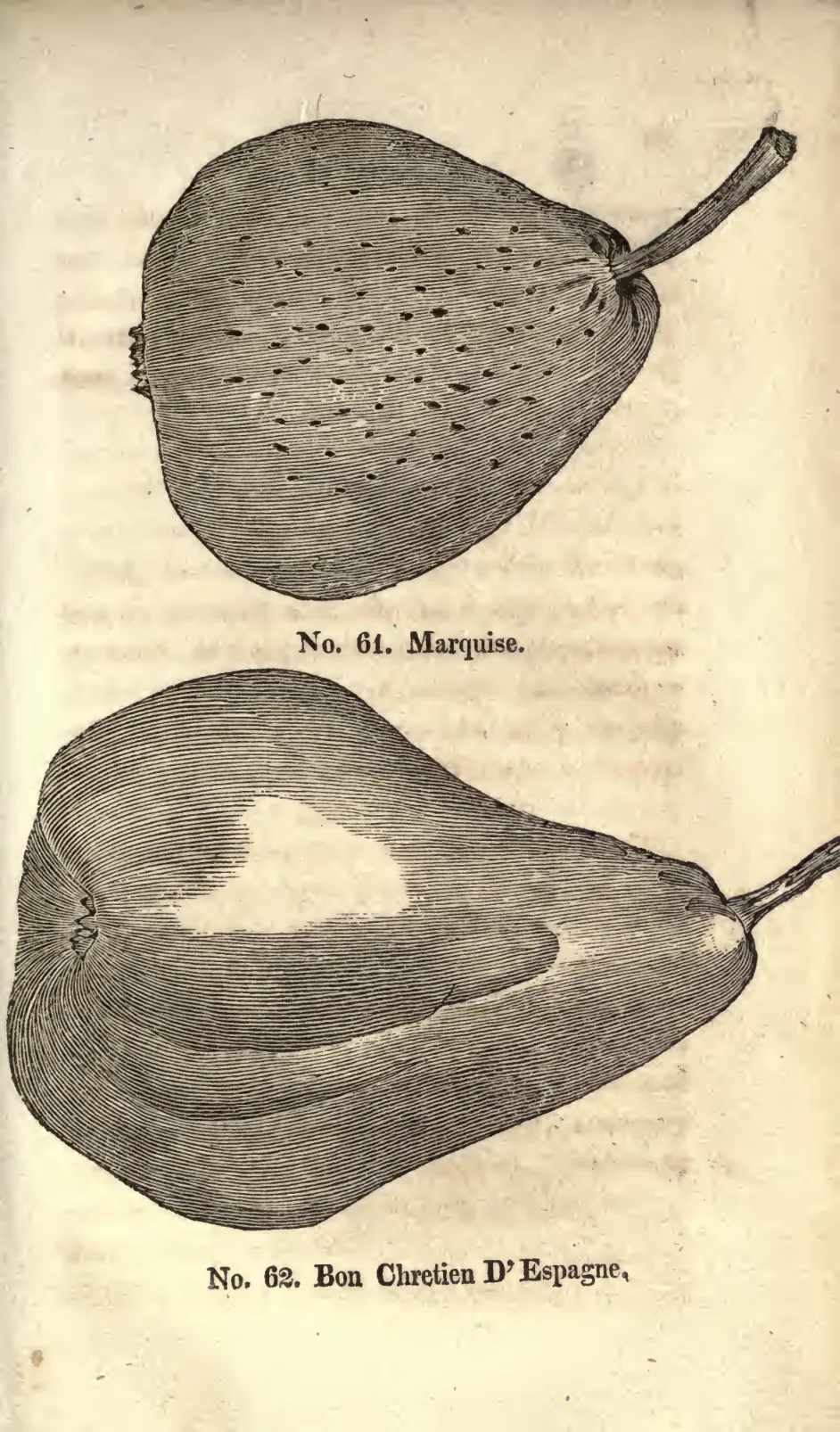
Marquise
Origin / History
Of French origin. Merlet described Marquise in 1675 in his Abrege des bons fruits. Figured and described by Duhamel, Trait. Arb. Fr. 2:221, Pl. XLIX, 1768, and by Hogg, Fruit Man. 614, 1884. Listed by Coxe in A View of the Cultivation of Fruit Trees (1817) as No. 61.
Tree
Not described in source.
Fruit
Size: Very large (Coxe); above medium (Hedrick).
Form: Pyramidal, rather flat at the crown, gradually lessening to the stalk (Coxe). Turbinate, globular in the lower part, conic and slightly obtuse in the upper (Hedrick).
Stem: Large, about an inch long (Coxe).
Cavity: Furrowed; the stalk planted in it (Coxe).
Calyx: Not described in source.
Basin: Not described in source.
Skin: Even, bright green changing to yellowish, growing yellow when fully ripe. Sometimes a light shade of red towards the sun (Coxe); a brownish tinge on the side next the sun (Hedrick).
Dots: Thickly covering the skin; green on the shaded side, brown or gray on the other (Hedrick). Dots of a deeper green than the ground (Coxe).
Flesh and flavor: Flesh white, semi-fine, breaking, very delicate, full of sugary juice, slightly acid and musky (Hedrick). Buttery and melting; juice sweet, mild, and sometimes a little musky (Coxe). Hedrick: "a good dessert pear".
Core and seeds: Not described in source.
Season
November and December.
Uses
Dessert.
Subtypes / Variants
Not described in source.
Other
Not described in source.
Book Sources
Described in 2 period pomological works
Nursery Catalog Sources
Found in 4 catalogs (1845–1900) from England, Massachusetts
- Winship's Nursery (Brighton Nurseries , operated by the Winship family), Brighton (Boston) , Massachusetts — 1845 — listed as Marquis
- Hovey & Co. , Cambridge , Massachusetts — 1849
- George Bunyard & Co. , Royal Nurseries, Maidstone, Kent , England — 1900 — listed as Marquis
- Central Experimental Farm , Dominion Department of Agriculture, Agassiz, British Columbia (under test; Bulletin No. 3, Second Series) — 1900
View original book sources (2)
— William Coxe, A View of the Cultivation of Fruit Trees (1817)
- MARQUISE.
This is a very large pear of pyramidal shape, rather flat at the crown, gradually lessening to the stalk, which is large and about an inch long, planted in a furrowed cavity—the skin is even, and green, with dots of a deeper green, growing yellow when fully ripe; sometimes a light shade of red towards the sun—the flesh is buttery and melting, the juice sweet, mild, and sometimes a little musky; it ripens in November and December.
— U.P. Hedrick, The Pears of New York (1921)Marquise.
- Duhamel Trait. Arb.Fr. 2:221, Pl. XLIX. 1768. 2. Hogg Fruit Man. 614. 1884.
Of French origin. Merlet described it in 1675 in his Abrege des bons fruits. Fruit above medium, turbinate, globular in the lower part, conic and slightly obtuse in the upper, bright green changing to yellowish, with a brownish tinge on the side next the sun, thickly covered with dots, which are green on the shaded side and brown or gray on the other; flesh white, semi-fine, breaking, full of sugary juice, slightly acid and musky, and very delicate; a good dessert pear; Nov. and Dec.