Martha
Crab Apple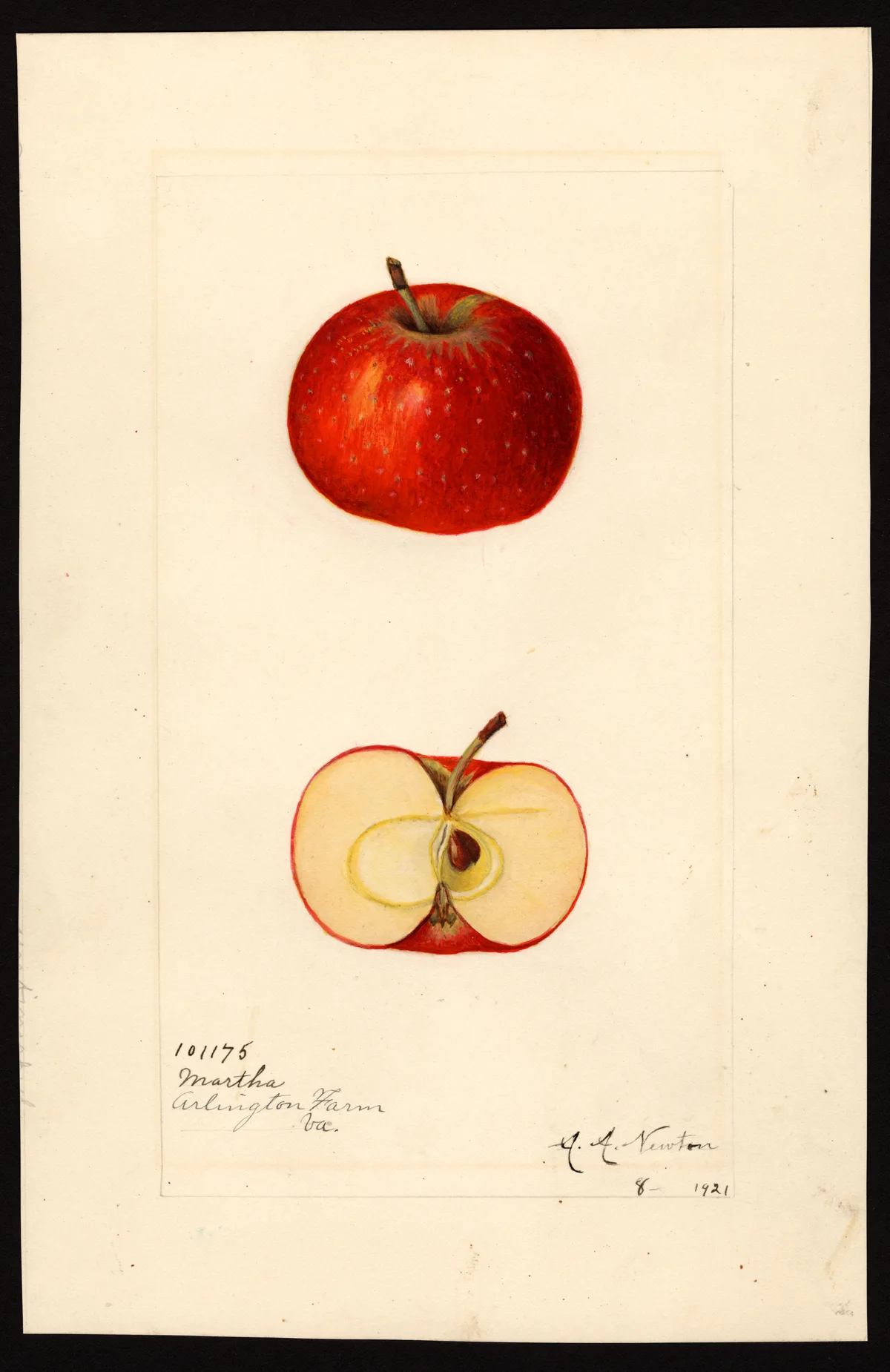
USDA Pomological Watercolor Collection
Martha
Origin/History
Martha originated with the late Peter M. Gideon of Excelsior, Minnesota. Hedrick notes it was "first described in 1839" (though the earliest reference Beach cites is the Iowa Horticultural Society Report of 1879). Stark Bros. notes it somewhat resembles the parent type. Beach observes that as of 1905 it had been grown but little in New York and should be more generally grown there.
Tree
Tree medium in size, moderately vigorous (Beach) — Hedrick describes the trees as "of but medium size and vigor" but elsewhere in his entry calls the tree "vigorous"; Central Experimental Farm (Agassiz, BC) describes the tree planted Spring 1895 as "a strong grower." Form spreading, open, and somewhat inclined to droop. Very hardy. Comes into bearing young, is a reliable cropper, and yields good to heavy crops annually or nearly annually; the fruit hangs well to the tree.
Twigs long, curved, slender; internodes long. Bark reddish-brown tinged with green, lightly streaked with scarf-skin, not pubescent. Lenticels quite numerous, small, oblong, not raised. Buds very prominent, large, long, acute, free, not pubescent. Leaves rather long, somewhat twisted and drooping.
Fruit
Size
Usually rather large (Beach, Budd-Hansen, Hedrick); Central Experimental Farm describes the fruit as "above medium size." Thomas describes it as medium. Uniform in size and shape.
Form
Roundish or oblate (Beach, Hedrick); Budd-Hansen and Thomas describe it as oblate. Very regular (Budd-Hansen) or regular to very faintly ribbed (Beach, Hedrick), usually symmetrical; sides sometimes unequal. Hedrick characterizes the fruits as "perfectly turned in oblate spheres."
Stem
Long, slender.
Cavity
Acute to somewhat obtuse (Beach) — Hedrick gives "acute"; Budd-Hansen describes it as "wide, regular." Medium in depth to rather shallow, rather broad, sometimes furrowed, often thinly russeted.
Calyx
Medium to small (Beach) — Hedrick gives "small." Closed or partly open, occasionally deciduous. Segments often nearly obsolete (Budd-Hansen). Calyx tube short, rather narrow, very small, conical or somewhat funnelform (Beach); Hedrick gives short, narrow, very small, conical. Stamens median to marginal.
Basin
Shallow, wide, obtuse, smooth (Beach, Hedrick); Budd-Hansen describes the basin as "very wide, nearly flat."
Skin
Moderately thin (Beach) — Hedrick gives "thin"; tough, smooth. Clear pale yellow almost entirely covered with an attractive bright light red overspread with bluish bloom; sometimes faint narrow stripes extend from the cavity to calyx. Budd-Hansen describes the surface as smooth, yellow, almost entirely covered with a beautiful bright red, with a bluish bloom, "no stripes or splashes." Stark Bros. describes the fruit as bright yellow, shaded dull red. Thomas describes it as yellow with a red cheek. Central Experimental Farm describes the skin as clear yellow, nearly covered with bright red.
Dots
Rather numerous, light-colored, small to medium size (Beach); Hedrick gives numerous, light colored, small; Budd-Hansen gives white, conspicuous.
Flesh/Flavor
Flesh yellowish (Beach) — Hedrick gives "yellow"; Budd-Hansen gives "yellowish white." Firm, moderately coarse (Beach) — Hedrick gives "coarse"; crisp, juicy, rather brisk subacid (Beach) — Hedrick gives "brisk subacid"; Budd-Hansen gives "acid"; Thomas gives "acid." Good to very good in flavor and quality. Beach calls it "excellent in flavor and quality; one of the very best of its class for all culinary purposes." Hedrick writes that the yellowish flesh, "though a little coarse, is so crisp, juicy, and well-flavored that one is tempted to say that this is the very best crab for culinary purposes." Budd-Hansen notes it is "good for culinary use." Stark Bros. notes it is "too tart to eat fresh, but is unsurpassed for cooking fresh."
Core/Seeds
Core medium size, axile; cells closed or nearly so (Beach) — Hedrick gives "cells closed"; Budd-Hansen gives "core closed." Carpels roundish or somewhat obovate, slightly tufted (Beach); Hedrick gives round or obovate, tufted. Seeds medium size, rather narrow, acute to acuminate (Beach); Hedrick gives narrow, acute.
Season
Season September to November (Beach, Hedrick); Budd-Hansen gives September to December; Hedrick elsewhere describes the season as "late fall." Thomas gives the season as early. Central Experimental Farm gives October.
Uses
Excellent for all culinary purposes — Beach calls it "one of the very best of its class for all culinary purposes." Hedrick is tempted to call it "the very best crab for culinary purposes." Budd-Hansen notes it is good for culinary use. Stark Bros. notes it is too tart to eat fresh but is unsurpassed for cooking fresh. Hedrick notes that the season (late fall) makes this one of the most desirable crabs for home or market.
The large fruits, handsomely colored with bright red on a yellow background, perfectly turned in oblate spheres, and the uniformity in size and shape, make Martha — in Hedrick's words — "one of the most prepossessing of all crabs." Beach notes the fruit is uniform, reliable, and satisfactory in appearance and quality.
Subtypes/Variants
Not described in source.
Other
Hedrick and Stark Bros. classify Martha among the crab-apples; Stark Bros. notes it somewhat resembles the parent type (the abbreviation "NMRS." appears at the close of the Stark Bros. entry).
Book Sources
Described in 4 period pomological works
Nursery Catalog Sources
Found in 24 catalogs (1891–1912) from Alabama, Illinois, Missouri, Nebraska, Oregon, Washington
- Missouri Nursery Co. , Louisiana , Missouri — 1891
- Milwaukie-Canby Nurseries , Canby, OR (and Milwaukie, OR) — 1893
- Multnomah Nurseries , Russellville , Oregon — 1894
- The Vineland Nurseries (Kelsey & Co. , Proprietors), St. Joseph, Missouri (Office: 13th and Atchison Sts., 2 Blocks East of the Citizens St. Car Line) — 1894
- Cotta Nursery (J.V. Cotta) , Carroll County , Illinois — 1895
- J.V. Cotta (Cotta Nursery) , Carroll County , Illinois — 1898
- Alabama Nursery Co. , Huntsville , Alabama — 1900
- Central Experimental Farm , Dominion Department of Agriculture, Agassiz, British Columbia (under test; Bulletin No. 3, Second Series) — 1900
- Benjamin Buckman (personal inventory) , Farmingdale , Illinois — 1901
- Mountain Grove Nurseries (Tippin & Moore , Proprietors; Geo. T. Tippin, J. W. Tippin, J. C. Moore), Mountain Grove , Missouri — 1901
- Washington Nursery Co. , Toppenish , Washington — 1901
- Pacific Nursery Company (W. O. Hudson & A. D. Hudson) , Tangent , Oregon — 1903
- Phoenix Nursery Company (W. E. Rossney , President; Sidney Tuttle, Vice-President), Bloomington , Illinois — 1904
- Stark Bros. Nurseries & Orchards Co. , Louisiana , Missouri — 1906
- The Dalles Nurseries , The Dalles , Oregon — 1906
- Milton Nursery Co. (A. Miller & Sons , Proprietors), Milton , Oregon — 1909
- Washington Nursery Company , Toppenish , Washington — 1909
- Stark Bros. Nurseries & Orchards Co. , Louisiana , Missouri — 1910
- Galbraith Nursery Co. (DeWitt Hansen , Pres.-Mgr.), Fairbury , Nebraska — 1911
- Stark Bros. Nurseries & Orchards Co. , Louisiana , Missouri — 1911
- Pacific Nursery Company , Portland , Oregon — 1912
- Stark Bros. Nurseries & Orchards Co. , Louisiana , Missouri — 1912
- Vineland Nurseries Company , Clarkston , Washington — 1912
- Washington Nursery Company , Toppenish , Washington — 1912
View original book sources (6)
— John J. Thomas, The American Fruit Culturist (1903)Martha.* Medium, oblate; yellow with a red cheek; acid, good. Season early. Minnesota.
— S.A. Beach, The Apples of New York, Vol. 2 (1905)MARTHA.
REFERENCES. 1. ? Ia. Hort. Soc. Rpt., 1879:452. 2. Ib., 1880:68. 3. Rural N. Y., 45:284. 1886. figs. 4. Am. Pom. Soc. Rpt., 1887:134. 5. Bailey, An. Hort., 1892:244. 6. Thomas, 1897:299. 7. Am. Pom. Soc. Cat., 1897:11. 8. Budd-Hansen, 1903:222. 9. Rural N. Y., 62:235. 1903. 10. Farrand, Mich. Sta. Bul., 205:47. 1903.
SYNONYMS. None.
Fruit large, very handsome clear yellow more or less overspread with bright red; excellent in flavor and quality; one of the very best of its class for all culinary purposes. The tree is of medium size, moderately vigorous, roundish or spreading, very hardy, comes into bearing young, and is a reliable cropper, yielding good to heavy crops annually or nearly annually. The fruit hangs well to the tree, is uniform, reliable, and satisfactory in appearance and quality. Season, September to late fall. It should be more generally grown in New York.
Historical. Originated with Peter M. Gideon, Excelsior, Minn. It has as yet been grown but little in this state.
TREE.
Tree medium in size, moderately vigorous. Form spreading, open and somewhat inclined to droop. Twigs long, curved, slender; internodes long. Bark reddish-brown tinged with green, lightly streaked with scarf-skin, not pubescent. Lenticels quite numerous, small, oblong, not raised. Buds very prominent, large, long, acute, free, not pubescent. Leaves rather long, somewhat twisted and drooping.
FRUIT.
Fruit usually rather large, uniform in size and shape. Form roundish or oblate, regular or very faintly ribbed, usually symmetrical; sides sometimes unequal. Stem long, slender. Cavity acute to somewhat obtuse, medium in depth to rather shallow, rather broad, sometimes furrowed, often thinly russeted. Calyx medium to small, closed or partly open, occasionally deciduous. Basin shallow, wide, obtuse, smooth. Skin moderately thin, tough, smooth, clear pale yellow almost entirely covered with an attractive bright light red overspread with bluish bloom; sometimes faint narrow stripes extend from the cavity to calyx. Dots rather numerous, light-colored, small to medium size. Calyx tube short, rather narrow, very small, conical or somewhat funnelform. Stamens median to marginal. Core medium size, axile; cells closed or nearly so. Carpels roundish or somewhat obovate, slightly tufted. Seeds medium size, rather narrow, acute to acuminate. Flesh yellowish, firm, moderately coarse, crisp, juicy, rather brisk subacid, good to very good in flavor and quality. Season September to November.
— J.L. Budd & N.E. Hansen, American Horticultural Manual, Part II: Systematic Pomology (1914)Martha. — Originated by the late Peter M. Gideon, Excelsior, Minnesota.
Fruit large, oblate, very regular; surface smooth, yellow, almost entirely covered with a beautiful bright red, with a bluish bloom, no stripes or splashes; dots white, conspicuous; cavity wide, regular; stem long; basin very wide, nearly flat; segments often nearly obsolete. Core closed; flesh yellowish white, acid, good for culinary use. September to December.
— U.P. Hedrick, Cyclopedia of Hardy Fruits (1922)MARTHA. Fig. 68. The large fruits, handsomely colored with bright red on a yellow background, perfectly turned in oblate spheres, and the uniformity in size and shape, make Martha one of the most prepossessing of all crabs. The yellowish flesh, though a little coarse, is so crisp, juicy, and well-flavored that one is tempted to say that this is the very best crab for culinary purposes. The trees, while of but medium size and vigor, are hardy, come into bearing young, bear annually, and are usually fruitful. Furthermore, the season, late fall, makes this one of the most desirable crabs for home or market. This is another of Peter Gideon's crab-apples first described in 1839.
Tree medium in size, vigorous, spreading, open, drooping. Fruit large, uniform in size and shape, round or oblate, regular or faintly ribbed, usually symmetrical, sides sometimes unequal; stem long, slender; cavity acute, broad, sometimes furrowed, often thinly russeted; calyx small, closed or partly open, occasionally deciduous; basin shallow, wide, obtuse, smooth; skin thin, tough, smooth, pale yellow almost covered with bright, light red overspread with bloom; sometimes faint narrow stripes extend from the cavity to calyx; dots numerous light colored, small; calyx-tube short, narrow, very small, conical; stamens median to marginal; core of medium size, axile; cells closed; carpels round or obovate, tufted; seeds narrow, acute; flesh yellow, firm, coarse, crisp, juicy, brisk subacid; good to very good; September to November.
— Central Experimental Farm, Central Experimental Farm, Agassiz BC — Catalogue of Fruit Trees under Test (Bulletin No. 3, 1900) (1900)Planted Spring 1895. Tree a strong grower. Fruit above medium size. Skin clear yellow, nearly covered with bright red. Season October.
— Stark Bros. Nurseries & Orchards Co., Stark Bros. Year Book (1910) (1910)Originated: A beautiful fruit, bright yellow, shaded dull red, somewhat resembling the parent type. Too tart to eat fresh, but is unsurpassed for cooking fresh. NMRS.