Maynard
Pear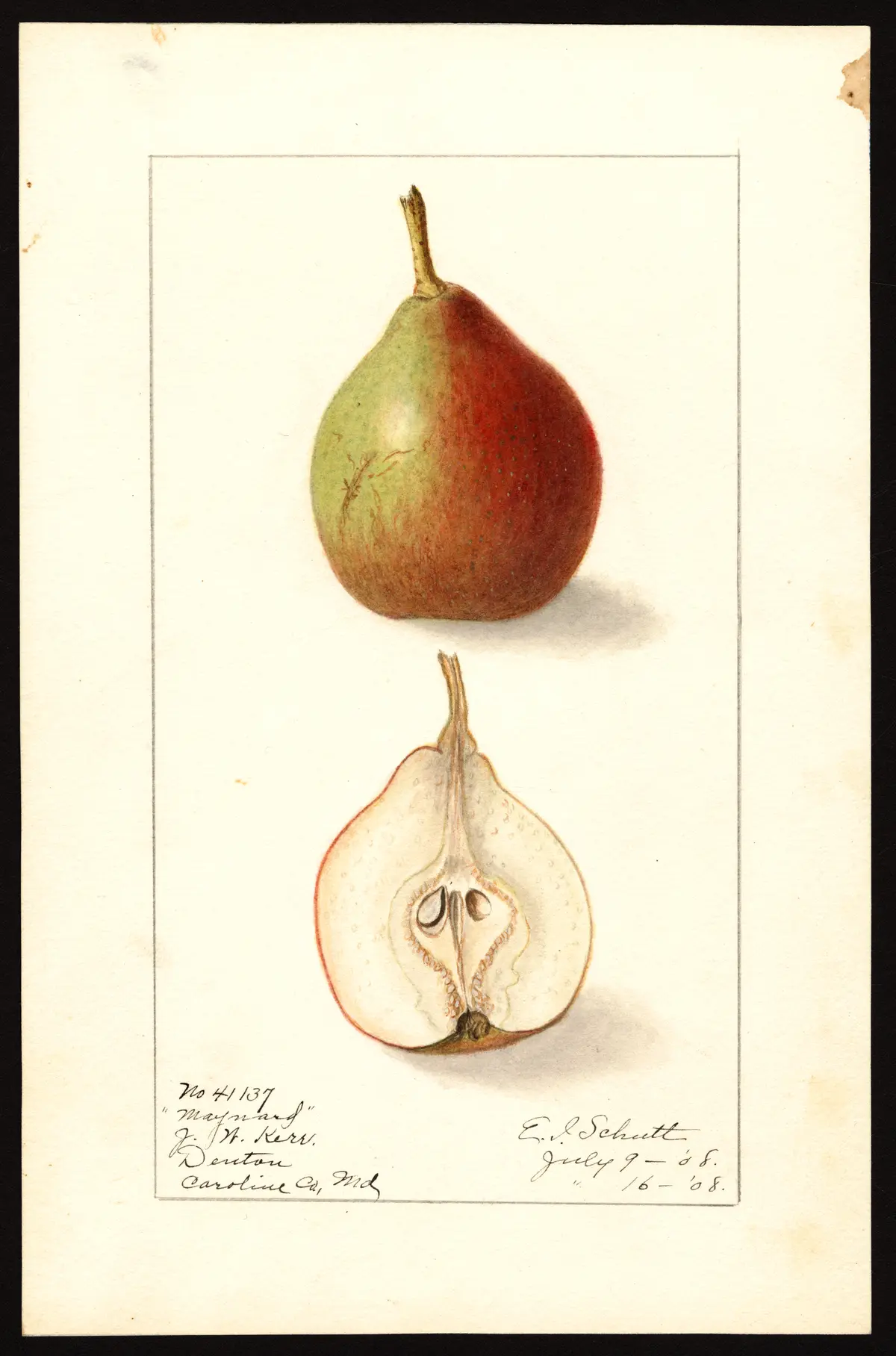
USDA Pomological Watercolor Collection
Maynard
Origin and History
Origin unknown; thought to have been first grown in Lancaster County, Pennsylvania. Recorded by Downing in 1857 and again in 1869; described by Hedrick in 1921, who cites both Downing editions as his sources.
Fruit
Size medium. Form obovate-pyriform.
Stem: Obliquely inserted, fleshy at its junction with the fruit. (Downing only.)
Calyx: Open, seated in a slight depression. (Downing only.)
Skin: Yellow, with russet dots and a crimson cheek.
Flesh: White, juicy, and sugary.
Quality: The two sources conflict here. Downing (1900) rates it "scarcely good"; Hedrick (1921) rates it "moderately good." Both are drawing on Downing's original descriptions, making the discrepancy notable — Hedrick may have been working from the 1857 edition, which may have carried a different evaluation than the 1900 revision.
Season
Ripens at the end of July (both sources agree; Downing specifies "last of July").
Tree
No tree characteristics are recorded by either source.
Uses
Not specified by either source, though the early-July ripening and "scarcely good" to "moderately good" quality ratings suggest a fresh-eating variety of modest commercial value.
Book Sources
Described in 2 period pomological works
View original book sources (2)
— A.J. Downing, The Fruits and Fruit Trees of America (1900)Maynard.
Origin unknown, grown in Lancaster Co., Pa.
Fruit medium, obovate pyriform. Skin yellow, with russet dots and a crimson cheek. Stalk obliquely inserted, fleshy at its junction. Calyx open, in a slight depression. Flesh white, juicy, and sugary. Scarcely good. Ripe last of July.
— U.P. Hedrick, The Pears of New York (1921)Maynard.
- Downing Fr. Trees Am. 52. 1857. 2. Ibid. 815. 1869.
Origin unknown but thought to have been first grown in Lancaster County, Pa. Fruit medium, obovate-pyriform, yellow with russet dots and a crimson cheek; flesh white, juicy and sugary; moderately good; end of July.