Mexico
Apple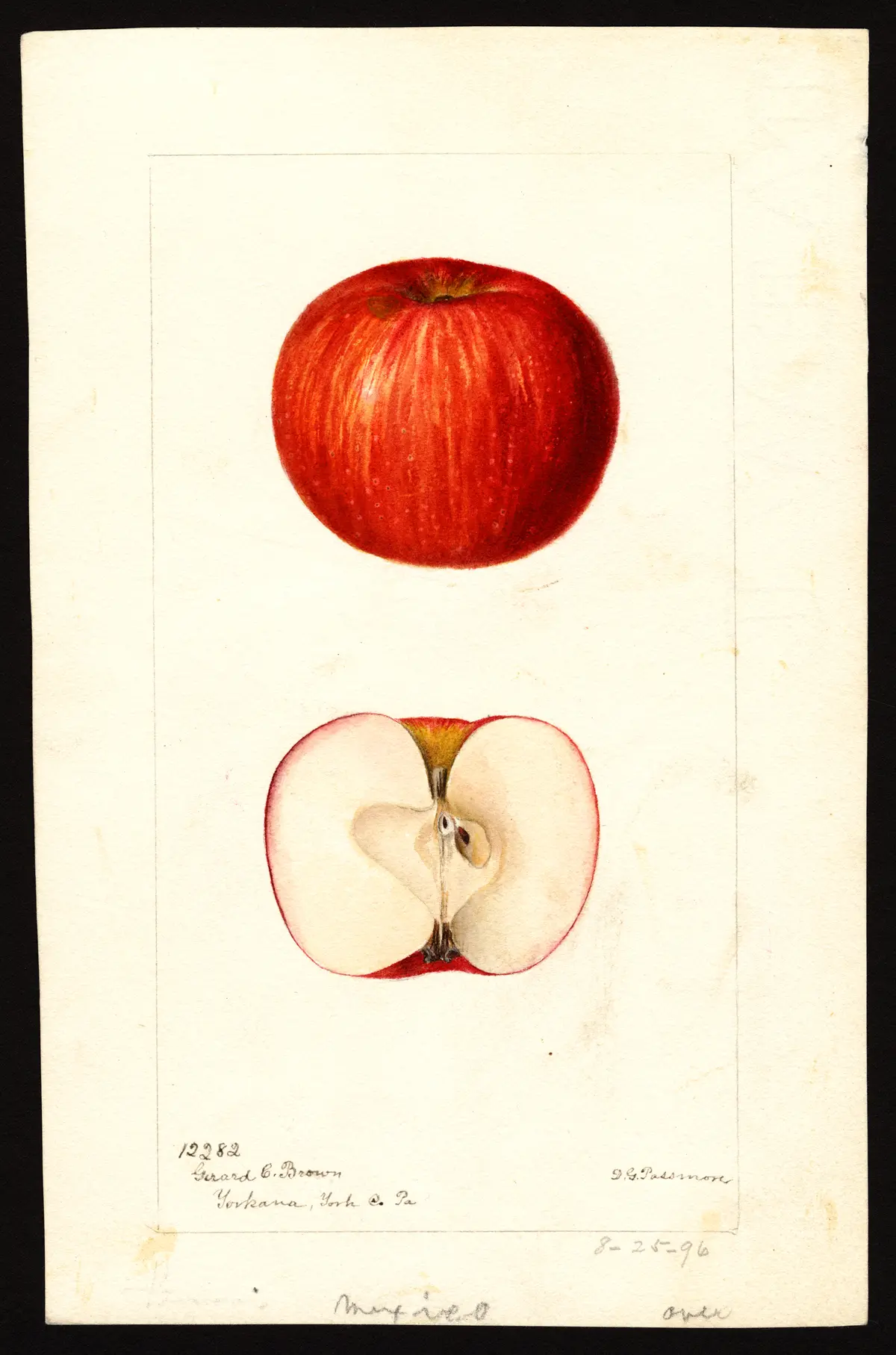
USDA Pomological Watercolor Collection
Mexico
Origin / History
Originated at Canterbury, Connecticut. Warder, writing in 1867, found it "not much known in the West." Thomas calls it "a handsome New England fruit." Lowther's station table records it from two stations in the Northern Division and marks it as reported in more than one of the three divisions.
Tree
Hardy and productive; very hardy (Thomas). Of moderate growth (Downing). Young shoots dull grayish brown, downy (Downing).
Fruit
Size: Medium.
Form: Round to roundish oblate. Warder calls it round and regular. Most authors give roundish or roundish oblate.
Stem: Medium to long. Slender (Warder). Thomas calls it large and long.
Cavity: Regular (Warder). Downing and Thomas describe it as broad, shallow, and russeted; Warder calls it acute.
Calyx: Closed (Warder, Downing). Medium (Warder) to large (Thomas).
Basin: Narrow, shallow, and regular.
Skin: Crimson to bright crimson-red, striped, splashed, and shaded with darker or very dark red, with a little yellow in the shade. Thomas describes it as striped light and dark red.
Dots: Light-colored, yellow-green (Warder). Warder calls them numerous; Downing gives a few large dots.
Flesh and flavor: Flesh white to whitish, stained with red. Tender, fine-grained (Warder), and juicy to rather juicy. Flavor pleasant subacid. Quality very good to "best," with Warder rating it "best." Downing gives "good to very good."
Core and seeds: Warder describes the core as large, open, and meeting the eye, with seeds numerous, angular, and pointed. Downing calls the core small.
Season
Late summer into autumn, August through October. Warder gives August and September, and Downing September and October.
Uses
Table and kitchen; also a market fruit (Lowther).
Subtypes / Variants
Not described in source.
Other
Warder's description was taken from fruit obtained from E. Newburg of Brooklyn, Connecticut.
Book Sources
Described in 4 period pomological works
Nursery Catalog Sources
Found in 3 catalogs (1855–1913) from Illinois, Massachusetts
- Joseph Breck & Co. , Boston , Massachusetts — 1855
- Benjamin Buckman (personal inventory) , Farmingdale , Illinois — 1901
- Benjamin Buckman (personal inventory) , Farmingdale , Illinois — 1913
View original book sources (4)
— John A. Warder, American Pomology: Apples (1867)Mexico.
Origin Canterbury, Connecticut. Tree hardy, productive. Not much known in the West.
Fruit — obtained from E. Newburg, Brooklyn, Connecticut — medium, round, regular; Surface bright crimson-red, striped darker; Dots numerous, yellow-green.
Basin shallow, regular; Eye medium, closed.
Cavity acute, regular; Stem long or medium, slender.
Core large, open, meeting the eye; Seeds numerous, angular, pointed; Flesh white, tender, fine-grained, juicy; Flavor sub-acid; Quality best; Use, table; Season, August and September.
— A.J. Downing, The Fruits and Fruit Trees of America (1900)Mexico.
Origin, Canterbury, Conn. Tree of moderate growth, productive, hardy. Young shoots dull grayish brown, downy.
Fruit medium, roundish oblate, crimson, striped, splashed, and shaded with very dark red, a little yellow in the shade, with a few large light dots. Stalk medium length. Cavity broad, shallow, russeted. Calyx closed in a narrow basin. Flesh whitish, stained with red, tender, rather juicy, pleasant subacid. Good to very good. Core small. September, October.
— John J. Thomas, The American Fruit Culturist (1903)Mexico. Size medium, roundish; striped light and dark red; stalk large and long; cavity broad, shallow, russeted; calyx large, in a narrow basin; flesh whitish stained with red, tender, with a very good flavor. A handsome New England fruit. Tree very hardy, productive.
— Granville Lowther (ed.), Encyclopedia of Practical Horticulture (1914)Mexico is a medium-sized fruit of roundish oblate form with red skin. Quality is very good; use is both kitchen and market; season is autumn. It is reported by 2 stations in the Northern Division; the asterisk indicates the variety is also reported in more than one of the three divisions.