Monarch
Pear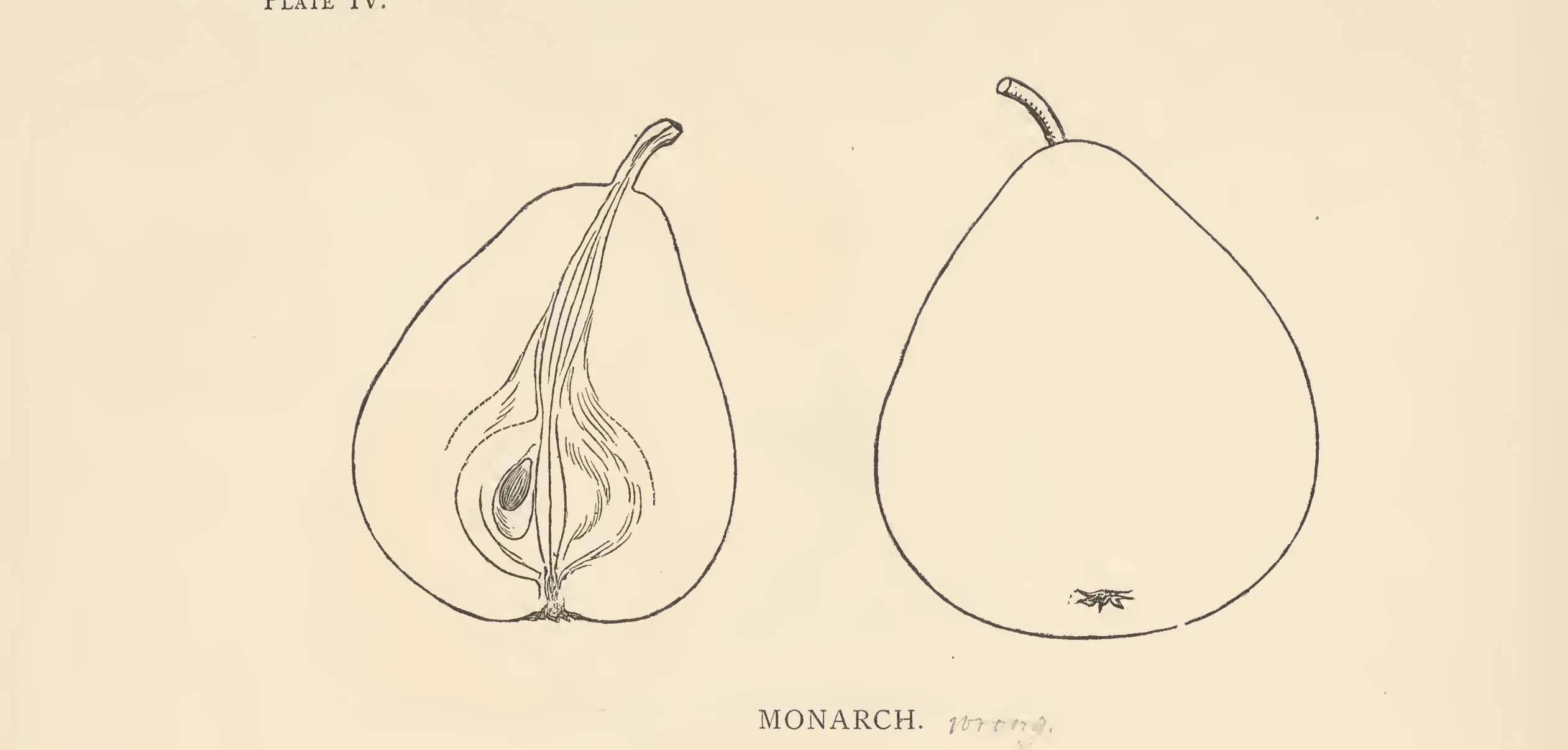
Monarch
Origin / History
Monarch is an English pear (Downing), classed as foreign by Elliott. It was raised by Thomas Andrew Knight at Downton Castle, England (Hedrick), and was Knight's favorite seedling. He was not certain of its parentage but believed it came from seed of the Autumn Bergamot (Herefordshire Pomona; Bunyard, "probably"). It first appeared in 1830, the first year of the reign of William IV, and was named in his honor. Knight wrote: "I named it the 'Monarch,' … under conviction that for the climate of England, it stands without an equal; and because it first appeared in the first year of the reign of our most excellent monarch" (Transactions of the Horticultural Society, 2nd Series, Vol. I, p. 107). The Society issued an official report on the merits of the Monarch from fruit grown in its gardens. The Herefordshire Pomona reproduces that report in full, with Knight's comments, in its Introduction (page 43). Elliott and Downing entered it under the name "Knight's Monarch."
The Herefordshire Pomona (1885) states that its estimation had "greatly increased" since the Society's report, and that it was "now universally admitted to be one of our most valuable pears." The same source says Monarch had become so great a favorite that every one liked to think he had it in his orchard. Many of Knight's other seedling pears were consequently called Monarch, until in Herefordshire "a complete confusion as to the real variety" arose. For this reason the Pomona added, besides its own colored figure (Plate IV), an exact outline of the colored representation in the Transactions, with the section. In America, Downing found that it "has not proved of much value at the North," but "in the Southern States it promises well." It was planted for trial at the Central Experimental Farm, Agassiz, British Columbia, in spring 1893.
Tree
Hardy to very hardy. The tree is vigorous, with shoots very vigorous (Veitch), though at Agassiz it was only a medium grower. Elliott says it requires very high culture. Knight called the whole character of the tree "wild and uncultivated," with the young wood very thorny. Wood light olive in color (Elliott), slender and straggling (Herefordshire Pomona). The habit is given variously: a handsome pyramid (Herefordshire Pomona); rather spreading, making a round-headed tree (Bunyard); shoots erect to the top of the tree (Veitch).
Easily recognized in winter by its very large oval buds, which stand out like those of a red currant (Bunyard). Leaf small, roundish, dark, a little upfolded, shallow crenate, turning orange-red (Bunyard).
Productive, a good bearer, of good fertility; Veitch calls it "a good attractive bearer." The Herefordshire Pomona calls it usually an excellent bearer, but capricious in some situations. It names the tree's greatest imperfection as a liability to lose its fruit from the wind before it is ripe, so that it requires a sheltered situation. Yet the fruit "is so excellent that it deserves to have a proper place found for it in every garden."
Fruit
Size: Medium, by most accounts; Elliott alone calls it large, and Bunyard gives small to medium. The Herefordshire Pomona gives 2¾ inches long by 2¼ inches wide.
Form: Roundish or globular; round conical and even (Bunyard). The Horticultural Society's report gives obovate, and Elliott obovate oblong.
Stem: Short or rather short, rather thick or stout; three-quarters of an inch long (Herefordshire Pomona).
Cavity: Small, frequently without depression (Herefordshire Pomona).
Calyx: Eye open; small (Herefordshire Pomona).
Basin: Shallow; undulating (Herefordshire Pomona).
Skin: Rough (Bunyard). Yellowish green, very much covered with brown russet, usually with a tinge of brownish red next the sun. The Horticultural Society's report gives the skin as yellowish, much speckled with brown. Elliott gives it as yellowish brown, tinged with red. Veitch calls the fruit rather handsome and of good color, "though sometimes coarse."
Dots: Many gray russet specks strewn over the surface; dotted with gray (Elliott).
Flesh and flavor: Flesh yellowish to yellow; Elliott gives yellowish white, and the Agassiz station white. Buttery, melting, juicy to very juicy. Flavor rich, sweet, sugary, agreeable, and agreeably perfumed, "delicious" (Bunyard). The Herefordshire Pomona calls it sprightly and Hedrick vinous. The Horticultural Society's report finds it "slightly musky, but not disagreeably so."
Quality "An excellent pear" in the Society's report; "first, one of the most valuable" (Hedrick); "Good" (Downing).
Core and seeds: Not described in source.
Season
December into March. Most authors place it in January, December–January, or January–February. The Agassiz station gives December to March.
Knight observed that Monarch, unlike most other pears, does not become mealy by being allowed to grow yellow on the tree; on the contrary, it is improved by being allowed to mature in this way.
Uses
Dessert (Bunyard).
Subtypes / Variants
Not described in source.
Other
In 1834 Knight had a sufficient quantity of Monarch pears to ascertain the specific gravity of the juice. He found it 1096, "that is fifteen above the Stire apple, and about the same which a solution of 2lbs. 6oz. of sugar would give to 8lbs of water." He found "the taste and flavour of the juice" to be "very delightful" (Transactions of the Horticultural Society, 2nd Series, Vol. II, p. 68).
Book Sources
Described in 5 period pomological works
- The Herefordshire Pomona (1876–1885)
- Bunyard, A Handbook of Hardy Fruits (1920)
- Hedrick, The Pears of New York (1921)
- Downing, Fruits and Fruit Trees of America (1900) — listed as Knight's Monarch
- Elliott, The Western Fruit Book (1865) — listed as Knight's Monarch
Nursery Catalog Sources
Found in 6 catalogs (1845–1911) from England, Massachusetts
- Winship's Nursery (Brighton Nurseries , operated by the Winship family), Brighton (Boston) , Massachusetts — 1845
- Hovey & Co. , Cambridge , Massachusetts — 1849 — listed as Knight's Monarch
- Joseph Breck & Co. , Boston , Massachusetts — 1855 — listed as Knight's Monarch
- George Bunyard & Co. , Royal Nurseries, Maidstone, Kent , England — 1900 — listed as Knight's Monarch
- Central Experimental Farm , Dominion Department of Agriculture, Agassiz, British Columbia (under test; Bulletin No. 3, Second Series) — 1900 — listed as Knight's Monarch
- James Veitch & Sons , Ltd., Royal Exotic Nursery, Chelsea, London (also Coombe Wood, Langley, and Feltham) , England — 1911 — listed as Knight's Monarch
View original book sources (7)
— F.R. Elliott, The Western Fruit Book (1865)Knight's Monarch. Foreign. A variety requiring very high culture ; wood, light olive color. Fruit, large, obovate oblong, yellowish brown, tinged with red, dotted with gray ; stem, short ; calyx, open ; flesh, yellowish white, melting, juicy. January.
— Woolhope Naturalists Field Club, The Herefordshire Pomona (1885)Plate IV. MONARCH, pear [Syn : Knight's Monarch.]
This pear was the favourite seedling of Mr. Thomas Andrew Knight. Of its parentage he was not quite sure, but he believed it to have originated from the seed of the Autumn Bergamot. " I named it the ' Monarch,' says Mr. Knight, " under conviction that for the climate of England, it stands without an equal; and because it first appeared in the first year of the reign of our most excellent monarch " (William IV, 1830). Trans. Hort. Soc., 2nd Series, Vol. I, p. 107.
Description.—Fruit; medium sized, roundish, two inches and three quarters long, by two and a quarter wide. Skin ; yellowish green, very much covered with brown russet, and strewed with grey russet specks. It has usually a tinge of brownish red next the sun. Eye ; small and open, set in a shallow undulating basin. Stalk ; three quarters of an inch long, inserted in a small cavity, frequently without depression. Flesh ; yellowish, buttery, melting, and very juicy ; with a rich, sprightly, sugary, and agreeably perfumed flavour. Season ; January and February.
The official report on the merits of the Monarch from fruit grown in the gardens of the Horticultural Society has already been given in full in the Introduction of this work (see page 43.) with Mr. Knight's comments upon it. Since this time its estimation has greatly increased and it is now universally admitted to be one of our most valuable pears.
The tree is very hardy, and forms a handsome pyramid, but its wood is slender and straggling. It is usually an excellent bearer, but in some situations it is capricious. Its greatest imperfection is the liability to lose its fruit from the wind before it is ripe. It requires therefore a sheltered situation ; but the fruit is so excellent that it deserves to have a proper place found for it in every garden.
The Monarch has indeed become so great a favourite that every one likes to think he has it in his orchard. Many of Mr. Knight's other seedling pears have thus been called the Monarch until in Herefordshire a complete confusion as to the real variety has taken place. For this reason, in addition to the coloured figure, an exact outline is also added of the coloured representation of the Monarch, as given in the " Transactions of the Horticultural Society, 2nd Series, Vol. I, p. 107," with the section at the head of the preceding page.
[Additional entry in this volume: "Monarch Pear", pp. 90–90]
Monarch Pear.—(With coloured figure.)
Fruit middle-sized, obovate; stalk short, rather thick; eye open, placed in a shallow depression. Skin yellowish, much speckled with brown, and having a tinge of brownish red next the sun. Flesh yellowish, melting, buttery, rich and sugary; slightly musky, but not disagreeably so. An excellent pear. Season, January.
Remarks.—The Monarch, unlike most other pears, does not become mealy by being allowed to grow yellow on the tree; on the contrary, it is improved by being allowed to mature in this way. I named it Monarch under conviction that, for the climate of England, it stands without an equal; and because it first appeared in the first year of the reign of our most excellent Monarch (William IV.) The whole character of the tree is wild and uncultivated, and the young wood very thorny.
And in Vol. II. 2nd Series, p. 68. Mr. Knight adds, I had this year (1834) a sufficient quantity of Monarch pears to enable me to ascertain the specific gravity of its juices, which was 1096, that is fifteen above the Stire apple, and about the same which a solution of 2lbs. 6oz. of sugar would give to 8lbs of water. The taste and flavour of the juice appear to me to be very delightful.
— A.J. Downing, The Fruits and Fruit Trees of America (1900)Knight's Monarch.
Monarch.
An English Pear, raised by Thomas Andrew Knight, which has not proved of much value at the North. In the Southern States it promises well. Tree vigorous, hardy, and productive.
Fruit medium, roundish, yellowish green, with brown russet and many gray russet specks. Flesh yellowish, melting, sweet, agreeable. Good. December, January.
— E.A. Bunyard, A Handbook of Hardy Fruits (1920)MONARCH. Her. Pom., L, 4. F. Monarque de Knight. Dessert, January to February, small to medium, round conical, even. Skin, rough. Colour, yellowgreen, covered with brown russet. Flesh, yellow, melting and delicious flavour. Eye, open in a shallow basin. Stem, rather short, stout. Growth, rather spreading, making a round headed tree; fertility good. Leaf, small, roundish, dark, a little upfolded, shallow crenate, turns orange red. Origin, raised by T. A. Knight, probably from a seed of the Autumn Bergamotte in 1830, and named in honour of William IV. It can be easily recognised in winter by its very large oval buds, which stand out like those of a red currant.
— U.P. Hedrick, The Pears of New York (1921)Monarch.
- Hogg Fruit Man. 312. 1866.
- Bunyard Handb. Hardy Fr. 188. 1920. Knight Monarch.
- Downing Fr. Trees Am. 796. 1869.
Raised by Thomas Andrew Knight, Downton Castle, Eng., in 1830.
Bunyard says: "Tree easily recognized in winter by its very large oval buds, which stand out like those of a red currant."
Fruit medium, globular, yellowish-green, much covered with brown-russet and strewed with gray-russet specks; flesh yellowish, buttery, melting and very juicy, with a rich, vinous, sugary, and agreeably-perfumed flavor; first, one of the most valuable; Dec. and Jan.
— Central Experimental Farm, Central Experimental Farm, Agassiz BC — Catalogue of Fruit Trees under Test (Bulletin No. 3, 1900) (1900)Planted Spring 1893. Tree a medium grower and productive. Fruit of medium size. Skin yellowish green. Flesh white, juicy, buttery, sweet. Season December to March.
— James Veitch & Sons, Veitch's Fruit Trees (1911) (1911)medium, rather handsome, a good-bearing sort; shoots erect to top of the tree and very vigorous. a medium-sized handsome pear; flesh melting and juicy; a good attractive bearer; fruit of good color, though sometimes coarse.