Moorfowl Egg
Pear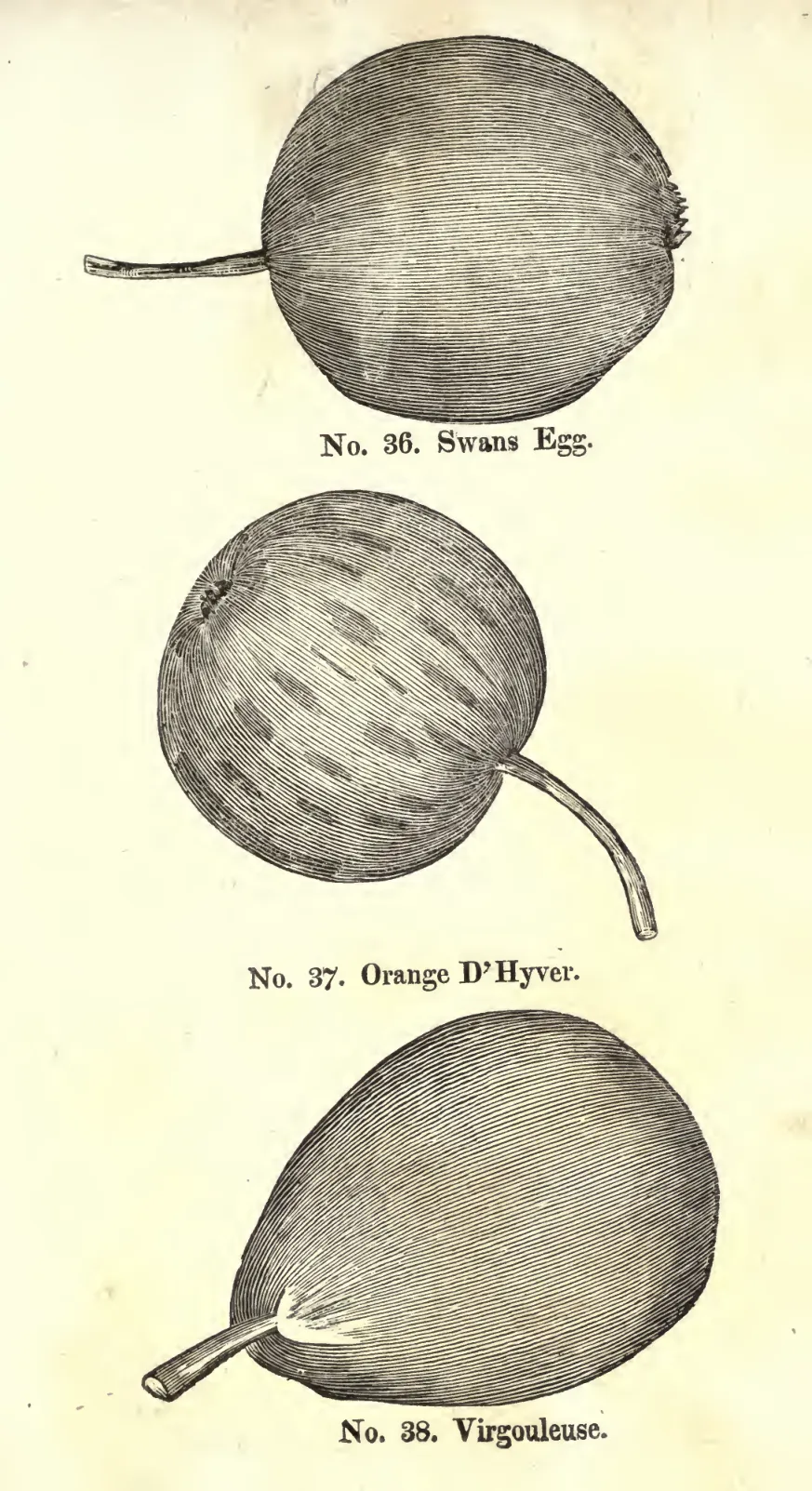
Moorfowl Egg
[NOTE: Source text may be incorrect — Coxe, Downing, Thomas, Bunyard, and Hedrick's "Swan Egg" entry describe Swan's Egg, and Downing and Thomas call "Moor-fowl Egg" an incorrect name for that pear. Hedrick, however, gives Moorfowl Egg its own entry as an old Scotch pear "partaking somewhat of the character of Swan Egg." The sections below follow Hedrick's Moorfowl Egg entry. The Swan's Egg material, which applies to fruit circulating under this name, is placed under Other.]
Origin / History
Moorfowl Egg is an old Scotch dessert pear, "partaking somewhat of the character of Swan Egg" (Hedrick). Hedrick's earliest reference is Lindley, 1831 (p. 361). Hogg, in 1884 (Fruit Man., p. 619), gives it as "Muirfowl Egg." Downing, followed by Thomas, does not admit it as a separate variety and treats the name as an incorrect one for Swan's Egg.
Tree
Not described in source.
Fruit
Size: Below medium.
Form: Globular.
Stem: Not described in source.
Cavity: Not described in source.
Calyx: Not described in source.
Basin: Not described in source.
Skin: Dull green changing to yellow-green, mottled with red next the sun.
Dots: Pale brown-russety, thickly strewed.
Flesh and flavor: Flesh yellowish, semi-buttery, tender; sweet and with a slight perfume.
Core and seeds: Not described in source.
Season
October.
Uses
Dessert.
Subtypes / Variants
Not described in source.
Other
Swan's Egg, the pear to which Downing and Thomas say the name Moorfowl Egg has been incorrectly applied, is a very old English variety, known for some years according to Bunyard. Batty Langley first described it in 1729; Hedrick cites Langley's Pomona, p. 132, Pl. LXIV. Hedrick notes that Lindley recommended it as suitable in the Highlands of Scotland. Downing calls it "a very old Pear, unworthy cultivation." Coxe records that many called it the Poire d'Auch, which he held to be an error. Forsyth says the Poire d'Auch resembles the Colmart, but fuller in the neck. The Abbé Rozier delineates the Colmart as a very different pear, much larger, with a distinct neck (Coxe's figure no. 44). Bunyard gives the tree a slender, very upright growth and great fertility, with leaves fairly large, oval, almost entire.
Fruit small to medium, or "of ordinary size" (Coxe), measuring 2½ by 2½ inches (Bunyard). Form oval or elliptical to globular-ovate; Bunyard alone calls it round, a little conical. Stem long; very long and slender, woody (Bunyard). Eye open, almost on the surface (Bunyard).
Skin green to pale green or yellowish green, thinly covered in part or washed with brown to pale brown on the sunny side, and dotted with brownish specks (Downing). Hedrick calls the skin smooth, yellowish green on the shaded side, clear brownish red on the cheek exposed to the sun, and covered with pale brown russet. Bunyard calls it rough, greenish yellow, almost covered with thick brown russet, occasionally with a dull brown flush.
Flesh white to yellowish white, soft, tender, melting, fairly juicy to very juicy, "full of a pleasant musky juice" (Coxe). Bunyard alone calls it rather firm. Flavor sweet, somewhat or a little musky, with a musky aroma. Hedrick adds that it is piquant and rates it "good." Most authors give October, and Bunyard classes it as a dessert pear. Coxe says it ripens in November and "with care may be preserved for some time."
Book Sources
Described in 5 period pomological works
- Hedrick, The Pears of New York (1921)
- Thomas, The American Fruit Culturist (1903)
- Bunyard, A Handbook of Hardy Fruits (1920) — listed as SWAN'S EGG
- Coxe, A View of the Cultivation of Fruit Trees (1817) — listed as Swans Egg
- Downing, Fruits and Fruit Trees of America (1900) — listed as Swan's Egg
Nursery Catalog Sources
Found in 6 catalogs (1845–1900) from Massachusetts
- Winship's Nursery (Brighton Nurseries , operated by the Winship family), Brighton (Boston) , Massachusetts — 1845
- Winship's Nursery (Brighton Nurseries , operated by the Winship family), Brighton (Boston) , Massachusetts — 1845 — listed as Swan's Egg
- Hovey & Co. , Cambridge , Massachusetts — 1849
- Hovey & Co. , Cambridge , Massachusetts — 1849 — listed as Swan's Egg
- Joseph Breck & Co. , Boston , Massachusetts — 1855 — listed as Swan's Egg
- Central Experimental Farm , Dominion Department of Agriculture, Agassiz, British Columbia (under test; Bulletin No. 3, Second Series) — 1900 — listed as Swan's Egg
View original book sources (5)
— William Coxe, A View of the Cultivation of Fruit Trees (1817)
- SWANS EGG.
A pear of ordinary size; of elliptical form; a long stem: the skin green, thinly covered in part with brown: the flesh melting, and full of a pleasant musky juice; ripens in November, and with care may be preserved for some time. This fruit is by many called the Poire d'Auch; this must be an error; Forsyth says the Poire d'Auch resembles the Colmart, but fuller in the neck; the Colmart is delineated by the Abbé Rozier as a very different pear, much larger, with a distinct neck: see figure no. 44.
— A.J. Downing, The Fruits and Fruit Trees of America (1900)SWAN'S EGG.
Moor-fowl Egg. incorrectly.
A very old Pear, unworthy cultivation.
Fruit small, oval. Skin pale green, washed with pale brown on the sunny side, and dotted with brownish specks. Flesh soft, juicy, with a sweet, somewhat musky flavor. October.
— John J. Thomas, The American Fruit Culturist (1903)Moor-fowl Egg. An incorrect name for Swan's Egg.
[Additional entry in this volume: "Swan's Egg", pp. 804–804]
Swan's Egg. Small, oval, pale green; juicy, sweet, slightly musky. October.
— E.A. Bunyard, A Handbook of Hardy Fruits (1920)SWAN'S EGG. Her. Pom., II., 34. F. Oeuf de Cygne. G. Schwaner Eierbirne. Dessert, October, small, 2½ by 2½, round, a little conical. Skin, rough. Colour, greenish yellow almost covered with thick brown russet, occasionally with dull brown flush. Flesh, white, rather firm, fairly juicy and a little musky. Eye, open almost on surface. Stem, very long and slender, woody. Growth, slender, very upright ; fertility great. Leaf, fairly large, oval, almost entire. Origin, this has been known for some years, and was first described by Batty Langley in 1729.
— U.P. Hedrick, The Pears of New York (1921)Moorfowl Egg.
- Lindley Guide Orch. Card. 361. 1831.
Muirfowl Egg. 2. Hogg Fruit Man. 619. 1884.
An old Scotch dessert pear partaking somewhat of the character of Swan Egg. Fruit below medium, globular, dull green changing to yellow-green, mottled with red next the sun, and thickly strewed with pale brown-russety dots; flesh yellowish, semi-buttery, tender, sweet and with a slight perfume; Oct.
[Additional entry in this volume: "Swan Egg", pp. 739–739]
Swan Egg.
i. Langley Pomona 132, Pl. LXIV. 1729.
An English variety recommended by Lindley as suitable in the Highlands of Scotland.
Fruit medium, globular-ovate; skin smooth, yellowish-green on the shaded side and clear brownish-red on the cheek exposed to the sun and covered with pale brown-russet; flesh yellowish-white, tender, very juicy, with a sweet and piquant flavor and musky aroma; good; Oct.