Mote's Sweet
Apple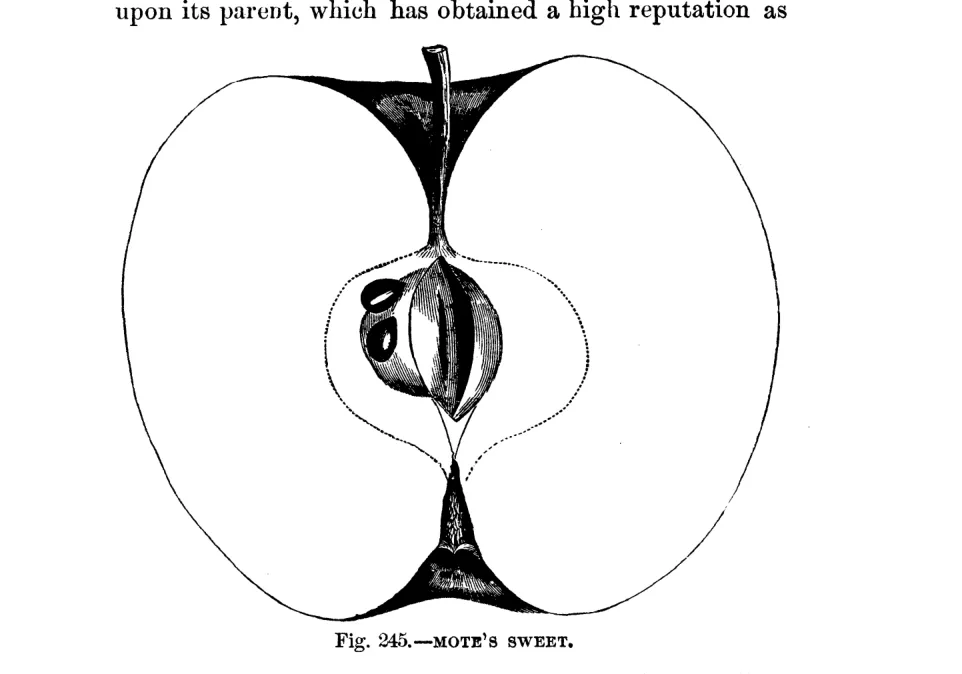
Mote's Sweet
Origin/History
A seedling of the Stillwater Sweet, grown by L. S. Mote, of Miami County, Ohio. Warder (1867) considers it "quite an improvement upon its parent, which has obtained a high reputation as a choice autumnal sweet apple," and calls it "one of the most delicious sweet apples." Downing (1900) notes it as "a valuable, but as yet comparatively new Apple."
Tree
Vigorous, spreading in habit. Warder describes the form as round and spreading; Downing as upright spreading, and productive. Shoot color is described differently between sources: Warder gives "pale," while Downing specifies "light reddish brown, downy." Foliage large, wide, finely serrated, and rather pale (Warder).
Fruit
Size: Large.
Form: Warder describes the fruit as globular, somewhat flattened or conic-truncated, and rather angular. Downing gives roundish, somewhat roundish oblate conic.
Stem: Described by Warder as long, yellow, and curved; by Downing as medium and slender.
Cavity: Deep and wide, with wavy walls (Warder). Downing describes it as large and deep.
Calyx/Eye: Warder gives the eye as medium, long, and closed. Downing describes the calyx as closed or partially open, with segments short and erect.
Basin: Medium in depth. Warder adds abrupt and wavy; Downing describes it as uneven.
Skin: Surface very smooth (Warder). Color pale whitish yellow — Warder specifies greenish yellow to whitish; Downing, pale whitish yellow. Both sources note a faint red blush: Warder calls it "a rare faint blush," Downing notes "a tinge of red in the sun." Dots scattered, gray, moderately sprinkled (Downing); Warder notes the dots are often rosy with whitish bases.
Flesh/Flavor: Flesh yellow to yellowish. Warder describes it as very fine-grained, almost melting, and juicy, with flavor very sweet and pleasant. Downing describes it as tender and moderately juicy, with a rich, honeyed sweetness. The two sources differ slightly on juiciness — Warder says simply juicy; Downing, moderately juicy.
Core/Seeds: Core described as open and clasping by Warder, who sizes it as medium; Downing describes it as small. Seeds numerous, angular, pale (Warder).
Season
September (Warder). September–October (Downing).
Uses
Table and kitchen (Warder). Quality rated "best" by Warder; "very good" by Downing.
Subtypes/Variants
Not described in source.
Other
Not described in source.
Book Sources
Described in 2 period pomological works
Nursery Catalog Sources
Found in 2 catalogs (1901–1913) from Illinois
- Benjamin Buckman (personal inventory) , Farmingdale , Illinois — 1901
- Benjamin Buckman (personal inventory) , Farmingdale , Illinois — 1913
View original book sources (2)
— John A. Warder, American Pomology: Apples (1867)Mote's Sweet.
This seedling from the Stillwater Sweet, grown by L. S. Mote, of Miami County, Ohio, is quite an improvement upon its parent, which has obtained a high reputation as a choice autumnal sweet apple. Tree round, spreading, vigorous; Shoots pale; Foliage large, wide, finely serrated, and rather pale.
Fruit large, globular, somewhat flattened, or conic-truncated, rather angular; Surface very smooth, greenish yellow to whitish, with a rare faint blush; Dots scattered, gray, often rosy, whitish bases.
Basin medium, abrupt, wavy; Eye medium, long, closed.
Cavity deep, wide, wavy; Stem long, yellow, curved.
Core medium, open, clasping; Seeds numerous, angular, pale; Flesh yellow, very fine-grained, almost melting, juicy; Flavor very sweet, pleasant; Use, table and kitchen; Quality best; Season, September. One of the most delicious sweet apples.
— A.J. Downing, The Fruits and Fruit Trees of America (1900)Mote's Sweet.
Originated on the property of L. S. Mote, Miami Co., Ohio. A valuable, but as yet comparatively new Apple. Tree vigorous, upright spreading, productive. Young shoots light reddish brown, downy.
Fruit large. Form roundish, somewhat roundish oblate conic. Color pale whitish yellow, with a tinge of red in the sun, and moderately sprinkled with gray dots. Stalk medium, slender. Cavity large, deep. Calyx closed or partially open. Segments short, erect. Basin medium, uneven. Flesh yellowish, tender, moderately juicy, rich honeyed sweet. Very good. Core small. September, October.