Munson
Apple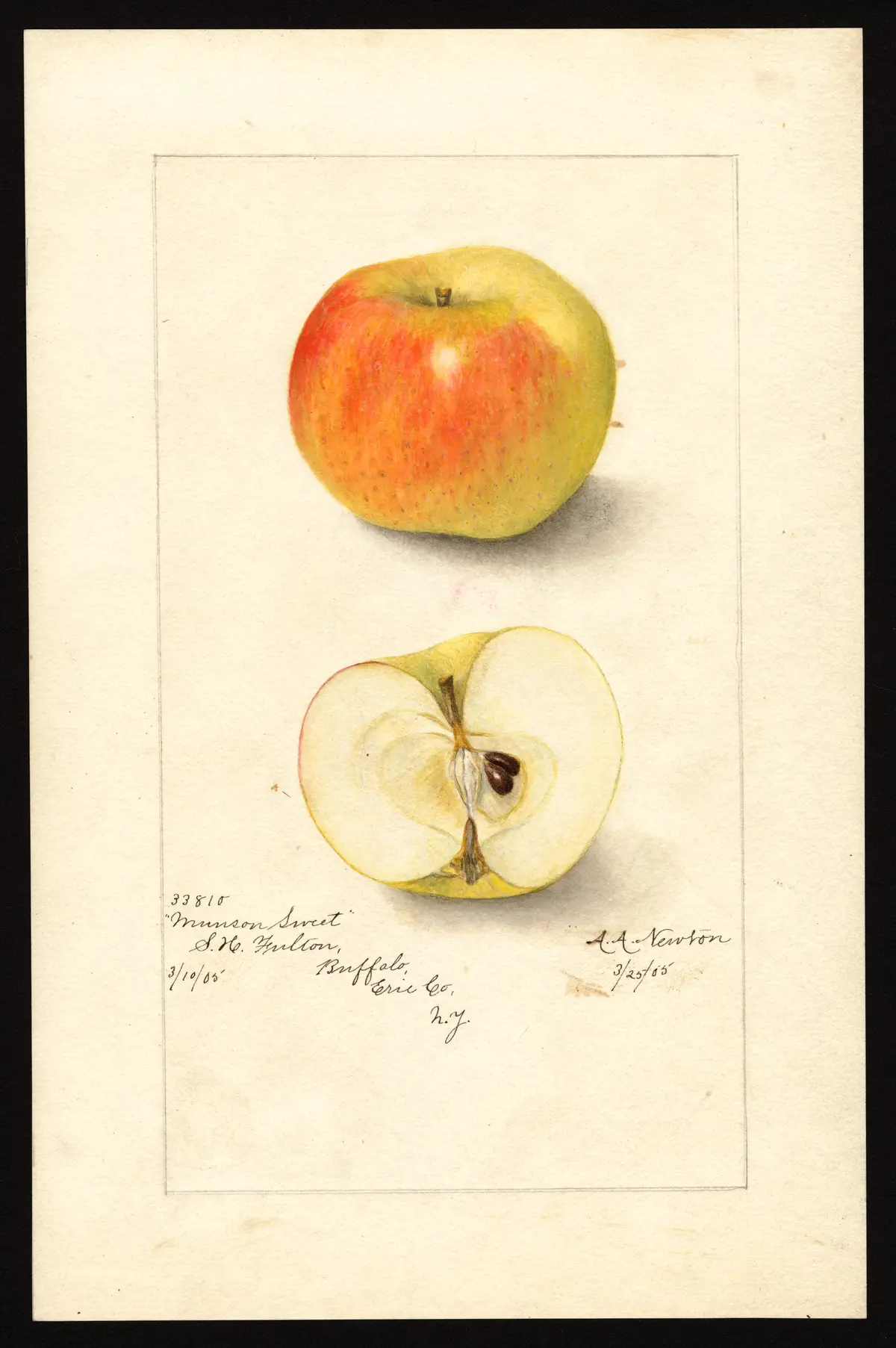
USDA Pomological Watercolor Collection
Munson
Origin / History
Origin uncertain; supposed to have originated in Massachusetts. Elliott and Thomas give it simply as from Massachusetts, and Warder calls it a New England variety. Hedrick places its origin in Massachusetts early in the eighteenth century and gives 1849 as the year it was first described. The earliest reference Beach cites is the Genesee Farmer of 1849, where it appears as "Munson Sweeting" and "Northern Sweeting." Elliott also published it as "Munson Sweeting"; Warder, Downing, and Thomas called it "Munson Sweet." Beach notes that in some parts of New York it was better known as Meachem Sweet or Rag Apple than under what he calls "the correct name of Munson."
Warder (1867) considered it "quite promising in its new western homes," where it was not yet widely known or tested. Thomas calls it "a valuable sweet apple." Beach (1905) reports it still propagated by nurserymen but not planted in New York as much as a generation earlier. Hedrick (1922) calls it a sweet apple prominent in New York and New England a generation ago but now disappearing. Lowther's station table records it from three stations in the Northern Division and two in the Central Division, with none in the Southern Division. At the Central Experimental Farm, Agassiz, British Columbia, it was planted in spring 1894.
Tree
Tree large, vigorous, a strong, good grower. Beach rates it moderately vigorous to vigorous, and at Agassiz it was only a medium grower. Most authors call the form spreading; Beach gives spreading or roundish, rather dense, and Elliott alone calls it upright.
Elliott describes the wood as dark-colored, with short-jointed shoots. Twigs short to rather long, curved, stout to moderately slender, with large terminal buds; internodes short. Bark dark brown, heavily streaked with scarf-skin, pubescent near tips. Lenticels quite numerous, rather conspicuous, medium size, roundish, raised. Buds large, prominent, broad, plump, obtuse, free, pubescent (Beach).
A good and abundant bearer, coming into bearing rather early. It is productive when established, and is said to be a regular, uniform, annual bearer (Warder, Thomas, Downing, Budd and Hansen). Beach finds it a pretty reliable cropper, commonly yielding good crops biennially.
Fruit
Size: Below medium to rather large, averaging about medium. Most authors give medium; Elliott gives medium or above, and Budd and Hansen give below medium.
Form: Oblate, flat or roundish flattened, smooth and regular to very regular. Beach describes it as roundish oblate, often somewhat elliptical, ribbed. The Agassiz bulletin calls it flatish, conical.
Stem: Short to medium; rather short and moderately thick (Beach).
Cavity: Large, wide, or broad in most accounts; deep (Budd and Hansen); wavy and green (Warder). Beach gives it as medium to rather large, narrow to medium width, acuminate, rather unsymmetrical, and lightly russeted, against the regular, obtuse cavity of Budd and Hansen.
Calyx: Calyx (eye) medium to small, closed; lobes rather narrow, acute (Beach). Budd and Hansen alone call it open, with segments erect and convergent. Calyx tube funnel-shaped, with a long cylinder (Beach), wide and open to the core (Budd and Hansen). Stamens marginal to median.
Basin: Small, shallow to very shallow, narrow, obtuse or a little abrupt to abrupt, often folded, plaited, or furrowed, often unsymmetrical (Warder, Beach). Budd and Hansen call it smooth, regular, and leather-cracked.
Skin: Rather thick and characteristically tough, separating readily from the tender flesh (Beach). Smooth. Pale yellow, yellow, or greenish yellow, green becoming yellow; sometimes or often somewhat blushed on the sunny side. Thomas describes the blush as brown, and Lowther's table records the color as yellow-red. Beach calls it attractive in appearance for a yellow apple.
Dots: Minute (Warder); obscure, numerous, whitish (Budd and Hansen).
Flesh and flavor: Flesh yellowish white to yellowish or tinged with yellow, or yellow with yellow veinings (Budd and Hansen). Fine-grained to moderately fine-grained, tender. Juicy to moderately juicy, though Elliott calls it "rather dry." Sweet; "very sweet" (Warder). Quality good to excellent: Elliott, Thomas, and Lowther's table give "very good," Beach "good to very good," and Downing merely "Good." Warder rates it "nearly first rate," and Budd and Hansen call it "excellent."
Core and seeds: Core small (Warder) to medium to large (Beach), closed. Beach gives it as axile or sometimes abaxile, with cells often unsymmetrical, closed or somewhat open; Budd and Hansen give the cells as round, slit. Core lines clasping the cylinder; carpels roundish to elliptical, emarginate, tufted (Beach). Seeds medium size, short to rather short, obtuse, dark brown; plump according to Warder and Budd and Hansen, flat according to Beach.
Season
The recorded season runs from September into February. Most authors give late September, October, or November to December, the last half of autumn, or early winter; Lowther's table says winter. Downing and Budd and Hansen extend it from September to February.
Uses
A sweet apple for home and family use; valuable for baking (Warder). Beach finds it desirable for home use but not very satisfactory for growing commercially, because there is little demand for a sweet apple of its season except in certain local markets.
Subtypes / Variants
Not described in source.
Other
Lowther's table records the form under the code "fi." Warder and Thomas (Fig. 370) figure the fruit.
Book Sources
Described in 8 period pomological works
- Beach, The Apples of New York Vol. 2 (1905)
- Budd & Hansen, Systematic Pomology (1914) — listed as Munson (Munson Sweet)
- Warder, American Pomology: Apples (1867) — listed as Munson Sweet
- Downing, Fruits and Fruit Trees of America (1900) — listed as Munson Sweet
- Elliott, The Western Fruit Book (1865) — listed as Munson Sweet
- Lowther (ed.), Encyclopedia of Practical Horticulture (1914) — listed as Munson Sweet
- Hedrick, Cyclopedia of Hardy Fruits (1922) — listed as MUNSON SWEET
- Thomas, The American Fruit Culturist (1903) — listed as Munson Sweet
Nursery Catalog Sources
Found in 10 catalogs (1890–1913) from Illinois, Maryland, Massachusetts, New Jersey, Pennsylvania
- William H. Moon Co. , Morrisville, Bucks County , Pennsylvania — 1890 — listed as Munson's Sweet
- Rogers Nursery Co. , Moorestown , New Jersey — 1893 — listed as Munson's Sweet
- The Vineland Nurseries (Kelsey & Co. , Proprietors), St. Joseph, Missouri (Office: 13th and Atchison Sts., 2 Blocks East of the Citizens St. Car Line) — 1894 — listed as Munson's Sweet
- Reading Nursery , Jacob W. Manning, Proprietor, Reading , Massachusetts — 1898 — listed as Munson's Sweet
- Brown Brothers Co. , Continental Nurseries, Rochester, NY (also operated from Toronto, Canada) — 1899 — listed as Munson's Sweet
- Central Experimental Farm , Dominion Department of Agriculture, Agassiz, British Columbia (under test; Bulletin No. 3, Second Series) — 1900 — listed as Munson Sweet
- Brown Brothers Co. , Continental Nurseries, Rochester, NY (also operated from Toronto, Canada) — 1901 — listed as Munson's Sweet
- Benjamin Buckman (personal inventory) , Farmingdale , Illinois — 1901 — listed as Munson Sweet
- Wm. J. Corse (successor to Robert Sinclair / Sinclair Nurseries) , Baltimore , Maryland — 1909 — listed as Munson's Sweet
- Benjamin Buckman (personal inventory) , Farmingdale , Illinois — 1913 — listed as Munson Sweet
View original book sources (9)
— F.R. Elliott, The Western Fruit Book (1865)Munson Sweeting. Orange Sweet. | Bay Apple. | Meachum's Sweet. From Massachusetts. Tree, strong, upright grower, dark-colored ; short-jointed shoots, good bearer. Fruit, medium or above, roundish flattened ; pale yellow, blush in sun ; flesh, yellowish white, tender, rather dry, sweet ; "very good." October to December.
— John A. Warder, American Pomology: Apples (1867)Munson Sweet.
ORANGE SWEET.
This New England variety is considered quite promising in its new western homes, where, however, it is not yet widely known or tested. Tree vigorous, spreading, and productive when established; said to be a regular bearer.
Fruit medium, flat; Surface smooth, green, becoming yellow; Dots minute. Basin small, abrupt, often folded or plaited; Eye medium, closed. Cavity wide, wavy, green; Stem medium or short. Core small, closed; Seeds plump; Flesh yellowish-white, fine grained, tender, juicy; Flavor very sweet; Quality nearly first rate; Valuable for baking; Season early winter.
— A.J. Downing, The Fruits and Fruit Trees of America (1900)Munson Sweet. Orange Sweet. Ray Apple. Meachem Sweet. Origin uncertain, probably Massachusetts. Tree vigorous, spreading, an annual and abundant bearer. Fruit medium, oblate, pale yellow, sometimes with a blush. Stem short. Cavity large. Calyx closed. Basin small. Flesh yellowish, juicy, sweet. Good. September to February.
— John J. Thomas, The American Fruit Culturist (1903)Munson Sweet.* Size medium, oblate, smooth, and regular; pale yellow, with a brown blush; stalk short, in a broad cavity; calyx in small basin; flesh yellowish white, tender, with a very good, sweet flavor. Tree a strong grower and uniform bearer. Last half of autumn. A valuable sweet apple. Mass. Fig. 370.
— S.A. Beach, The Apples of New York, Vol. 2 (1905)MUNSON.
REFERENCES. 1. Genesee Farmer, 10:288. 1849. 2. Barry, 1851:285. 3. Humrickhouse, Mag. Hort., 19:163. 1853. 4. Elliott, 1854:148. 5. Downing, 1857:174. 6. Gregg, 1857:44. 7. Horticulturist, 17:104, 150. 1862. 8. Am. Pom. Soc. Cat., 1862. 9. Warder, 1867:388. fig. 10. Thomas, 1875:198. 11. Lyon, Mich. Hort. Soc. Rpt., 1890:294. 12. Bailey, An. Hort., 1892:245. 13. Hoskins, Rural N. Y., 53:278. 1894. 14. Burrill and McCluer, Ill. Sta. Bul., 45:333. 1896. 15. Munson, Me. Sta. Rpt., 1896:71. 16. Ib., 18:89. 1902. 17. Budd-Hansen, 1903:133. fig. 18. Farrand, Mich. Sta. Bul., 205:145. 1903. 19. Powell and Fulton, U. S. B. P. I. Bul., 48:50. 1903. 20. Beach and Clark, N. Y. Sta. Bul., 248:133. 1904.
SYNONYMS. Meachem Sweet (5). MUNSON (17, 18, 19, 20). MUNSON SWEET (2, 3, 5, 8, 9, 10, 11, 12, 13, 14, 15, 16). Munson Sweet (17, 19, 20). MUNSON SWEETING (4, 6). Munson Sweeting (1). NORTHERN SWEETING (1). Orange Sweet (5, 9). Rag Apple (5).
In some parts of New York this variety is better known under either the names Meachem Sweet or Rag Apple than it is under the correct name of Munson.
The fruit commonly averages about medium size. It is attractive in appearance for a yellow apple, being pale yellow often somewhat blushed; skin characteristically tough separating readily from the tender flesh; season late September to December. It is a desirable variety for home use but is not very satisfactory for growing commercially because there is little demand for a sweet apple of its season except in certain local markets. The tree is a good grower, comes into bearing rather early and is a pretty reliable cropper commonly yielding good crops biennially.
Historical. Origin uncertain. Supposed to have originated in Massachusetts. It is still propagated by nurserymen (12) but it is not being planted in New York now as much as it was a generation ago.
TREE.
Tree large, moderately vigorous to vigorous. Form spreading or roundish, rather dense. Twigs short to rather long, curved, stout to moderately slender with large terminal buds; internodes short. Bark dark brown, heavily streaked with scarf-skin; pubescent near tips. Lenticels quite numerous, rather conspicuous, medium size, roundish, raised. Buds large, prominent, broad, plump, obtuse, free, pubescent.
FRUIT.
Fruit below medium to rather large, averaging about medium size. Form roundish oblate, often somewhat elliptical, ribbed. Stem rather short, moderately thick. Cavity medium to rather large, acuminate, narrow to medium width, rather unsymmetrical, lightly russeted. Calyx medium to small, closed; lobes rather narrow, acute. Basin shallow to very shallow, narrow, obtuse or a little abrupt, furrowed, often unsymmetrical.
Skin rather thick and tough separating readily from the flesh, smooth, greenish-yellow often somewhat blushed.
Calyx tube funnel-shape with long cylinder. Stamens marginal to median. Core medium to large, axile or sometimes abaxile; cells often unsymmetrical, closed or somewhat open; core lines clasping the cylinder. Carpels roundish to elliptical, emarginate, tufted. Seeds medium size, rather short, flat, obtuse, dark brown.
Flesh tinged with yellow, moderately fine-grained, tender, moderately juicy, sweet, good to very good.
Season late September to December.
— J.L. Budd & N.E. Hansen, American Horticultural Manual, Part II: Systematic Pomology (1914)Munson (Munson Sweet).—Origin probably Massachusetts; tree vigorous, spreading, an abundant annual bearer. Fruit below medium; form very regular, oblate; surface yellow, with blush on sunny side; dots obscure, numerous, whitish; cavity deep, wide, regular, obtuse; stem short; basin smooth, regular, leather-cracked; calyx open; segments erect convergent. Core closed; cells round, slit; tube funnel-shaped, wide, open to core; stamens marginal; seeds short, plump; flesh yellow, with yellow veinings, excellent. September to February.
— Granville Lowther (ed.), Encyclopedia of Practical Horticulture (1914)Munson Sweet (13) is medium in size, form: fi, yellow-red in color, very good in quality, suited for family use, and ripens in winter. It was reported by 3 stations in the Northern Division (asterisk indicates the variety is reported in more than one division) and 2 stations in the Central Division (asterisk indicates cross-division reporting). No stations were recorded for the Southern Division.
— U.P. Hedrick, Cyclopedia of Hardy Fruits (1922)MUNSON SWEET. Meachem Sweet. Orange Sweet.
Munson is a sweet apple prominent in New York and New England a generation ago but now disappearing. It is supposed to have originated in Massachusetts early in the eighteenth century and was first described in 1849. Tree large, vigorous, spreading, dense. Fruit large, round-oblate, often elliptical, ribbed; stem short, thick; cavity large, acuminate, narrow, unsymmetrical, russeted; calyx closed; lobes narrow, acute; basin shallow or very shallow, narrow, obtuse, furrowed, often unsymmetrical; skin thick, tough, separating readily from the flesh, smooth, greenish-yellow often blushed; calyx-tube funnel-shape with long cylinder; stamens marginal; calyx closed or open; core-lines clasping the cylinder; carpels round to elliptical, emarginate, tufted; seeds short, flat, obtuse, dark brown; flesh yellow, fine-grained, tender, juicy, sweet; good to very good; September to December.
— Central Experimental Farm, Central Experimental Farm, Agassiz BC — Catalogue of Fruit Trees under Test (Bulletin No. 3, 1900) (1900)Planted Spring 1894. Tree a medium grower. Fruit of medium size, flatish, conical. Skin pale yellow. Flesh yellowish, juicy, sweet. Season November and December.