Nelson
Apple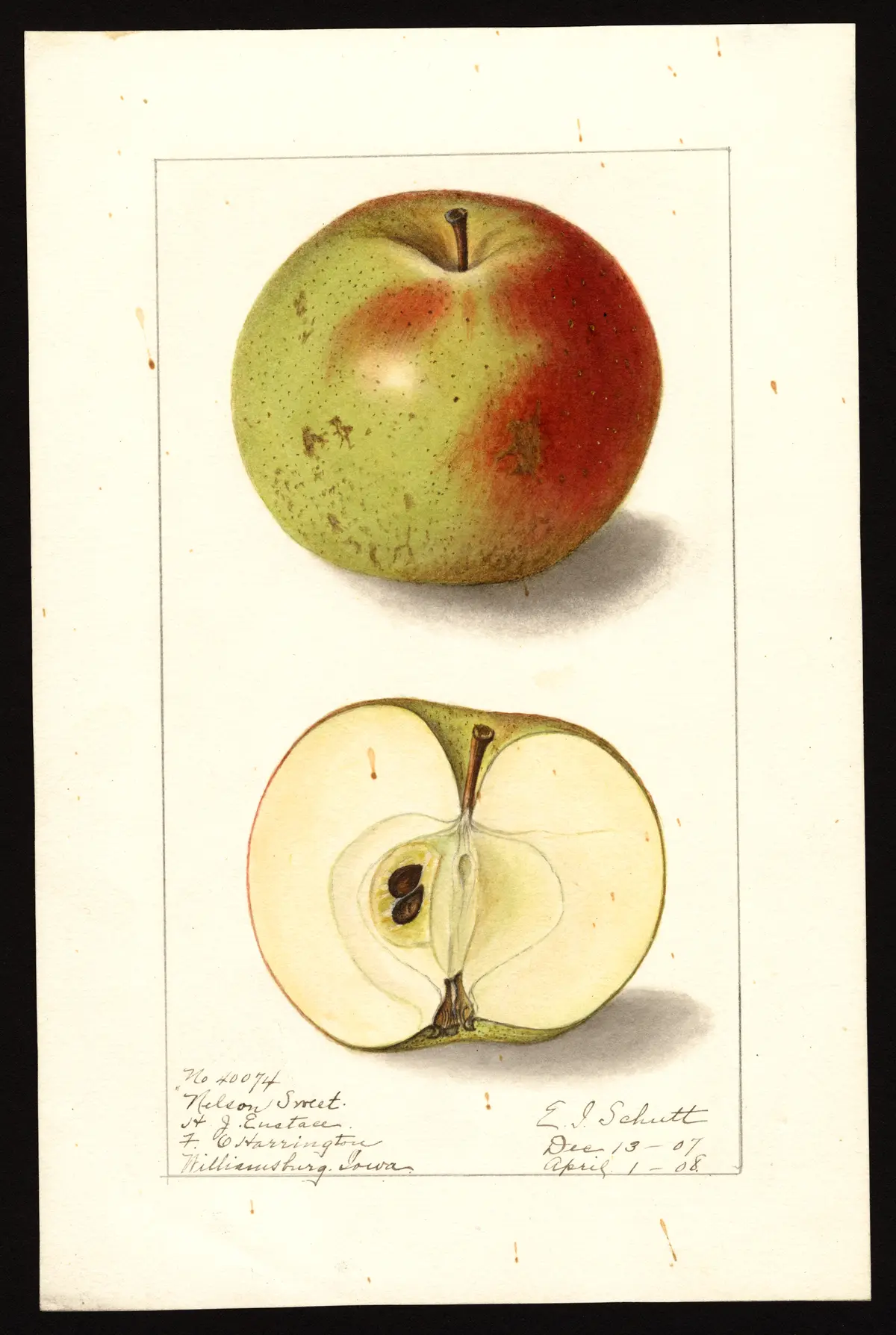
USDA Pomological Watercolor Collection
Nelson
Origin / History
Origin unknown (Downing); origin uncertain (Beach). Nelson was first brought to notice in Illinois. It was first exhibited before the Illinois Horticultural Society at its Champaign meeting, December, 1866; Beach cites the American Journal of Horticulture, 1867, for this, and Downing's entry is credited to the same journal. Beach received it in 1889 from Benjamin Buckman, Farmingdale, Illinois, for testing in New York, and finds it practically unknown in New York.
Beach calls it "a good sweet apple of medium size, green with dull blush."
Tree
Tree vigorous to moderately vigorous; Beach calls it a good grower. Form open, spreading and rather flat. Twigs short to rather long, rather slender to stout, with large terminal buds, nearly straight but geniculate; internodes medium to rather long. Bark clear reddish-brown tinged with olive-green, partly streaked with thin scarfskin, slightly pubescent. Lenticels quite numerous, small to medium, round or oval, usually not raised. Buds rather small to large, broad, plump, obtuse, free, slightly pubescent.
Comes into bearing rather young. A reliable cropper and almost an annual bearer, yielding moderate to rather heavy crops (Beach).
Fruit
Size: Medium to large; medium to above, uniform in size and shape.
Form: Roundish oblate to roundish-ovate, regular, sometimes inclined to oblong or elliptical, and often somewhat ribbed. A suture line often extends from the cavity to the basin.
Stem: Below medium to rather long, slender to rather slender, pubescent.
Cavity: Medium to rather small, usually narrow, moderately deep, acute to acuminate, regular, green, partly russeted, sometimes lipped.
Calyx: Medium to rather small, closed (usually so, Beach), pubescent; segments (lobes) reflexed, long, acute. Calyx tube large, narrow above, funnel-shape, sometimes approaching cylindrical. Stamens median to nearly marginal.
Basin: Small, shallow to moderately deep, often narrow, uneven, obtuse to somewhat abrupt, furrowed and wrinkled.
Skin: Moderately thick, tough, smooth. Dull green at first, becoming yellow or more or less tinged with yellow, sometimes bronzed with dull brown, or shaded with a brownish blush that sometimes partly deepens to red. Prevailing effect green or yellowish; green with dull blush.
Dots: Numerous, often submerged and whitish, sometimes areolar with a russet point; about the cavity larger, irregular and often elongated.
Flesh and flavor: Greenish yellow, or tinged with yellow or greenish; firm, fine-grained to moderately fine, not crisp but somewhat tough, juicy. Sweet to very sweet, with distinct flavor. "Good" (Downing); "good quality" (Beach).
Core and seeds: Core medium or above, axile; cells symmetrical, closed; core lines clasping the funnel cylinder. Carpels elliptical to broadly obcordate, somewhat tufted. Seeds often abortive, small to medium, plump, obtuse, moderately wide, rather light reddish-brown.
Season
February to July. Downing gives May to July; Beach gives February to June, with a commercial limit in common storage of April or May. A very late-keeping sweet apple.
Uses
A good variety for the home orchard where a very late-keeping sweet apple is desired. Beach does not consider it valuable commercially, because it is sweet, not large and not very attractive in appearance.
Subtypes / Variants
Not described in source.
Other
Not described in source.
Book Sources
Described in 2 period pomological works
USDA Nomenclature (1905)
From W.H. Ragan, Nomenclature of the Apple, USDA Bulletin No. 56
From Amer. Journal of Horticulture.
Probably distinct from preceding.
Nursery Catalog Sources
Found in 3 catalogs (1900–1913) from Illinois
- Central Experimental Farm , Dominion Department of Agriculture, Agassiz, British Columbia (under test; Bulletin No. 3, Second Series) — 1900 — listed as Nelson Sweet
- Benjamin Buckman (personal inventory) , Farmingdale , Illinois — 1901 — listed as Nelson Sweet
- Benjamin Buckman (personal inventory) , Farmingdale , Illinois — 1913 — listed as Nelson Sweet
View original book sources (2)
— A.J. Downing, The Fruits and Fruit Trees of America (1900)Nelson.
Origin unknown.
Fruit medium to large. Form roundish oblate, regular. Color dull green, becoming yellow, sometimes bronzed with dull brown. Stalk rather long, slender. Cavity medium, acute, regular, green. Calyx medium, closed. Segments reflexed. Basin small, uneven. Flesh greenish yellow, firm, fine-grained, juicy, sweet. Core medium. Good. May to July. (Am. Jour. of Hort.)
— S.A. Beach, The Apples of New York, Vol. 1 (1905)NELSON.
REFERENCES. 1. Am. Jour. of Hort., 2:16. 1867. 2. Downing, 1872:284. 3. Ill. Hort. Soc. Rpt., 1879. 4. Beach, N. Y. Sta. An. Rpt., 13:590. 1894. 5. Ib., 14:262. 1895. 6. Ib., 15:282. 1896. 7. Beach and Clark, N. Y. Sta. Bul. 248:133. 1904.
SYNONYM. Nelson Sweet (3, 4, 6).
A good sweet apple of medium size, green with dull blush, in season from February to June. Its commercial limit here in common storage is April or May. The tree is a good grower and a reliable cropper. It comes into bearing rather young and is almost an annual bearer, yielding moderate to rather heavy crops. It is a good variety for the home orchard where a very late-keeping sweet apple is desired, but it is not considered valuable commercially because it is sweet, not large and not very attractive in appearance.
Historical. Nelson was first brought to notice in Illinois but its origin is uncertain. It was first exhibited before the Illinois Horticultural Society at its Champaign meeting, December, 1866 (1). Received in 1889 from Benjamin Buckman, Farmingdale, Illinois, for testing here. It appears to be practically unknown in New York.
TREE.
Tree vigorous to moderately vigorous. Form open, spreading and rather flat. Twigs short to rather long, rather slender to stout with large terminal buds, nearly straight but geniculate; internodes medium to rather long. Bark clear reddish-brown tinged with olive-green, partly streaked with thin scarfskin, slightly pubescent. Lenticels quite numerous, small to medium, round or oval, usually not raised. Buds rather small to large, broad, plump, obtuse, free, slightly pubescent.
FRUIT.
Fruit medium to above, uniform in size and shape. Form roundish to roundish-ovate, sometimes inclined to oblong, pretty regular but sometimes inclined to elliptical and often somewhat ribbed. Stem below medium to above, rather slender, pubescent. Cavity rather small, usually narrow, moderately deep, acuminate, partly russeted, sometimes lipped. Calyx rather small to medium, usually closed, pubescent; lobes reflexed, long, acute. Basin shallow to moderately deep, often narrow, obtuse to somewhat abrupt, furrowed and wrinkled. Skin moderately thick, tough, smooth, dull green at first, but eventually becoming more or less tinged with yellow, shaded with a brownish blush which sometimes partly deepens to red. A suture line often extends from the cavity to the basin. Dots numerous, often submerged and whitish, sometimes areolar with russet point; about the cavity they are larger, irregular and often elongated. Prevailing effect green or yellowish.
Calyx tube large, narrow above, funnel-shape, sometimes approaching cylindrical. Stamens median to nearly marginal. Core medium or above, axile; cells symmetrical, closed; core lines clasping the funnel cylinder. Carpels elliptical to broadly obcordate, somewhat tufted. Seeds often abortive, small to medium, plump, obtuse, moderately wide, rather light reddish-brown. Flesh tinged with yellow or greenish, firm, moderately fine, not crisp but somewhat tough, juicy, sweet to very sweet, with distinct flavor and good quality.