Nixonite
Apple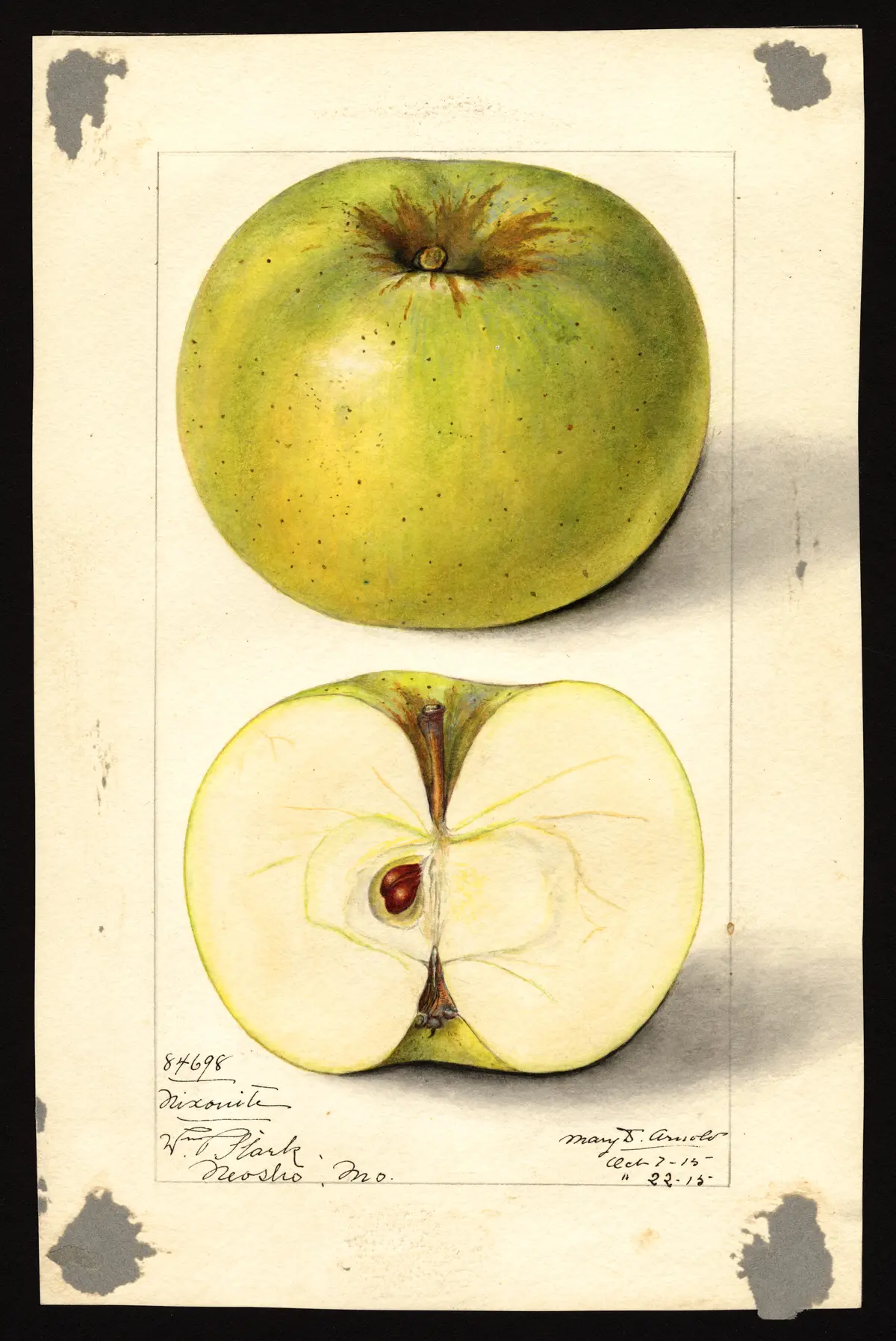
USDA Pomological Watercolor Collection
Nixonite
Origin/History
Nixonite originated on the farm of M. Nixon, near Hopewell, Missouri, approximately fifty to seventy-five years before 1914 (Budd & Hansen). It came up from seed alongside an old lead mine (Budd & Hansen). It was much grown in southeastern Missouri (Budd & Hansen).
Tree
Not an early bearer, but productive with age (Budd & Hansen).
Fruit
Size: Large (Thomas); large to very large (Budd & Hansen).
Form: Round oblate (Thomas); roundish, truncated, nearly regular, sometimes unequal (Budd & Hansen).
Stem: Short (Budd & Hansen).
Cavity: Deep, narrow, acute, lined with stellate russet (Budd & Hansen).
Calyx: Open; segments divergent, long, pointed (Budd & Hansen).
Basin: Abrupt, wavy, medium (Budd & Hansen).
Skin: Yellow (Thomas); clear rich yellow, overlaid with whitish (Budd & Hansen). Dots obscure, numerous, white, minute, suffused; a few large russet dots (Budd & Hansen).
Core/Seeds: Core open, axile, wide, flattened; cells round, slit; tube funnel-shaped; stamens median; seeds plump (Budd & Hansen).
Flesh/Flavor: Coarse and acid (Thomas). Budd & Hansen describe the flesh as yellowish with yellow veinings, juicy, crisp, sprightly, spicy, and subacid, rating it very good. The two sources conflict on texture (coarse vs. crisp) and acidity (acid vs. subacid).
Season
Winter (Budd & Hansen). A good keeper (Thomas).
Uses
Not described in source.
Subtypes/Variants
Not described in source.
Other
Not described in source.
Book Sources
Described in 2 period pomological works
View original book sources (2)
— John J. Thomas, The American Fruit Culturist (1903)Nixonite (Ozark Mammoth). Large, round oblate, yellow, flesh coarse, acid; good keeper. Mo.
— J.L. Budd & N.E. Hansen, American Horticultural Manual, Part II: Systematic Pomology (1914)Nixonite (Ozark Mammoth). — Originated "on the farm of M. Nixon, near Hopewell, Mo., some fifty or seventy-five years ago. It came up from seed alongside of an old lead mine." Tree not an early bearer but productive with age. Much grown in southeastern Missouri.
Fruit large to very large, roundish, truncated, nearly regular sometimes unequal; surface clear rich yellow, overlaid with whitish; dots obscure, numerous, white, minute, suffused, a few large russet dots; cavity deep, narrow, acute, lined with stellate russet; stem short; basin abrupt, wavy, medium; calyx open; segments divergent, long, pointed. Core open, alaxile, wide, flattened; cells round, slit; tube funnel-shaped; stamens median; seeds plump; flesh yellowish, with yellow veinings, juicy, crisp, sprightly, spicy, subacid, very good. Winter.