No. 4. Summer Queen
Apple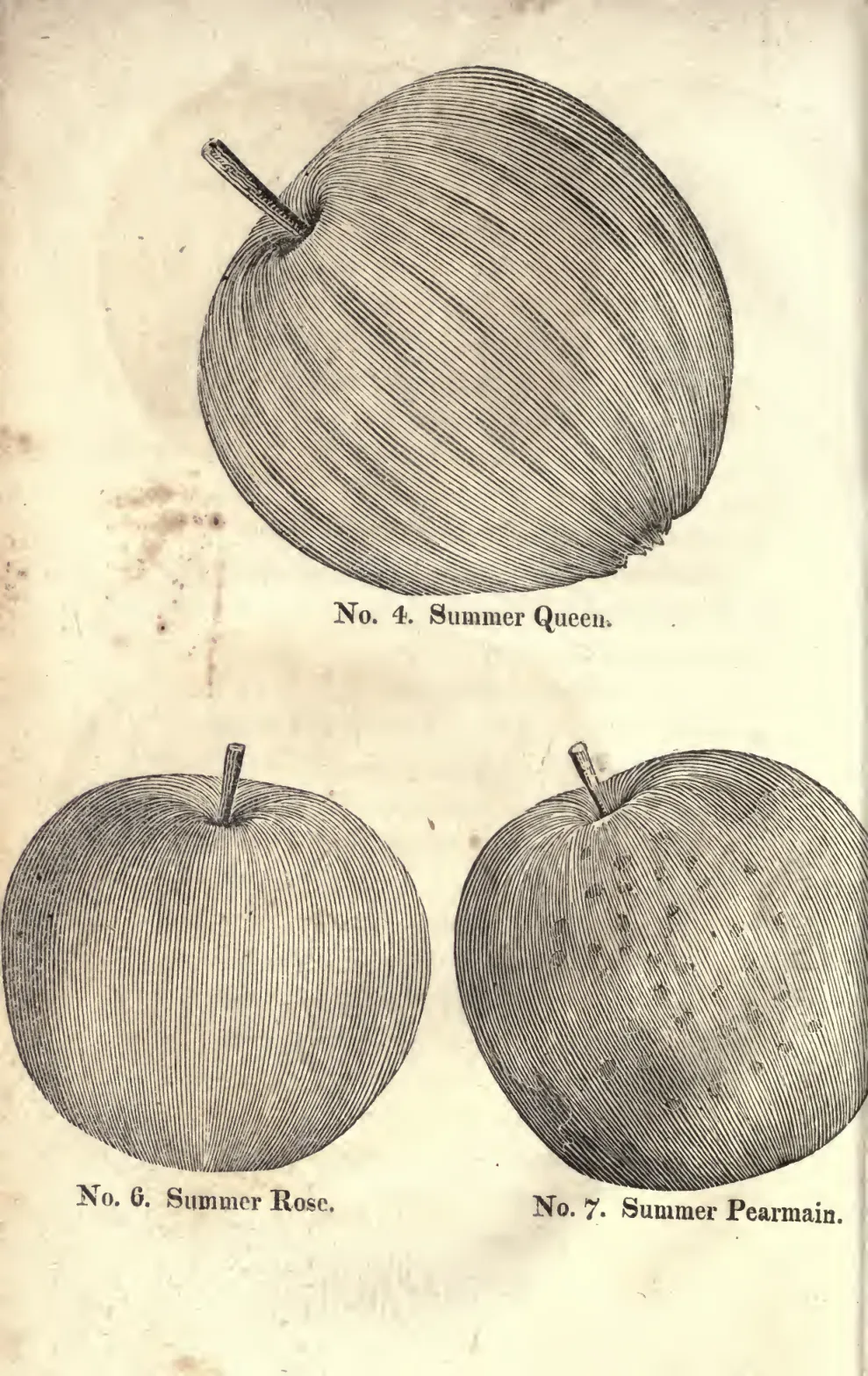
No. 4. Summer Queen
Origin / History
No. 4. Summer Queen is described by William Coxe in A View of the Cultivation of Fruit Trees (1817), where it is listed as an apple of the finest quality with uncommonly beautiful appearance. It is known by the name of Swetts Harvest in many parts of New-Jersey.
Tree
The tree is of a very luxuriant growth, with large leaves and hanging boughs. It is a great and constant bearer.
Fruit
Size: The size is large.
Form: Not described in source.
Stem: The stalk is long, and planted in a deep cavity, with projections of the flesh around the stalk, like the Roman stem.
Cavity: The stalk is planted in a deep cavity, with projections of the flesh around the stalk, like the Roman stem.
Calyx: The blossom end is much pointed, and full of little furrows and protuberances.
Basin: Not described in source.
Skin: The skin has a fine rich yellow ground, mixed with red, handsomely striped and clouded, sometimes in a proportion greater than the yellow.
Dots: Not described in source.
Flesh and flavor: The flesh is rich, yellow, and highly scented, equally suited for eating and stewing. The fruit is of the finest quality.
Core and seeds: Not described in source.
Season
The fruit is not fully ripe until the beginning of August, but can be used for stewing long before that time.
Uses
The flesh is equally suited for eating and stewing. The fruit can be used for stewing long before it is fully ripe.
Subtypes / Variants
Not described in source.
Other
Not described in source.
Book Sources
Described in 1 period pomological work
View original book sources (1)
— William Coxe, A View of the Cultivation of Fruit Trees (1817)NO. 4. SUMMER QUEEN.
The Summer queen is an apple of the finest quality, and its appearance is uncommonly beautiful. The size is large; the skin has a fine rich yellow ground, mixed with red, handsomely striped and clouded, sometimes in a proportion greater than the yellow; the blossom end is much pointed, and full of little furrows and protuberances; the stalk is long, and planted in a deep cavity, with projections of the flesh around the stalk, like the Roman stem; the flesh is rich, yellow, and highly scented, equally suited for eating and stewing. It is not fully ripe until the beginning of August, but can be used for stewing long before that time: the tree is of a very luxuriant growth, with large leaves and hanging boughs: it is a great and constant bearer; it is known by the name of Swetts Harvest in many parts of New-Jersey.