Nottingham Brown
Apple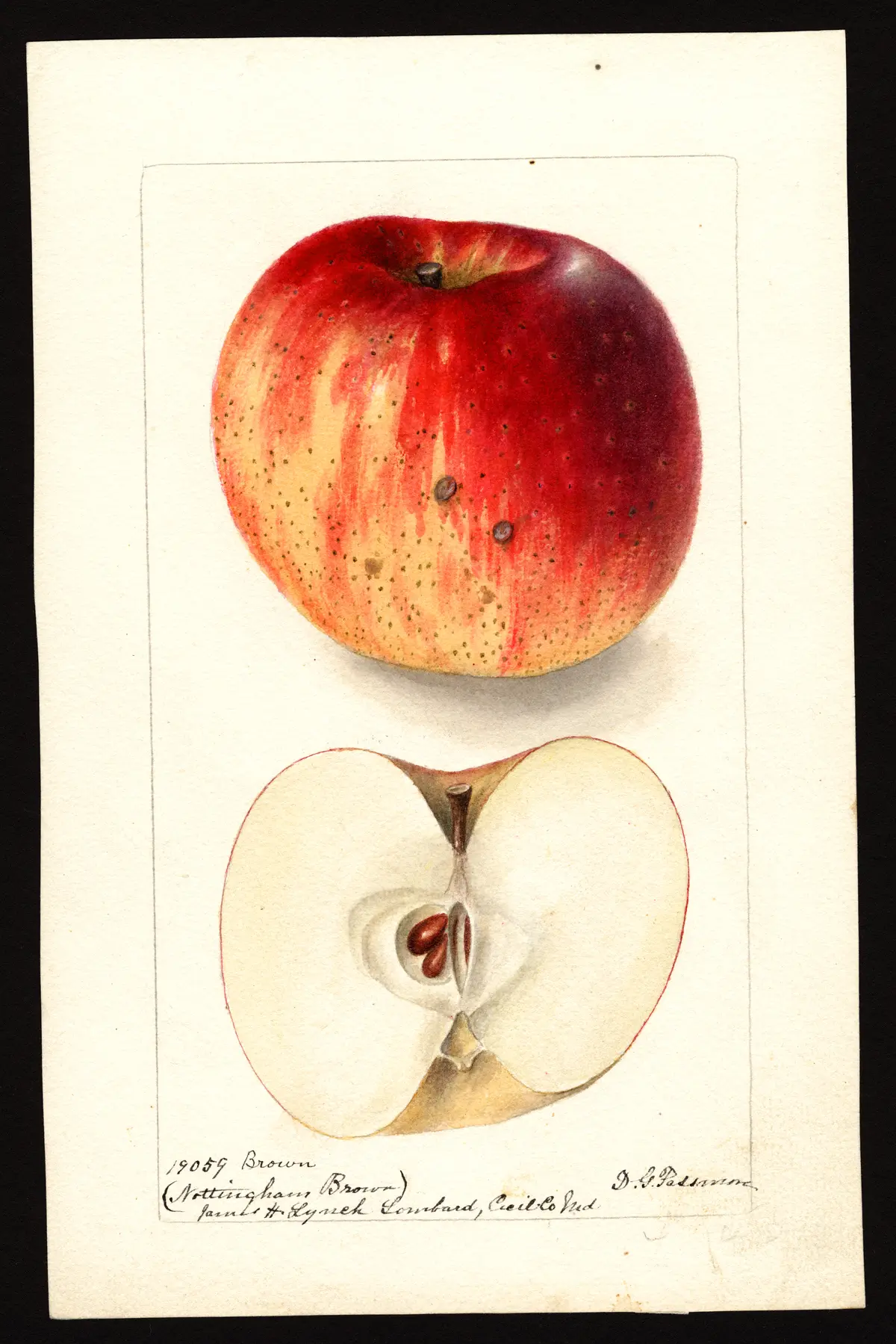
USDA Pomological Watercolor Collection
Nottingham Brown
Origin and History
Nottingham Brown originated in Pennsylvania.
Tree
Not described in source.
Fruit
Nottingham Brown produces large, roundish fruits. The skin is medium thick and tenacious. The surface displays raised dots and russet knobs, with yellow as the base color, washed with mixed crimson, splashes, and broad broken stripes of dark crimson. The dots are prominent and areole in character.
The cavity is regular, large, and deep, with russet markings. The stem is short and stout.
The basin is regular, large, and deep, with an abrupt edge featuring furrows and corrugations. The calyx is small and closed; the segments are long and converging.
The core is conical, small, clasping, and partially open. Seeds are numerous, medium in size, plump, and brown.
The flesh is yellowish, satiny, moderately fine, breaking, and juicy. The flavor is sprightly subacid, rated good to very good.
Season
Winter.
Uses
Not described in source.
Subtypes and Variants
Not described in source.
Book Sources
Described in 1 period pomological work
Nursery Catalog Sources
Found in 2 catalogs (1901–1913) from Illinois
- Benjamin Buckman (personal inventory) , Farmingdale , Illinois — 1901
- Benjamin Buckman (personal inventory) , Farmingdale , Illinois — 1913
View original book sources (1)
— J.L. Budd & N.E. Hansen, American Horticultural Manual, Part II: Systematic Pomology (1914)Nottingham Brown. — Origin, Pennsylvania.
Fruit large, roundish; skin medium thick, tenacious; surface with raised dots, and russet knobs, yellow, washed with mixed crimson, splashes, and broad broken stripes of dark crimson; dots prominent, areole; cavity regular, large, deep, with russet markings; stem short, stout; basin regular, large, deep, abrupt, with furrows and corrugations; calyx small, closed; segments long, converging. Core conical, small, clasping, partially open; seeds numerous, medium, plump, brown; flesh yellowish, satiny, moderately fine, breaking, juicy, sprightly subacid, good to very good. Winter. (U. S. Div. of Pomology, 1902.)