Oconee Greening
Apple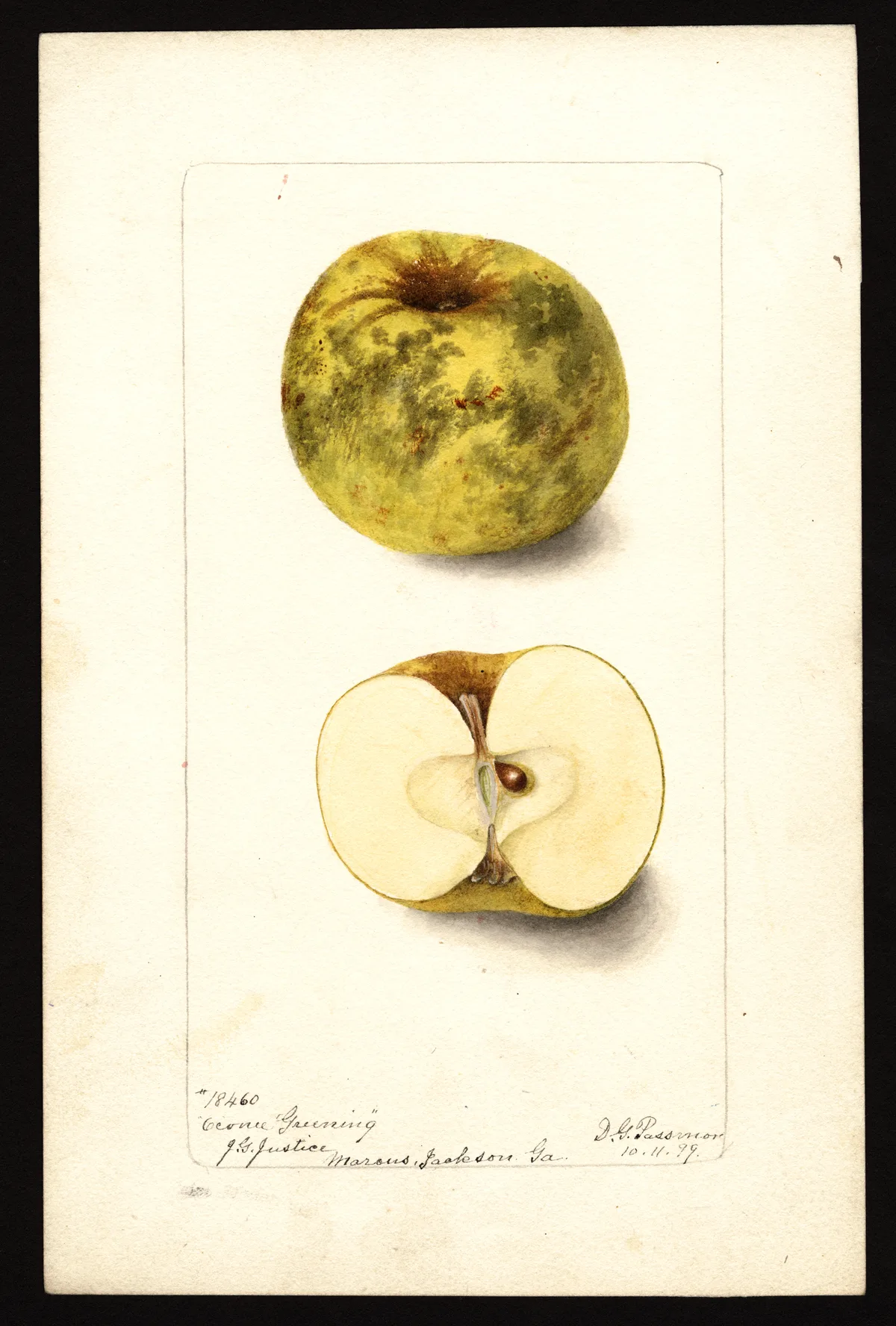
USDA Pomological Watercolor Collection
Oconee Greening
Origin/History
Originated on the banks of the Oconee river, a little below Athens, Georgia (Downing, Elliott, Budd & Hansen). Thomas notes the variety as a Georgia apple.
Tree
Vigorous and an abundant/productive bearer (Downing, Budd & Hansen).
Fruit
Size
Large (Downing, Budd & Hansen); very large (Elliott, Thomas); medium (Lowther).
Form
Roundish flattened (Downing, Elliott, Budd & Hansen); roundish-oblate (Thomas); oblate (Lowther).
Stem
Stalk very short (Downing, Elliott); stem short (Budd & Hansen).
Cavity
Rather regular, deep (Downing, Elliott, Budd & Hansen); russeted (Budd & Hansen).
Calyx
Open (Downing, Elliott, Budd & Hansen).
Basin
Shallow, slightly furrowed (Downing, Elliott, Budd & Hansen).
Skin
Yellow, a little brownish in the sun, russet about the stem, with a few scattered russet dots (Downing, Elliott). Budd & Hansen describe the surface as yellow, a little brownish in the sun, with few russet dots. Lowther records the color as yellow-red.
Flesh/Flavor
Yellowish, fine-grained, crisp, abounding in a delightful aromatic, lively, subacid juice (Downing, Elliott, Budd & Hansen). Thomas describes the flavor as "lively sub-acid, aromatic." Quality is rated "good to very good" by Downing and Budd & Hansen, "very good" by Thomas and Lowther, and "best" by Elliott (citing Ad. Int. Rept., Ga. H. Sc.).
Core/Seeds
Not described in source.
Season
October, November (Downing, Budd & Hansen); winter (Thomas, Lowther).
Uses
Both kitchen and market (Lowther).
Subtypes/Variants
Not described in source.
Other
Thomas notes that the variety resembles Disharoon. Lowther records the variety in the Northern Division as rated 1, with the variety also reported in another division.
Book Sources
Described in 5 period pomological works
Nursery Catalog Sources
Found in 3 catalogs (1886–1913) from Alabama, Illinois
- Huntsville Wholesale Nurseries (Jessie S. Moss , Proprietor; W.F. Heikes, Manager), Huntsville , Alabama — 1886
- Benjamin Buckman (personal inventory) , Farmingdale , Illinois — 1901
- Benjamin Buckman (personal inventory) , Farmingdale , Illinois — 1913
View original book sources (5)
— A.J. Downing, The Fruits and Fruit Trees of America (1900)Oconee Greening.
Origin, banks of the Oconee river, a little below Athens, Ga. Tree vigorous and abundant bearer.
Fruit large, roundish flattened, yellow, a little brownish in the sun, russet about the stem, with a few scattered russet dots. Calyx open, in a shallow, slightly furrowed basin. Stalk very short, in a rather regular, deep cavity. Flesh yellowish, fine-grained, crisp, abounding in a delightful aromatic, lively, subacid juice. Good to very good. October, November.
— Granville Lowther (ed.), Encyclopedia of Practical Horticulture (1914)Oconee Greening. Size: medium. Form: oblate. Color: yellow-red. Quality: very good. Use: both kitchen and market. Season: winter. Northern Division: 1 (also reported in another division).
— F.R. Elliott, The Western Fruit Book (1865)Oconee Greening.
Origin, banks of the Oconee river, a little below Athens, Ga. Fruit very large, roundish flattened : skin, yellow, a little brownish in the sun, russet about the stem, with a few scattered russet dots; calyx, open, in a shallow, slightly-furrowed basin; stalk, very short, in a rather regular, deep cavity; flesh, yellowish, fine-grained, crisp, abounding in a delightful aromatic, lively, sub-acid juice ; quality, "best." — (Ad. Int. Rept., Ga. H. Sc.)
— John J. Thomas, The American Fruit Culturist (1903)Oconee Greening. Very large, roundish-oblate, yellow; lively sub-acid, aromatic, very good. Resembles Disharoon. Winter. Ga.
— J.L. Budd & N.E. Hansen, American Horticultural Manual, Part II: Systematic Pomology (1914)Oconee. — Origin, bank of Oconee River, near Athens, Georgia, tree vigorous and productive.
Fruit large; form roundish-flattened; surface yellow, a little brownish in the sun; dots few, russet; cavity rather regular, deep, russeted; stem short; basin shallow, slightly furrowed ; calyx open; flesh yellowish, fine-grained, crisp, abounding in a delightful aromatic, lively, subacid juice, good to very good. October to November.