Ohio Nonpareil
Apple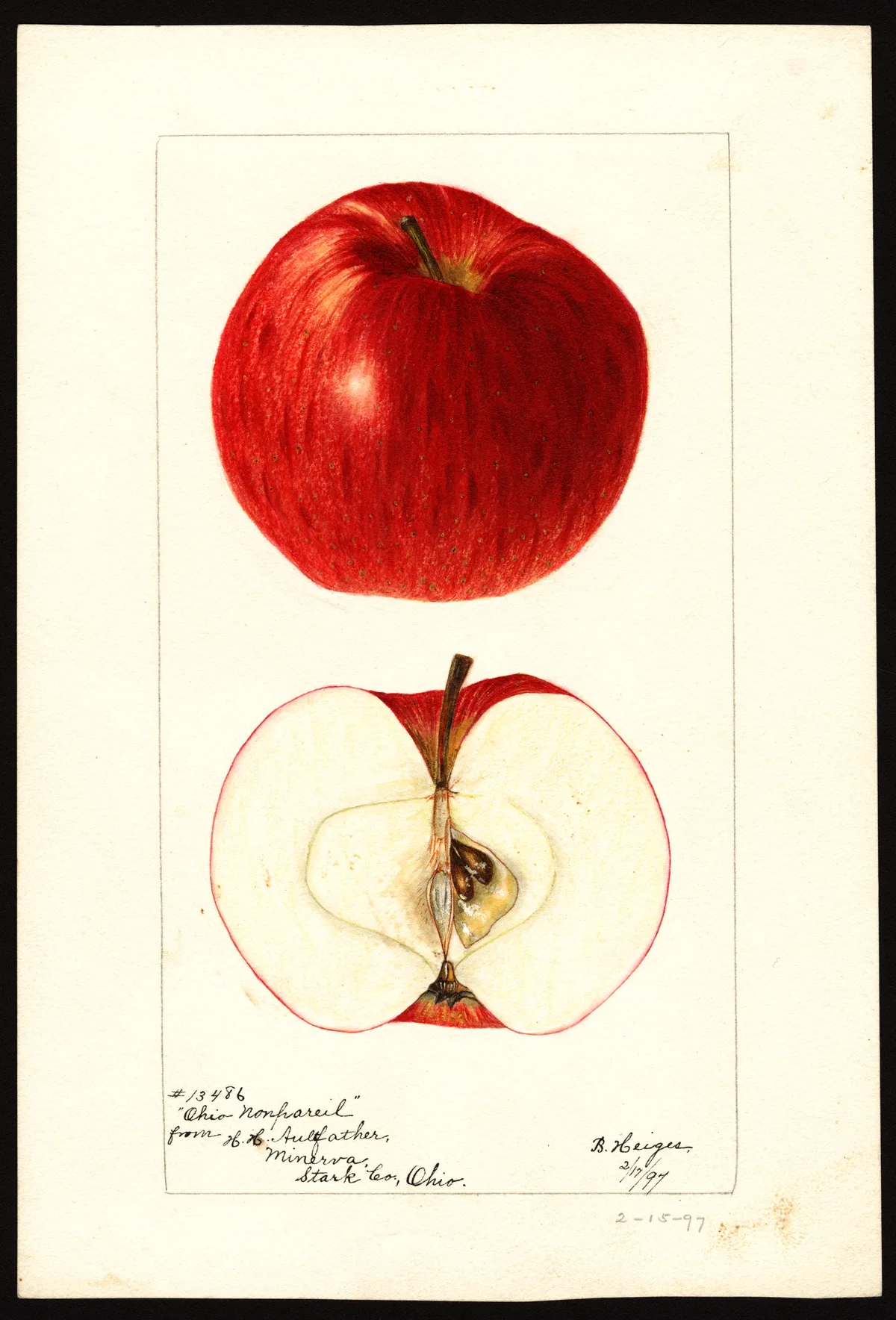
USDA Pomological Watercolor Collection
Ohio Nonpareil
Origin / History
Originated near Massillon, Ohio, with the first known trees in the orchard of a Mr. Myers (Warder, Budd-Hansen, Hedrick); Downing notes the origin is in doubt and gives Bowman of Massillon as the owner of the first known trees. First described in 1848 (Beach Vol 2, Hedrick), and again in the Western Horticultural Review for February 1853 (Warder). Warder records that the original tree bore annual crops of even-sized fruit for twenty years. Although an old variety, Beach notes it was not much disseminated in New York; it was more popular in the Middle West and still offered by nurserymen there at the turn of the century. By Hedrick's account (1922) it had become a variety "once very popular in the Middle West" but by then was "to be found only in old orchards." Warder reports that, when compared with some of the best dessert apples of the season — Hawley, Fall Pippin, Fall Wine, Rambo, and others — this variety was declared to be "better than the best."
Tree
Sources differ on vigor. Warder calls the tree vigorous, healthy, and spreading, with limbs straight, stout and compact, "not liable to break with the weight of fruit." Downing likewise describes young trees as very vigorous with stout, straight shoots, while the orchard trees are very wide, regular, open, and spreading, requiring little or no thinning, and bearing the fruit evenly over the whole tree, all of fair size and smooth. Budd-Hansen agrees: vigorous, wide spreading. Thomas calls the growth strong and straight, forming a compact head, and productive. Beach (Vol 2) and Hedrick, by contrast, describe the tree as medium-sized and only moderately vigorous, spreading and not dense; Beach adds that it appears to be hardy and moderately long-lived, does not come into bearing very young, and is not always a reliable cropper, while Hedrick states bluntly that "the tree is seldom satisfactory."
Twigs: medium in length, curved, rather stout (Beach).
Young shoots: smooth, rich, dark reddish brown (Downing).
Bark: olive-green with some reddish-brown, thinly streaked and mottled with gray scarf-skin (Beach).
Lenticels: scattering, conspicuous, large, usually round, becoming laterally compressed (Beach).
Buds: medium to small, obtuse, appressed, pubescent (Beach).
Fruit
Size: Medium to large (Downing, Beach, Hedrick); large (Budd-Hansen, Thomas, Lowther); large to very large (Warder).
Form: Regular, roundish oblate (Warder, Downing, Budd-Hansen, Beach, Hedrick); slightly oblate (Thomas); often obscurely ribbed (Beach, Hedrick).
Stem: Short, small (Warder); short, rather slender (Budd-Hansen); medium, rather slender (Downing); medium to rather short, rather thick (Beach); short and thick (Hedrick).
Cavity: Deep, acute, regular, and large (Warder, Downing, Budd-Hansen); rather large, acute, deep, pretty symmetrical, more or less russeted, the russet sometimes outspreading over the base (Beach); large, acute, deep, symmetrical, russeted, with the russet sometimes spreading over the base (Hedrick); medium (Thomas).
Calyx: Large, closed (Warder); rather large, partially open, with rather short segments (Downing, Budd-Hansen); medium or above, closed or slightly open, with lobes medium in length, narrow, and acute (Beach); closed or slightly open, lobes narrow and acute (Hedrick).
Calyx tube: Moderately short to short, conical (Beach, Hedrick).
Stamens: Basal to nearly median (Beach); basal (Hedrick).
Basin: Medium, wide, regular (Warder, Budd-Hansen); medium (Downing, Thomas); rather small, medium in depth, narrow to moderately wide, somewhat abrupt, rather symmetrical (Beach); small, medium in depth, wide, abrupt, symmetrical (Hedrick).
Skin: Smooth; ground color pale yellow to deep yellow, shaded, marbled, and irregularly striped and splashed with two shades of rich, bright red, often described as carmine, almost entirely overspreading the surface (Warder, Downing, Beach, Hedrick, Budd-Hansen, Thomas); Lowther summarizes the color simply as "yellow-red."
Dots: Scattered and gray (Warder); few, light, gray (Budd-Hansen); thinly sprinkled, light and gray (Downing); moderately numerous to numerous, small to medium, areolar with russet center or grayish (Beach, Hedrick).
Flesh: Yellowish to yellowish white, sometimes simply yellow, fine-grained (Beach: "moderately fine"), tender, crisp, juicy, rich, slightly aromatic, agreeable subacid (Warder, Downing, Beach, Hedrick, Budd-Hansen, Thomas). Beach and Hedrick add that it is firm and breaking/crisp. Thomas calls the flavor "excellent sub-acid."
Quality: Very good; good to very good (Beach, Hedrick); first quality (Warder); very good (Downing, Budd-Hansen, Lowther).
Core: Regular and somewhat open (Warder, Budd-Hansen); small (Downing); small, somewhat abaxile (Beach) to abaxile (Hedrick); cells symmetrical, not uniformly developed (Beach), nearly closed to somewhat open / closed or open; core lines meeting or slightly clasping (Beach, Hedrick).
Carpels: Roundish, rather flat, tufted (Beach); round, flat, tufted (Hedrick).
Seeds: Numerous to many, medium in size (Warder, Budd-Hansen); medium in size, moderately long to long, plump, acute, tufted (Beach, Hedrick).
Season
Most sources give October and November (Downing, Beach, Hedrick, Budd-Hansen). Warder extends the season from September to December. Thomas calls it an autumn apple. Lowther, in contrast, lists the season of ripening as winter.
Uses
Suited equally for dessert (table), market, and culinary (kitchen) use (Downing, Beach, Lowther, Budd-Hansen). Warder adds that it is first quality for table, market, cooking, or drying. Beach notes it is regarded as a good variety for home use, and some recommend it for commercial planting. Thomas reports it as "much valued at the West."
Subtypes / Variants
Not described in source.
Other
Lowther reports the variety from 4 stations in the Northern Division, 3 stations in the Central Division, and 1 station in the Southern Division, with the asterisk on each division count indicating that the variety is reported as adapted to more than one of the three divisions.
Book Sources
Described in 8 period pomological works
- Warder, American Pomology: Apples (1867)
- Beach, The Apples of New York Vol. 2 (1905)
- Downing, Fruits and Fruit Trees of America (1900)
- Beach, The Apples of New York Vol. 1 (1905) — listed as Ohio Pippin
- Budd & Hansen, Systematic Pomology (1914)
- Lowther (ed.), Encyclopedia of Practical Horticulture (1914)
- Hedrick, Cyclopedia of Hardy Fruits (1922)
- Thomas, The American Fruit Culturist (1903) — listed as Myer's
Nursery Catalog Sources
Found in 16 catalogs (1891–1913) from Alabama, Illinois, Missouri, Washington
- Missouri Nursery Co. , Louisiana , Missouri — 1891 — listed as Shannon
- Puyallup & Yakima Nurseries , Puyallup, Washington (Lock Box 191) and North Yakima , Washington — 1892 — listed as Shannon
- The Vineland Nurseries (Kelsey & Co. , Proprietors), St. Joseph, Missouri (Office: 13th and Atchison Sts., 2 Blocks East of the Citizens St. Car Line) — 1894 — listed as Shannon
- Stark Bros. Nurseries & Orchards Co. , Louisiana , Missouri — 1898
- J.V. Cotta (Cotta Nursery) , Carroll County , Illinois — 1898 — listed as Shannon
- Central Experimental Farm , Dominion Department of Agriculture, Agassiz, British Columbia (under test; Bulletin No. 3, Second Series) — 1900
- Alabama Nursery Co. , Huntsville , Alabama — 1900 — listed as Shannon
- Central Experimental Farm , Dominion Department of Agriculture, Agassiz, British Columbia (under test; Bulletin No. 3, Second Series) — 1900 — listed as Shannon
- Benjamin Buckman (personal inventory) , Farmingdale , Illinois — 1901
- Benjamin Buckman (personal inventory) , Farmingdale , Illinois — 1901 — listed as Shannon
- Benjamin Buckman (personal inventory) , Farmingdale , Illinois — 1901 — listed as Red Bellflower
- Stark Bros. Nurseries & Orchards Co. , Louisiana , Missouri — 1906
- Stark Bros. Nurseries & Orchards Co. , Louisiana , Missouri — 1912
- Vineland Nurseries Company , Clarkston , Washington — 1912 — listed as Shannon
- Benjamin Buckman (personal inventory) , Farmingdale , Illinois — 1913 — listed as Shannon
- Benjamin Buckman (personal inventory) , Farmingdale , Illinois — 1913 — listed as Red Bellflower
View original book sources (8)
— John A. Warder, American Pomology: Apples (1867)Ohio Nonpareil. MYER'S NONPAREIL.—WESTERN BEAUTY.
This fine fruit originated with Mr. Myers, near Massillon, Ohio.
It was described in the Western Horticultural Review for February, 1853.
Tree vigorous, healthy, spreading, limbs straight, stout and compact, not liable to break with the weight of fruit. The original tree had borne annual crops of even sized fruit for twenty years.
Fruit large to very large, regular, oblate, very handsome; Surface smooth, yellow, covered with bright red; Dots scattered, gray.
Basin medium, wide, regular; Eye large, closed. Cavity deep, acute, regular; Stem short, small. Core regular, somewhat open; Seeds numerous, medium; Flesh yellowish, tender, fine-grained, juicy; sub-acid, rich; First quality, for table, market, cooking or drying; Season September to December. Compared with some of the best dessert apples of the season, such as Hawley, Fall Pippin, Fall Wine, Rambo, and others, this variety was declared to be "better than the best."
— A.J. Downing, The Fruits and Fruit Trees of America (1900)Ohio Nonpareil.
Myer's Nonpareil. Cattell Apple. Western Beauty, erroneously. Rusty Core.
This is one of the most valuable of autumn Apples, whether for market or table use. Its origin is in doubt, the first known trees of it being in the orchard of Bowman, Massillon, Ohio. The young trees are very vigorous, with stout, straight shoots, while the orchard trees are very wide, regular, open, spreading, requiring little or no thinning, and bearing the fruit evenly over the whole tree, and all fair sized, smooth fruit. Young shoots smooth, rich, dark reddish brown.
Fruit medium to large. Form roundish oblate. Color yellow, shaded, marbled, and splashed with two shades of rich red, thinly sprinkled with light and gray dots. Stalk medium, rather slender. Cavity large, deep, regular. Calyx rather large, partially open. Segments rather short. Basin medium. Flesh yellowish white, fine-grained, tender, juicy, rich, slightly aromatic subacid. Core small. Very good. October, November.
Ohio Nonpareil.
Ohio Pippin. Ernst's Pippin. Shannon.
Origin in doubt. Supposed Dayton, Ohio. It was first disseminated by the late A. H. Ernst, of Cincinnati. Tree healthy, vigorous, spreading, moderately productive. Young shoots strong, dull reddish brown, quite downy.
Fruit large, roundish oblate, yellow, with mottled red in the sun. Flesh yellowish, moderately juicy, pleasant, sharp subacid. Good. Core small. November, January.
— S.A. Beach, The Apples of New York, Vol. 1 (1905)(I) SHANNON.
REFERENCES. 1. Downing, 1881:104 app. 2. Am. Pom. Soc. Rpt., 1885:25. 3. Van Deman, U. S. Pom. Rpt., 1886:269. fig. 4. Babcock, Rural N. Y., 49:873. 1890. figs. 5. McNeil, Ark. Sta. Rpt., 1890:33. 6. Bailey, An. Hort., 1892:249. 7. Clayton, Ala. Sta. Bul., 47:7. 1893. 8. Stinson, Ark. Sta. Bul., 43:104. 1896. 9. Ib., 60:133. 1899. 10. Dickens and Greene, Kan. Sta. Bul., 106:55. 1902.
SYNONYM. SHANNON PIPPIN (1, 7).
Fruit large, yellow, smooth, pretty uniform, rather attractive in appearance and very good in quality; suitable for either home use or market. So far as tested here it is not sufficiently productive to be valuable in this region.
Historical. The history of the Shannon is rather obscure. For some time it was supposed by leading pomologists that Shannon was an Arkansas name given to the Ohio Pippin.¹·² Later investigators however have been led to question the correctness of this view (1, 3, 9) and the bulk of the evidence now seems to indicate that the Shannon is an Arkansas seedling closely resembling the Ohio Pippin yet with sufficient difference to distinguish the varieties. As fruited at this Station the tree of Ohio Pippin is slightly less vigorous than that of Shannon. The fruit averages smaller, is usually somewhat conic, the seeds are more numerous, the flavor is milder and the season is decidedly earlier than that of Shannon. Shannon is said to have originated near Boonsboro, Washington county, Ark. (9). It has been but little disseminated in New York.
TREE.
Tree vigorous with long and rather stout branches. Form rather open, spreading. Twigs medium to long, moderately stout, crooked to nearly straight, quite pubescent; internodes moderately short to very short. Bark reddish-brown, mottled with thin scarf-skin. Lenticels numerous, inconspicuous, very small, roundish or sometimes elongated. Buds medium to large, roundish, plump, somewhat acute to rather obtuse, appressed, pubescent.
¹Warder, 1867:484, 731. ²Downing, 1869:292.
FRUIT.
Fruit large. Form oblate to roundish oblate, often somewhat elliptical and obscurely ribbed; sides sometimes unequal. Stem short, moderately thick. Cavity moderately large, acute to acuminate, deep, moderately broad to very broad, symmetrical or somewhat furrowed, often with radiating russet rays or overspread with russet. Calyx large, open or partly open; lobes separated at base. Basin above medium to rather small, moderately shallow to deep, moderately narrow to rather wide, abrupt, usually indistinctly furrowed but sometimes smooth.
Skin rather thin, tough, smooth, bright, clear pale yellow, usually somewhat blushed. Dots inconspicuous, pale green or whitish, often submerged, sometimes with russet point.
Calyx tube yellow, rather long, very wide, cone-shape or somewhat funnel-form and sometimes extending to the core. Stamens median.
Core medium to rather small, slightly abaxile; cells often not uniformly developed, symmetrical, partly open or closed; core lines slightly clasping or meeting. Carpels thin, tender, roundish, mucronate, but slightly emarginate if at all, usually smooth. Seeds few, short to medium, plump, narrow to rather wide, acute.
Flesh whitish tinged with yellow, moderately firm, moderately fine-grained, breaking, tender, juicy to very juicy, sprightly subacid, good to very good.
Season at Geneva November to April or May.
(II) SHANNON.
REFERENCE. 1. J. R. Johnson, Cat., 1894.
The variety described below, so far as we know, has not been disseminated in New York. The following account is given in order that the reader may distinguish between this Shannon and the Shannon above described.
This originated as a chance seedling on the farm of Wm. Shannon, Coshocton county, Ohio. It was introduced by J. R. Johnson, of Coshocton, who stated that it is "yellow, of good size and good quality, keeps till April and holds its flavor; tree a good grower and a good bearer" (1). Mr. Johnson reports that he ventured to catalogue it under the name Shannon for local trade although he knew that a very different apple had been previously introduced under that name by A. H. Ernst.¹
¹Letter, J. R. Johnson, 1888.
— S.A. Beach, The Apples of New York, Vol. 2 (1905)OHIO NONPAREIL.
REFERENCES.
- Mag. Hort., 14:114. 1848. 2. Emmons, Nat. Hist. N. Y., 3:77. 1851. fig. 3. Elliott, 1854:148. fig. 4. Mag. Hort., 22:85, 506. 1856. 5. Hooper, 1857:15. 6. Downing, C., Mag. Hort., 27:59. 1861. 7. Am. Pom. Soc. Cat., 1862. 8. Elliott, Mag. Hort., 32:51. 1866. 9. Warder, 1867:447. fig. 10. Downing, 1869:29. fig. 11. Am. Pom. Soc. Cat., 1869. 12. Fitz, 1872:171. 13. Thomas, 1875:203. 14. Barry, 1883:340. 15. Lyon, Mich. Hort. Soc. Rpt., 1890:294. 16. Bailey, An. Hort., 1892:245. 17. Budd-Hansen, 1903:141. fig.
SYNONYMS. BELLFLOWER OF THE WEST (5). Cattell Apple (10, of Pennsylvania 6). MYERS NONPAREIL (3, 7, 8, 13). Myers Nonpareil (6, 9, 10, 12, 14). Nonpareil (6). OHIO NONPAREIL (1, 4, 6, 9, 10, 11, 12, 14, 15, 17). Ohio Nonpareil (5, 13). OHIO NONPAREIL (2, 16). Red Bellflower of some (5). Rusty Core (6, 10). Wells (5). Western Beauty (9, erroneously 10).
A fine fall apple of good color and good quality for either dessert or culinary purposes. The tree is a moderate grower and appears to be hardy and moderately long-lived. It does not come into bearing very young and is not always a reliable cropper. It is regarded as a good variety for home use and some recommend it for commercial planting. Season October and November.
Historical. Originated near Massillon, Ohio. Although this is an old variety having first been described in 1848 (1) we do not find that it has been much disseminated in New York. It is more popular in the Middle West and is still offered by nurserymen in that region (16).
TREE.
Tree medium size, moderately vigorous. Form rather spreading, not dense. Twigs medium length, curved, rather stout. Bark olive-green with some reddish-brown, thinly streaked and mottled with gray scarf-skin. Lenticels scattering, conspicuous, large, usually round, becoming laterally compressed. Buds medium to small, obtuse, appressed, pubescent.
FRUIT.
Fruit medium to large. Form roundish oblate, often obscurely ribbed. Stem medium to rather short, rather thick. Cavity rather large, acute, deep, pretty symmetrical, more or less russeted, the russet sometimes outspreading over the base. Calyx medium or above, closed or slightly open; lobes medium in length, narrow, acute. Basin rather small, medium in depth, narrow to moderately wide, somewhat abrupt, rather symmetrical. Skin pale yellow to deep yellow almost entirely overspread with bright red, mottled and irregularly striped and splashed with carmine. Dots moderately numerous, small to medium, areolar with russet center or grayish. Calyx tube moderately short, conical. Stamens basal to nearly median. Core small, somewhat abaxile; cells symmetrical, not uniformly developed, nearly closed to somewhat open; core lines meeting or slightly clasping. Carpels roundish, rather flat, tufted. Seeds medium size, moderately long, plump, acute, tufted. Flesh tinged with yellow, firm, moderately fine, crisp, tender, juicy, agreeable subacid, aromatic, good to very good.
Season October and November.
— Granville Lowther (ed.), Encyclopedia of Practical Horticulture (1914)Ohio Nonpareil is a large apple of roundish (oblate) form with yellow-red skin. Quality is very good. It is suited for both kitchen and market use. Season of ripening is winter. It was reported by 4 stations in the Northern Division, 3 stations in the Central Division, and 1 station in the Southern Division; the asterisk on each division count indicates the variety is reported as adapted to more than one of the three divisions.
— John J. Thomas, The American Fruit Culturist (1903)Myer's. (Ohio Nonpareil.) Large, roundish, slightly oblate; marbled and splashed red on yellow; cavity and basin medium; flesh yellowish white, with an excellent sub-acid flavor. Autumn. Growth strong and straight, forming a compact head. Productive, and much valued at the West.
— J.L. Budd & N.E. Hansen, American Horticultural Manual, Part II: Systematic Pomology (1914)Ohio Nonpareil.—Originated with Mr. Myers near Massillon, Ohio. Tree vigorous, wide spreading.
Fruit large; form roundish oblate, regular; surface smooth, yellow, shaded, marbled and splashed with two shades of rich bright red; dots few, light, gray; cavity large, deep, acute, regular; stem short, rather slender; basin wide, regular, medium; calyx rather large, partially open; segments rather short. Core small, somewhat open; seeds many; flesh yellowish white, fine-grained, tender, juicy, rich, slightly aromatic, subacid, very good. October, November.
— U.P. Hedrick, Cyclopedia of Hardy Fruits (1922)OHIO NONPAREIL. Nonpareil. Red Bellflower. This sort, once very popular in the Middle West, is now to be found only in old orchards. The tree is seldom satisfactory. It originated near Massillon, Ohio, and was first described in 1848.
Tree medium in size, spreading.
Fruit medium to large, round-oblate, often obscurely ribbed; stem short and thick; cavity large, acute, deep, symmetrical, russeted, the russet sometimes spreading over the base; calyx closed or slightly open; lobes narrow, acute; basin small, medium in depth, wide, abrupt, symmetrical; skin yellow overspread with bright red, mottled and irregularly striped and splashed with carmine; dots numerous, small, areolar with russet center; calyx-tube short, conical; stamens basal; core small, abaxile; cells symmetrical, closed or open; core-lines meeting; carpels round, flat, tufted; seeds medium in size, long, plump, acute, tufted; flesh yellow, firm, fine, crisp, tender, juicy, agreeably subacid, aromatic; good to very good; October and November.