Ohio Pippin
Apple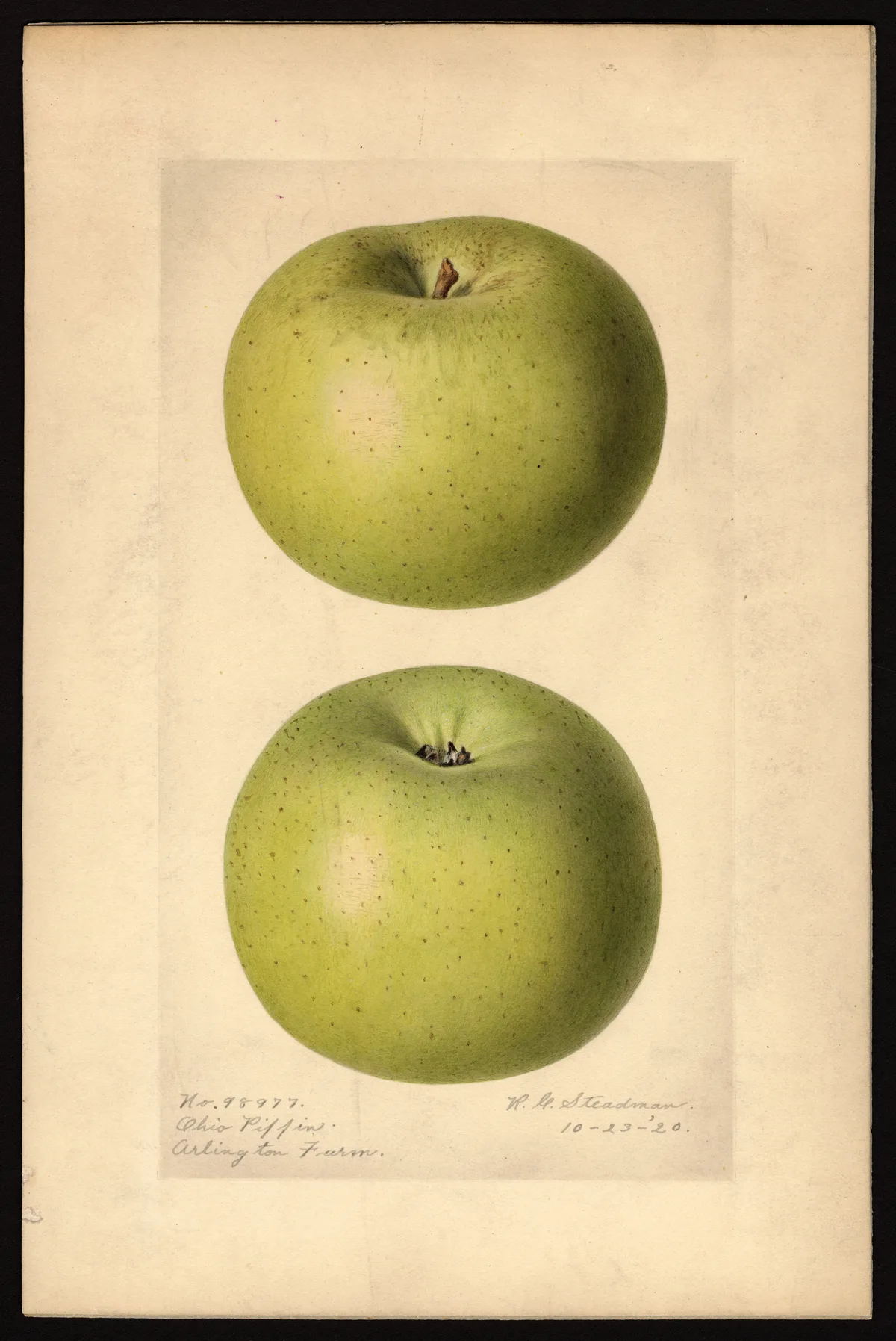
USDA Pomological Watercolor Collection
Ohio Pippin
Origin / History
Supposed to have originated in Dayton, Ohio. The variety was introduced to wider distribution through the efforts of the late A. H. Ernst, long President of the Ohio Pomological Society, who furnished trees to Robert Buchanan, an enthusiastic pomologist of Cincinnati. Both gentlemen were too modest to permit their names to be attached to a fruit they did not originate, though both aided its spread. Another focus of distribution was the orchard and nursery of R. W. Todd at Madison, Indiana; the grafts set by Todd are the oldest trees known, having been obtained personally by him from Dayton many years before Warder's 1867 account. The variety has also been received under the name Shannon from Dr. J. A. Dibrell of Van Buren, Arkansas. It has been disseminated pretty widely in the Middle West but is scarcely known among New York fruit growers (Beach, 1905).
Tree
Tree healthy, attains good size. Vigor rather vigorous to vigorous (Warder describes it as large and vigorous; Beach as rather vigorous). Form open, somewhat roundish or spreading and inclined to droop. Comes into bearing rather young and is a reliable cropper, being almost an annual bearer and often yielding full crops.
Twigs short, straight, stout; internodes short. Bark dark dull brown, lightly streaked with scarf-skin, slightly pubescent near tips. Lenticels scattering, medium to below average size, oblong, not raised. Buds very deeply set in the bark, medium size, flat, obtuse, appressed, slightly pubescent. Leaves large (Warder).
Fruit
Size: Warder (1867) describes the fruit as large, often very large. Beach (1905) describes it as above medium to medium. These assessments conflict and likely reflect regional or strain variation.
Form: Oblate conic to roundish oblate, rather irregular in shape, being often somewhat elliptical or obscurely ribbed; somewhat conic (Warder).
Stem: Short; Warder describes it as stout, Beach as slender. Usually not exserted.
Cavity: Rather large, acute or slightly acuminate, varying sometimes to rather obtuse, deep, broad, often furrowed, sometimes lipped, sometimes russeted and with outspreading russet rays. Warder describes it as wide, wavy or regular, brown.
Calyx: Medium to large, open; lobes reflexed, rather broad, obtuse, separated at the base. Warder gives the eye as large or very large, open, with segments short.
Basin: Variable: Beach describes it as ranging from small and shallow to rather broad, deep, and abrupt, sometimes compressed, wrinkled. Warder describes it as wide, deep, folded. These accounts partially conflict; both note irregularity.
Skin: Smooth, somewhat glossy. Color attractive bright yellow (Beach) to greenish-yellow (Warder), often with a faint orange or pinkish blush; Warder specifies the blush as sometimes present near the base. Dots whitish, submerged, sometimes russet or areolar with a russet point (Beach); Warder describes them as small and gray.
Internal structure (Beach): Calyx tube short, rather wide above, cone-shape or approaching truncate funnel-form. Stamens basal or nearly so.
Flesh: Whitish or tinged with yellow (Beach); Warder describes it as yellowish. Firm, fine, tender, crisp, moderately juicy (Beach); Warder describes the texture as breaking and tender. The two accounts conflict slightly on texture — breaking (Warder, 1867) versus firm and crisp (Beach, 1905).
Flavor: Mild subacid, becoming mildly sweet (Beach). Warder gives acid to subacid. Quality good.
Core / Seeds: Core small (Beach) to medium or large (Warder) — these accounts conflict directly. Usually axile; cells symmetrical, closed or partly open; core lines clasping (Beach). Warder describes the core as regular, closed, and meeting the eye. Carpels broadly roundish, approaching elliptical, but slightly emarginate if at all, mucronate, slightly tufted (Beach). Seeds numerous, light colored, rather small, very plump, obtuse (Beach); Warder describes them as medium, plump, sometimes imperfect.
Season
Late September or October through January (Beach); Warder gives December and January. October appears to be the commercial limit in Beach's latitude (New York). The two sources conflict on the early bound of the season: Beach indicates the fruit may be available as early as late September or October, while Warder places it as a December–January fruit. Both agree it is a late-keeping variety.
Uses
Market and kitchen; Warder notes it is too large for dessert use. Beach describes it as quite attractive for a yellow apple, mild in flavor, and of good quality, indicating commercial and culinary suitability.
Subtypes / Variants
Not described in source.
Other
Encyclopedia of Practical Horticulture (Lowther, ed., 1914) — entry is a coded table row; no prose description provided:
Ohio Pippin (15).............. L | rob | yr | VG | b | W | 4* | 14* | ....
Description absent; variety present in variety-characteristic table.
Book Sources
Described in 3 period pomological works
View original book sources (3)
— John A. Warder, American Pomology: Apples (1867)Ohio Pippin.
ERNST'S APPLE.—BUCHANAN, ETC.—SHANNON!
We owe our acquaintance with this fine large fruit to the late Mr. A. H. Ernst, long President of the Ohio Pomological Society, who furnished trees to Mr. Robert Buchanan, an enthusiastic Pomologist of Cincinnati. Both these gentlemen were too modest to permit their names to be attached to a fruit which they did not originate, but which they have aided to distribute. Another focus of distribution was the orchard and nursery of R. W. Todd, at Madison, Indiana, and the fruit has been received under the name of Shannon, from Doctor J. A. Dibrell, of Van Buren, Arkansas. Origin Dayton, Ohio, from whence it was procured personally by Mr. Todd, many years ago, and the grafts set by him are the oldest trees known.
Tree healthy, vigorous, large, spreading; Shoots stout, dark; Leaves large.
Fruit large, often very large, oblate, somewhat conic, irregular; Surface smooth, greenish-yellow, sometimes blushed faintly near the base; Dots small gray.
Basin wide, deep, folded; Eye large or very large, open; Segments short.
Cavity wide, wavy or regular, brown; Stem short, stout.
Core medium to large, regular, closed, meeting the eye; Seeds numerous, medium, plump, sometimes imperfect; Flesh yellowish, breaking, tender, juicy; Flavor acid to sub-acid; Quality good; Market and kitchen, too large for dessert; Season, December, January.
— S.A. Beach, The Apples of New York, Vol. 2 (1905)OHIO PIPPIN.
REFERENCES. 1. Warder, 1867:484. fig. 2. Downing, 1869:292. 3. Am. Pom. Soc. Cat., 1881:12. 4. Thomas, 1885:223. 5. Taylor, Am. Pom. Soc. Rpt., 1895:193. 6. Budd-Hansen, 1903:141. 7. Beach and Clark, N. Y. Sta. Bul. 248:135. 1904.
SYNONYMS. Buchanan (1). Ernst's Apple (1). ERNST'S PIPPIN (4). Ernst's Pippin (2). OHIO PIPPIN (1, 2, 3, 5, 6, 7). Ohio Pippin (4). Shannon (1, 2, 3, 6).
Fruit of good medium size, quite attractive for a yellow apple, mild in flavor and of good quality. Season late September or October to January; October appears to be its commercial limit in this latitude (7). The tree attains good size, is rather vigorous and healthy, comes into bearing rather young and is a reliable cropper, being almost an annual bearer and often yielding full crops.
Historical. This variety is supposed to have originated in Dayton, Ohio (1, 2). It has been disseminated pretty widely in the Middle West but it is scarcely known among New York fruit growers.
TREE.
Tree rather vigorous. Form open, somewhat roundish or spreading and inclined to droop. Twigs short, straight, stout; internodes short. Bark dark dull brown, lightly streaked with scarf-skin, slightly pubescent near tips. Lenticels scattering, medium to below, oblong, not raised. Buds very deeply set in the bark, medium size, flat, obtuse, appressed, slightly pubescent.
FRUIT.
Fruit above medium to medium. Form oblate conic to roundish oblate, rather irregular in shape being often somewhat elliptical or obscurely ribbed. Stem short, slender, usually not exserted. Cavity rather large, acute or slightly acuminate, varying sometimes to rather obtuse, deep, broad, often furrowed, sometimes lipped, sometimes russeted and with outspreading russet rays. Calyx medium to large, open; lobes reflexed, rather broad, obtuse, separated at the base. Basin small and shallow to rather broad, deep and abrupt, sometimes compressed, wrinkled.
Skin smooth, somewhat glossy, attractive bright yellow often with a faint orange or pinkish blush. Dots whitish, submerged, sometimes russet or areolar with russet point. Calyx tube short, rather wide above, cone-shape or approaching truncate funnel-form. Stamens basal or nearly so. Core small, usually axile; cells symmetrical, closed or partly open; core lines clasping. Carpels broadly roundish, approaching elliptical, but slightly emarginate if at all, mucronate, slightly tufted. Seeds numerous, light colored, rather small, very plump, obtuse. Flesh whitish or tinged with yellow, firm, fine, tender, crisp, moderately juicy, mild subacid becoming mildly sweet, good.
— Granville Lowther (ed.), Encyclopedia of Practical Horticulture (1914)Ohio Pippin (15).............. L | rob | yr | VG | b | W | 4* | 14* | ....