Okabena
Apple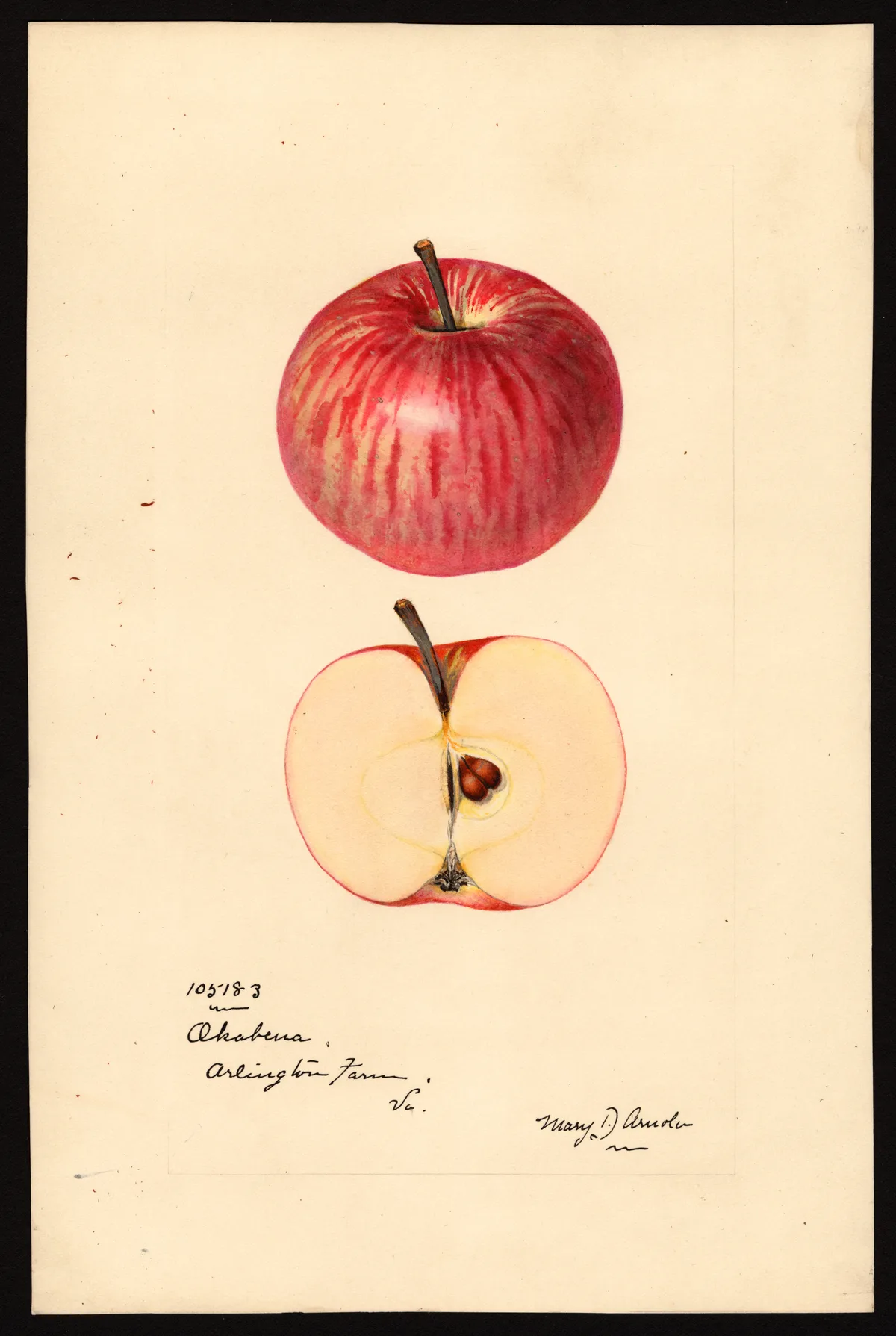
USDA Pomological Watercolor Collection
Okabena
Origin / History
Okabena originated in 1871 on the banks of Lake Okabena, near Worthington, in southwestern Minnesota. It was raised from seed furnished by Peter M. Gideon in 1871. Sources differ on the seed parent: Beach (1905) and Hedrick (1922) report it as a seedling of Oldenburg said to have been fertilized by Wealthy; Budd & Hansen (1914) likewise give it as a seedling of Oldenburg fertilized by Wealthy; Hansen (1902) gives it as a seedling of Duchess fertilized by Wealthy. The variety was introduced by the Jewell Nursery Company (Beach gives the name as "Jewel Nursery Company") and was received for testing at the New York (Geneva) Station in 1892. In 1899 it was placed on the list of the American Pomological Society as a variety of value in the Upper Mississippi valley. So far as Beach could learn, it had been grown in the East only in an experimental way. Beach considered it not particularly attractive in appearance, nor more than moderately good in quality, and not recommended for planting in New York. Hedrick judged that its fruits were not attractive enough in appearance, nor good enough in quality for the great apple regions of the country, but that the hardiness of the tree makes it a desirable variety for the northern part of the Great Plains.
Tree
Of the Russian type, rather small, compact, very hardy (Hedrick); hardy at the South Dakota Station (Hansen). An annual and abundant bearer (Hansen); bearing almost annually, productive (Hedrick).
Fruit
Size
Sources disagree: Hansen (1902) and Budd & Hansen (1914) describe the fruit as large; Hedrick (1922) describes it as of medium size, not uniform in size.
Form
Regular, oblate (Hansen; Budd & Hansen); round-oblate or sometimes slightly conical, symmetrical (Hedrick).
Stem
Variable (Hansen; Budd & Hansen); long, slender (Hedrick).
Cavity
Regular, deep, sometimes russeted (Hansen; Budd & Hansen); acuminate, deep, broad, russeted, symmetrical (Hedrick).
Calyx
Closed (Hansen; Budd & Hansen); closed, medium to large (Hedrick).
Basin
A marked characteristic — wide, rather shallow, regular, sometimes abrupt (Hansen; Budd & Hansen); shallow, wide, obtuse, almost smooth, symmetrical (Hedrick).
Skin / Surface
Surface yellow (Hansen) or greenish yellow (Budd & Hansen), striped and splashed with red, sometimes covering the entire surface, on the sunny side mixed and marbled with dark crimson stripes and splashes; Hansen called it a handsome fruit. Hedrick describes the skin as rather thick, tender, light greenish-yellow overlaid with scattering stripes of light red.
Dots
Minute, scattered, white, obscure (Hansen; Budd & Hansen); numerous, pale, submerged (Hedrick).
Flesh / Flavor
White, fine-grained, sometimes stained, juicy, subacid, very good (Hansen; Budd & Hansen — Hansen adds the explicit qualifier "very good" to the rating). Hedrick describes the flesh as tinged with yellow, sometimes with a trace of red, firm, tender, juicy, subacid; he rates the quality as rather poor, suitable only for culinary purposes.
Core / Seeds
Core small, closed, clasping (Hansen); core closed, clasping (Budd & Hansen); core closed, with clasping core-lines, axile (Hedrick). Tube long, broad, funnel-shaped (Hansen); tube funnel-shaped (Budd & Hansen); calyx-tube narrow, funnel-shaped (Hedrick). Stamens marginal (all three). Carpels round, emarginate (Hedrick).
Season
December (Hansen; Budd & Hansen). August and September (Hedrick). Beach classes it as an autumn apple.
Uses
According to Hedrick, the quality is rather poor and suitable only for culinary purposes.
Subtypes / Variants
Not described in source.
Other
Not described in source.
Book Sources
Described in 4 period pomological works
Nursery Catalog Sources
Found in 5 catalogs (1900–1921) from Illinois, Oregon
- Central Experimental Farm , Dominion Department of Agriculture, Agassiz, British Columbia (under test; Bulletin No. 3, Second Series) — 1900
- Benjamin Buckman (personal inventory) , Farmingdale , Illinois — 1901
- Pacific Nursery Company , Portland , Oregon — 1912
- Union Nurseries , J.B. Weaver & Sons, Union , Oregon — 1915
- Benedict Nursery Co. , Portland , Oregon — 1921
View original book sources (4)
— S.A. Beach, The Apples of New York, Vol. 2 (1905)OKABENA.
REFERENCES. 1. Am. Pom. Soc. Rpt., 1887:132. 2. Ib., Cat., 1899:19. 3. Macoun, Can. Dept. Agr. Rpt., 1901:97. 4. Hansen, S. D. Sta. Bul., 76:78. 1902. fig. 5. Dickens and Greene, Kan. Sta. Bul., 106:54. 1902. 6. Munson, Me. Sta. An. Rpt., 18:84. 1902. 7. Budd-Hansen, 1903:141. fig.
SYNONYMS. OKABENA (1, 2, 3, 4, 5, 7). OKOBENA (6).
An autumn apple not particularly attractive in appearance, nor more than moderately good in quality. Not recommended for planting in New York.
Historical. Originated in 1871 near Worthington, Minn., from seed of Oldenburg said to be fertilized by Wealthy (7). Received for testing at this Station in 1892, from the Jewel Nursery Company which introduced this variety. In 1899 it was given a place on the list of the American Pomological Society as a variety of value in the Upper Mississippi valley (2). So far as we can learn it has been grown in the East only in an experimental way.
— N.E. Hansen, A Study of Northwestern Apples (1902)Okabena—Originated on the banks of Lake Okabena, near Worthington, Minnesota. A seedling of Duchess fertilized by the Wealthy from seed furnished by Peter M. Gideon in 1871. Tree an annual and abundant bearer, hardy at this Station—Fruit large, regular, oblate; surface yellow, striped and splashed with red, sometimes covering the entire surface, on sunny side mixed and marbled with dark crimson stripes and splashes, a handsome fruit; dots minute, scattered, white, obscure; cavity regular, deep, sometimes russeted; stem variable; basin a marked characteristic, wide, rather shallow, regular, sometimes abrupt; calyx closed. Core small, closed, clasping; tube long, broad, funnel-shaped; stamens marginal; flesh white, fine grained, sometimes stained, juicy, subacid, very good. December.
— J.L. Budd & N.E. Hansen, American Horticultural Manual, Part II: Systematic Pomology (1914)Okabena.—Originated on the banks of Lake Okabena, near Worthington, southwestern Minnesota. A seedling of Oldenburg, fertilized by Wealthy from seed furnished by Peter M. Gideon in 1871. Fruit large, regular, oblate; surface greenish yellow, striped and splashed with red, sometimes covering the entire surface, on sunny side mixed and marbled with dark crimson stripes and splashes; dots minute, scattered, white, obscure; cavity regular, deep, sometimes russeted; stem variable; basin a marked characteristic, wide, rather shallow, regular, sometimes abrupt; calyx closed. Core closed, clasping; tube funnel-shaped; stamens marginal; flesh white, sometimes stained, fine-grained, juicy, subacid, very good. December.
— U.P. Hedrick, Cyclopedia of Hardy Fruits (1922)OKABENA.
The fruits of Okabena are not attractive enough in appearance, nor good enough in quality for the great apple regions of the country, but the hardiness of the tree makes it a desirable variety for the northern part of the Great Plains. Okabena originated in 1871 near Worthington, Minnesota, from a seed of Oldenburg supposed to have been fertilized by Wealthy. The variety was introduced by the Jewell Nursery Company in 1892.
Tree of the Russian type, rather small, compact, very hardy, bearing almost annually, productive. Fruit of medium size, not uniform in size, round-oblate or sometimes slightly conical, symmetrical; stem long, slender; cavity acuminate, deep, broad, russeted, symmetrical; calyx closed, medium to large; basin shallow, wide, obtuse, almost smooth, symmetrical; skin rather thick, tender, light greenish-yellow overlaid with scattering stripes of light red; dots numerous, pale, submerged; core closed, with clasping core-lines, axile; calyx-tube narrow, funnel-shaped; stamens marginal; carpels round, emarginate; flesh tinged with yellow, sometimes with a trace of red, firm, tender, juicy, subacid; quality rather poor, suitable only for culinary purposes; season August and September.