Olive
Apple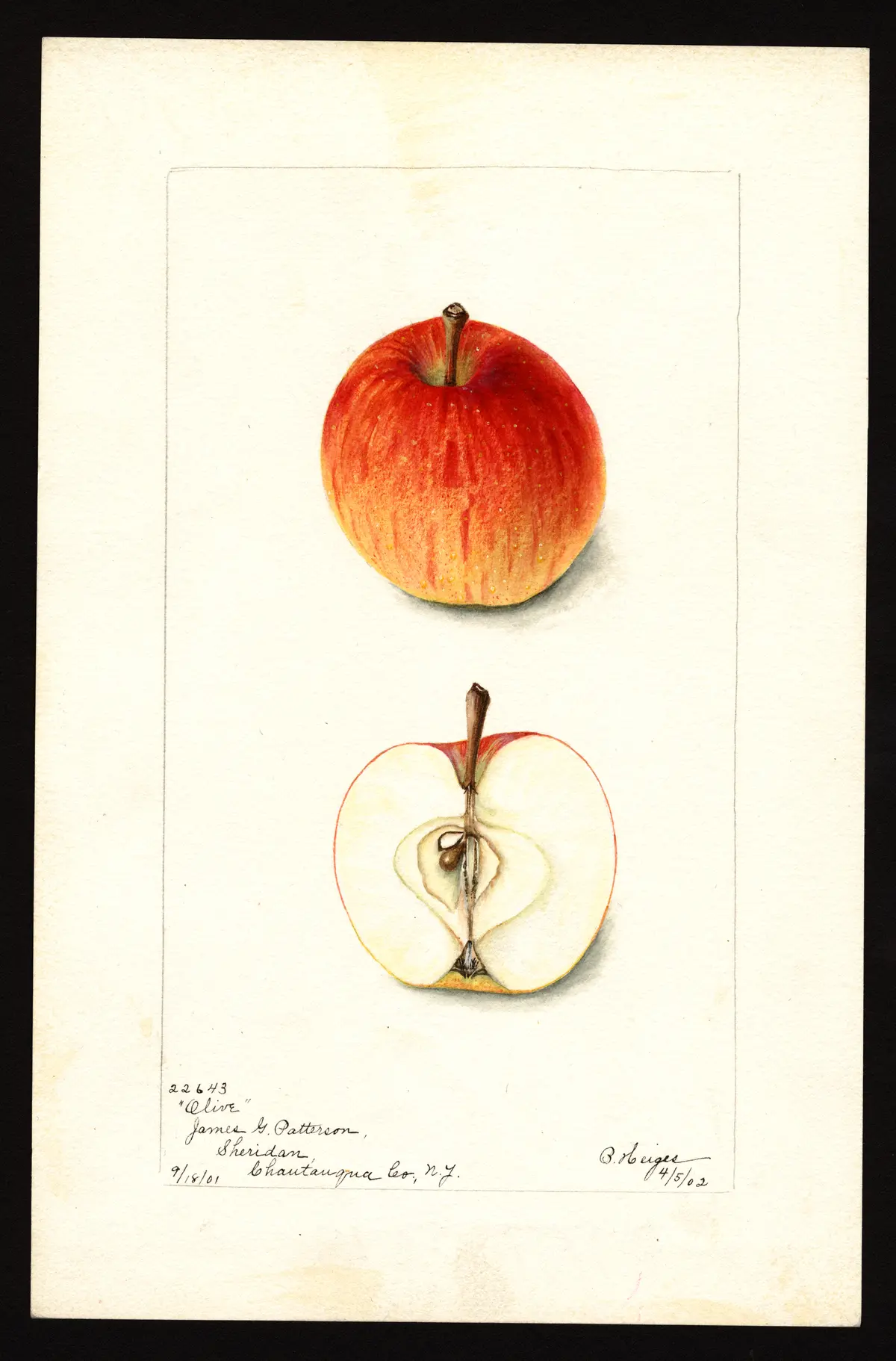
USDA Pomological Watercolor Collection
Olive
[NOTE: Source text may be incorrect — Beach states that this Olive of Wake County, North Carolina "is not the Olive of Coxe, neither is it the Olive from Vermont" noticed by Downing. Those two apples, and Downing's separate entry Oline, are given under Other and are not part of this description.]
Origin / History
Originated in Wake County, North Carolina (Downing; Beach repeats it). Beach calls it "a small red apple, rather attractive in color" and "unworthy of consideration by New York fruit growers." In North Carolina it is a fall apple. Beach distinguishes it from the Olive of Coxe (1817) and from the Olive from Vermont noticed by Downing and described in 1860 in Gardeners Monthly.
Tree
Tree vigorous, an upright grower (Downing); moderately vigorous (Beach). Form roundish or upright spreading, rather dense. Twigs short to above medium, slender, straight but geniculate; internodes long to medium. Bark clear brown with reddish tinge, lightly streaked with scarf-skin, slightly pubescent near tips. Lenticels rather conspicuous, quite numerous, small to above medium, oval or elongated, usually not raised. Buds deeply set in bark, small, plump, obtuse, appressed, not pubescent. Comes into bearing young and is productive, a reliable annual cropper (Beach). Fruit hangs well to the tree (Beach).
Fruit
Size: Small to nearly medium, fairly uniform in size and shape (Beach); medium (Downing).
Form: Roundish inclined to conic, varying to obovate, obscurely ribbed, fairly symmetrical; Downing: slightly conical.
Stem: Short to above medium (Beach); Downing alone gives the stalk as long, stout.
Cavity: Rather small, acute to acuminate, moderately deep, rather narrow, usually russeted, often somewhat furrowed, often lipped.
Calyx: Medium or above, usually open, lobes often leafy (Beach); open (Downing). Calyx tube short, conical or urn-shape with fleshy pistil point projecting into the base, or approaching funnel-form. Stamens median to basal.
Basin: Abrupt, moderately shallow, moderately narrow to rather wide, often somewhat furrowed and wrinkled.
Skin: Thick, tough, entirely covered with bright, deep, dark red, or mottled with red and striped with carmine, over a deep yellow ground color; sometimes marked with broken stripes of grayish scarf-skin. Downing: crimson.
Dots: Numerous, pale, often large, areolar and conspicuous (Beach); gray (Downing).
Flesh and flavor: Flesh deeply tinged with yellow, moderately coarse, rather crisp, somewhat tough, juicy; rich, mild subacid or nearly sweet, distinctly aromatic. Quality "fair to good" (Beach). Downing: crisp, juicy, subacid.
Core and seeds: Core medium, somewhat abaxile; cells usually symmetrical and open; core lines meeting or slightly clasping. Carpels broadly roundish, slightly emarginate if at all, mucronate. Seeds brownish-black, small, rather short, wide, plump, obtuse.
Season
October and November in North Carolina (Downing). As grown at the New York Station the season extends to midwinter, and often a considerable portion of the fruit remains sound till April or later (Beach).
Uses
Not described in source.
Subtypes / Variants
Not described in source.
Other
Separate apples of the same name, which Beach says are not this fruit. Coxe's Olive: an admired English table apple; skin yellowish green, rough, with dark clouds and a russet cast; eye large; stem short; flesh rich and yellow, with a sprightly taste; ripens in October; Coxe adds that it "does not appear to bear a comparison with many of our table apples of that season, in beauty or flavour." Downing's Vermont Olive Apple (Gardeners Monthly): medium, oblate, inclining to conic, yellowish, shaded, splashed, and striped with shades of red, few areole dots; stalk short; calyx closed; flesh white, tender, juicy, mild subacid; November to January.
Downing also has a separate entry, Oline: tree vigorous, productive; fruit very large, roundish, yellow, washed with red; flesh tender, fine, subacid; "Very good"; November, December (Soc. V. M.).
Book Sources
Described in 3 period pomological works
USDA Nomenclature (1905)
From W.H. Ragan, Nomenclature of the Apple, USDA Bulletin No. 56
From report of Society of Van Mons.
From Gardener's Monthly.
Nursery Catalog Sources
Found in 3 catalogs (1900–1913) from Illinois
- Central Experimental Farm , Dominion Department of Agriculture, Agassiz, British Columbia (under test; Bulletin No. 3, Second Series) — 1900
- Benjamin Buckman (personal inventory) , Farmingdale , Illinois — 1901
- Benjamin Buckman (personal inventory) , Farmingdale , Illinois — 1913
View original book sources (3)
— William Coxe, A View of the Cultivation of Fruit Trees (1817)NO. 116. OLIVE.
An admired English table apple; a yellowish green, rough skin, with dark clouds, and a russet cast—the eye large; the stem short; the flesh rich and yellow; with a sprightly taste: ripens in October. It does not appear to bear a comparison with many of our table apples of that season, in beauty or flavour.
— A.J. Downing, The Fruits and Fruit Trees of America (1900)Olive.
Origin, Wake Co., N. C. Tree vigorous, upright grower.
Fruit medium, slightly conical, crimson, with gray dots. Calyx open. Stalk long, stout. Flesh crisp, juicy, subacid. October, November.
There is another Olive Apple, from Vermont, which is medium, oblate, inclining to conic, yellowish, shaded, splashed, and striped with shades of red, few areole dots. Stalk short. Calyx closed. Flesh white, tender, juicy, mild subacid. November to January. (Gar. Mon.)
[Additional entry in this volume: "Oline", pp. 319–319]
Oline.
Tree vigorous, productive.
Fruit very large, roundish, yellow, washed with red. Flesh tender, fine, subacid. Very good. November, December. (Soc. V. M.)
— S.A. Beach, The Apples of New York, Vol. 1 (1905)OLIVE.
REFERENCES. 1. Downing, 1869:294. 2. Beach and Clark, N. Y. Sta. Bul., 248:136. 1904. 3. Ragan, U. S. B. P. I. Bul., 56:219. 1905.
A small red apple, rather attractive in color. Unworthy of consideration by New York fruit growers. The tree comes into bearing young and is productive being a reliable annual cropper. The fruit hangs well to the tree. This is not the Olive of Coxe,¹ neither is it the Olive from Vermont noticed by Downing (1) and described in 1860 in Gardeners Monthly (3).
Historical. Originated in Wake county, North Carolina (1). It is there a fall apple but as grown at this Station its season extends to midwinter and often a considerable portion of the fruit remains sound till April or later.
TREE.
Tree moderately vigorous. Form roundish, or upright spreading, rather dense. Twigs short to above medium, slender, straight but geniculate; internodes long to medium. Bark clear brown with reddish tinge, lightly streaked with scarf-skin, slightly pubescent near tips. Lenticels rather conspicuous, quite numerous, small to above medium, oval or elongated, usually not raised. Buds deeply set in bark, small, plump, obtuse, appressed, not pubescent.
FRUIT.
Fruit small to nearly medium, fairly uniform in size and shape. Form roundish inclined to conic, varying to obovate, obscurely ribbed, fairly symmetrical. Stem short to above medium. Cavity rather small, acute to acuminate, moderately deep, rather narrow, usually russeted, often somewhat furrowed, often lipped. Calyx medium or above, usually open; lobes often leafy. Basin abrupt, moderately shallow, moderately narrow to rather wide, often somewhat furrowed and wrinkled.
Skin thick, tough, entirely covered with bright, deep, dark red or mottled with red and striped with carmine over a deep yellow ground color, sometimes marked with broken stripes of grayish scarf-skin. Dots numerous, pale, often large, areolar and conspicuous.
Calyx tube short, conical or urn-shape with fleshy pistil point projecting into the base, or approaching funnel-form. Stamens median to basal.
Core medium, somewhat abaxile; cells usually symmetrical and open; core lines meeting or slightly clasping. Carpels broadly roundish, slightly emarginate if at all, mucronate. Seeds brownish-black, small, rather short, wide, plump, obtuse.
Flesh deeply tinged with yellow, moderately coarse, rather crisp, somewhat tough, juicy, rich, mild subacid or nearly sweet, distinctly aromatic, fair to good in quality.
¹Coxe, 1817:166.