Oliver
Apple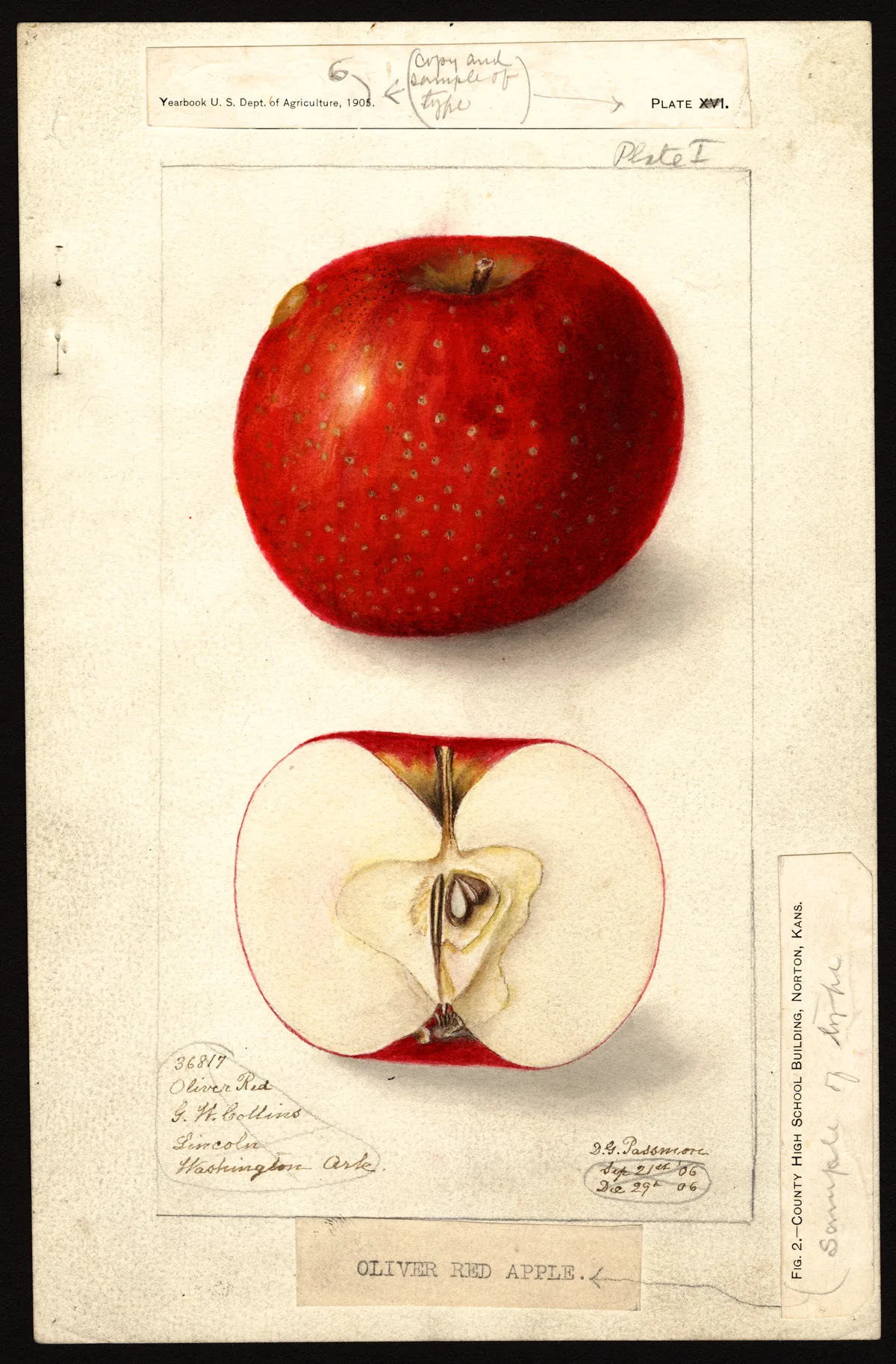
USDA Pomological Watercolor Collection
Oliver
Origin / History
Oliver is supposed to have originated in northwestern Arkansas. It has been propagated there since about 1873, where it has been known as Oliver Red or Oliver. It was first described in 1893 (Hedrick); the earliest reference Beach cites is the Arkansas Horticultural Society Report of that year. It was disseminated from the Stark Nurseries, Louisiana, Mo., under the name Senator.
Budd and Hansen call it a handsome apple "now much grown in its native state, Arkansas." Beach finds it, among the varieties introduced from Arkansas and Missouri, one of the most promising for the New York fruit grower, though not yet sufficiently tested to determine its value in that region. He doubts whether it can always be properly ripened in the northern portion of the Baldwin apple belt, but finds it more promising in the southern portion.
Hedrick writes that Oliver "has not generally received the attention which both fruit and tree-characters justify." He reports its cultivation confined to northwestern Arkansas and neighboring states "where long seasons insure full development."
Tree
Tree medium in size, very vigorous, healthy. Beach calls it evidently hardy in Western New York, and Hedrick calls it hardy. Branches long, rather stocky. Form roundish or somewhat spreading; top open. Twigs stocky, medium in length and thickness; internodes medium in length. Bark dull brown and olive-green, pubescent. Lenticels numerous, large, mostly long, conspicuous, raised. Buds large, appressed, broad, obtuse, pubescent. Leaves medium or often large, long and rather broad, thick, dark green; foliage rather dense.
Comes into bearing young. Productive, bearing abundantly. Beach says it gives promise of being an annual or nearly annual bearer; Hedrick says it bears almost annually. The fruit hangs well to the tree, with little loss from drops or culls.
Fruit
Size: Large or above medium, of good size, pretty uniform. Thomas calls it medium, and Hedrick in his introductory remarks writes that the apples, "while not large, are uniform in size."
Form: Roundish or somewhat oblate, pretty symmetrical, regular or somewhat elliptical or obscurely angular; sides sometimes unequal. Of desirable shape, shapely, pretty uniform in shape (Beach). Budd and Hansen give it as roundish oblate, with the form variable, from nearly flat to roundish slightly flattened.
Stem: Short to moderately long, medium in thickness to stout.
Cavity: Medium to rather large, deep, moderately broad to rather narrow, regular. Smooth and green or partly covered with greenish russet, sometimes with outspreading russet rays. Beach describes it as acute to decidedly acuminate; Budd and Hansen call it obtuse.
Calyx: Medium to rather large, usually somewhat open (Beach); open (Budd and Hansen). Lobes often separated at the base, short, broad, obtuse, erect or somewhat reflexed; Budd and Hansen describe the segments as erect convergent. Calyx tube conical, obtusely cone-shaped, rarely somewhat funnel-form (Beach). Stamens below median to basal.
Basin: Large, wide, usually saucer-shape and abrupt, somewhat wrinkled. Beach notes it is sometimes moderately shallow and rather obtuse; Budd and Hansen call it deep and obscurely ribbed.
Skin: Moderately thin, tough, somewhat waxy, smooth or slightly roughened with large russet dots. Ground green, greenish yellow, bright yellow, or deep rich yellow. Mottled and striped with red, or nearly to wholly covered with bright deep red or bright rich red, and splashed with purplish carmine. Budd and Hansen describe the coloring as obscurely splashed on the sunny side, and marbled, mixed, and dotted on the shaded side. An attractive, handsome dark red apple, handsome in color, smooth of skin.
Dots: Conspicuous, very distinct, numerous, rather large to large, gray or russet. Often somewhat elongated or irregular about the cavity (Beach).
Flesh and flavor: Flesh whitish with a tinge of yellow or green, yellowish white, or yellowish. Stained with pink (Thomas) or sometimes tinged with red (Budd and Hansen). Moderately fine to fine-grained, crisp, rather tender, breaking, juicy. Flavor somewhat sprightly to sprightly subacid, eventually approaching sweet. Budd and Hansen call it "mild, pleasant, rich," and Hedrick "pleasantly acidulous."
Quality good to very good: "good quality" and "good or possibly very good" (Beach), "very good" (Budd and Hansen), "good" (Hedrick).
Core and seeds: Core rather small to small, distant (Beach), axile or nearly so; Budd and Hansen call it half open. Cells closed or slit, ovate (Budd and Hansen). Core lines meeting, or clasping the funnel cylinder when the calyx tube is funnel-form. Carpels roundish or somewhat elongated, narrowing toward base and apex, emarginate, mucronate, smooth or nearly so.
Seeds irregular, dark brown, plump, moderately long to long, wide. Beach describes them as large, numerous, completely filling the cells, and obtuse or sometimes acute; Budd and Hansen call them few and pointed.
Season
The recorded season runs from November into April. Beach gives December to March or April, with a commercial season in ordinary storage of December to midwinter, extending in cold storage to March or April. Budd and Hansen, calling it a late fall apple, give November and December in Arkansas.
Beach finds that it coincides pretty closely with Baldwin in season but may not keep quite so late. Hedrick holds that its season coincides with Baldwin's, "being, if anything, a little longer."
Uses
Not described in source.
Subtypes / Variants
Not described in source.
Other
Not described in source.
Book Sources
Described in 4 period pomological works
Nursery Catalog Sources
Found in 13 catalogs (1896–1932) from Illinois, Missouri, Washington
- Stark Bros. Nurseries & Orchards Co. , Louisiana , Missouri — 1896 — listed as Senator
- Stark Bros. Nurseries & Orchards Co. , Louisiana , Missouri — 1898 — listed as Senator
- Central Experimental Farm , Dominion Department of Agriculture, Agassiz, British Columbia (under test; Bulletin No. 3, Second Series) — 1900 — listed as Oliver Red
- Mountain Grove Nurseries (Tippin & Moore , Proprietors; Geo. T. Tippin, J. W. Tippin, J. C. Moore), Mountain Grove , Missouri — 1901 — listed as Oliver Red
- Benjamin Buckman (personal inventory) , Farmingdale , Illinois — 1901 — listed as Oliver Red
- Stark Bros. Nurseries & Orchards Co. , Louisiana , Missouri — 1906
- Stark Bros. Nurseries & Orchards Co. , Louisiana , Missouri — 1910
- Stark Bros. Nurseries & Orchards Co. , Louisiana , Missouri — 1911
- Vineland Nurseries Company , Clarkston , Washington — 1912 — listed as Oliver Red
- Stark Bros. Nurseries & Orchards Co. , Louisiana , Missouri — 1912
- Benjamin Buckman (personal inventory) , Farmingdale , Illinois — 1913 — listed as Oliver Red
- Stark Bros. Nurseries & Orchards Co. , Louisiana , Missouri — 1918 — listed as Senator
- Stark Bro's Nurseries , Louisiana , Missouri — 1932
View original book sources (4)
— John J. Thomas, The American Fruit Culturist (1903)Oliver. Medium, red on greenish yellow ground, with grayish dots; flesh yellowish white, stained with pink, crisp, sprightly, sub-acid. Arkansas.
— S.A. Beach, The Apples of New York, Vol. 1 (1905)OLIVER.
References. 1. Ark. Hort. Soc. Rpt., 1893. 2. Heiges, U. S. Pom. Rpt., 1895:33. 3. Rural N. Y., 54:843. 1895. fig. 4. Gard. and For., 8:520. 1895. 5. Thomas, 1897:268. 6. Van Deman, Amer. Gard., 19:823. 1898. 7. Stinson, Ark. Sta. Bul., 49:16. 1898. fig. 8. Beach, Amer. Gard., 20:124, 166. 1899. 9. Ib., W. N. Y. Hort. Soc. Rpt., 1899:90, 138. 10. Stinson, Ark. Sta. Bul., 60:130. 1899. 11. Brackett, Amer. Gard., 22:191. 1901. 12. Budd-Hansen, 1903:143. fig. 13. Powell and Fulton, U. S. B. P. I. Bul., 48:51. 1903.
Synonyms. Oliver (2). Oliver's Red (6, 7, 10, 11, 12). Senator (2, 4, 5). Senator (6, 7, 8, 10, 11, 12, 13).
An attractive dark red apple of good size and good quality. It is of desirable shape, smooth and pretty uniform. It appears to coincide pretty closely with Baldwin in season, but it may not keep quite so late. Its commercial season in ordinary storage appears to be December to midwinter; in cold storage it extends to March or April. Among the varieties which have been introduced from Arkansas and Missouri this appears to be one of the most promising for the New York fruit grower, but as yet it has not been sufficiently tested to determine its value in this region. It is doubtful whether it can always be properly ripened in the northern portion of the Baldwin apple belt, but in the southern portion it appears to be more promising. The tree is evidently hardy in Western New York. It is healthy, vigorous, comes into bearing young, is productive and gives promise of being an annual or nearly annual bearer. The fruit hangs well to the tree, and there is little loss from drops or culls.
Historical. This variety has been propagated since about 1873 in Northwestern Arkansas where it has been known as Oliver Red or Oliver. It is supposed to have originated in that region (7, 11). It has been disseminated from the Stark Nurseries, Louisiana, Mo., under the name Senator.
Tree. Tree medium in size, very vigorous; branches long, rather stocky. Form roundish or somewhat spreading; top open. Twigs stocky, medium in length and thickness; internodes medium in length. Bark dull brown and olive-green, pubescent. Lenticels numerous, large, mostly long, conspicuous, raised. Buds large, appressed, broad, obtuse, pubescent. Leaves medium or often large, long and rather broad, thick, dark green; foliage rather dense.
Fruit. Fruit large or above medium, pretty uniform in size and shape. Form roundish or somewhat oblate, pretty symmetrical, regular or somewhat elliptical or obscurely angular; sides sometimes unequal. Stem short to moderately long, medium in thickness. Cavity medium to rather large, acute to decidedly acuminate, deep, moderately broad to rather narrow, regular, smooth and green or partly covered with greenish-russet, sometimes with outspreading russet rays. Calyx medium to rather large, usually somewhat open; lobes often separated at the base, short, broad, obtuse, erect or somewhat reflexed. Basin large, usually saucer-shape, wide and abrupt, sometimes moderately shallow and rather obtuse, somewhat wrinkled.
Skin moderately thin, tough, somewhat waxy, smooth or slightly roughened with large russet dots, green or bright yellow, mottled and striped with red or nearly covered with bright deep red and splashed with purplish-carmine. Dots conspicuous, numerous, gray or russet, rather large, often somewhat elongated or irregular about the cavity.
Calyx tube obtusely cone-shaped, rarely somewhat funnel-form. Stamens below median to basal.
Core distant, rather small, axile or nearly so; cells closed or slit; core lines meeting or when the calyx tube is funnel-form clasping the funnel cylinder. Carpels roundish or somewhat elongated, narrowing toward the base and apex, emarginate, mucronate, smooth or nearly so. Seeds irregular, large, numerous, completely filling the cells, moderately long, wide, obtuse, or sometimes acute, dark brown.
Flesh whitish with tinge of yellow or green, moderately fine and crisp, rather tender, breaking, juicy, somewhat sprightly subacid eventually approaching sweet, good or possibly very good.
Season December to March or April.
— J.L. Budd & N.E. Hansen, American Horticultural Manual, Part II: Systematic Pomology (1914)Oliver (Senator; Oliver Red).—A handsome late fall apple now much grown in its native state, Arkansas.
Fruit large, roundish oblate, form variable, from nearly flat to roundish slightly flattened; surface deep rich yellow wholly covered with bright rich red, coloring obscurely splashed on sunny side, marbled, mixed and dotted on shaded side; dots numerous, large, very distinct, russet; cavity regular, medium, obtuse, lined with green and russet: stem medium, stout; basin wide, deep, obscurely ribbed and wrinkled; calyx open; segments erect convergent. Core half open, small, meeting; cells ovate, slit; calyx-tube conical; stamens basal; seeds few, plump, long, pointed; flesh yellowish, sometimes tinged with red, fine-grained, juicy, mild, pleasant, rich, subacid, very good. November and December in Arkansas.
— U.P. Hedrick, Cyclopedia of Hardy Fruits (1922)OLIVER. Oliver's Red. Senator. Oliver has not generally received the attention which both fruit and tree-characters justify. The apples are handsome in color, smooth of skin, shapely, and while not large are uniform in size. The quality is good, the flavor being pleasantly acidulous, eventually approaching sweet. The trees are hardy, vigorous, come in bearing young, bear abundantly, almost annually, and hold the crop well. The season coincides with that of Baldwin, being, if anything, a little longer. Oliver is supposed to have originated in northwestern Arkansas, and its cultivation is confined to that and neighboring states where long seasons insure full development. It was first described in 1893. Tree medium in size, very vigorous, round-spreading; branches long, stocky. Leaves long and broad, thick, dark green. Fruit large, uniform in size and shape, round or oblate, symmetrical, regular, elliptical or obscurely angular, sides sometimes unequal; stem short to long; cavity medium to large, acute, deep, broad to narrow, regular, smooth, green or partly covered with greenish-russet, sometimes with outspreading russet rays; calyx large, open; lobes separated at the base, short, broad, obtuse, erect or reflexed; basin large, saucer-shape, wide and abrupt, sometimes shallow and obtuse, wrinkled; skin thin, tough, waxy, smooth or roughened with large russet dots, yellow, mottled and striped with red or nearly covered with bright deep red and splashed with carmine; dots conspicuous, numerous, gray or russet, large, often elongated or irregular about the cavity; calyx-tube obtusely cone-shaped; carpels round or elongated narrowing toward the base and apex, emarginate, mucronate, smooth; seeds irregular, large, numerous, completely filling the cells, long, wide, obtuse, dark brown; flesh yellow, fine and crisp, tender, breaking, juicy, sprightly subacid; good or very good; December to April.