Orange Musquee
Pear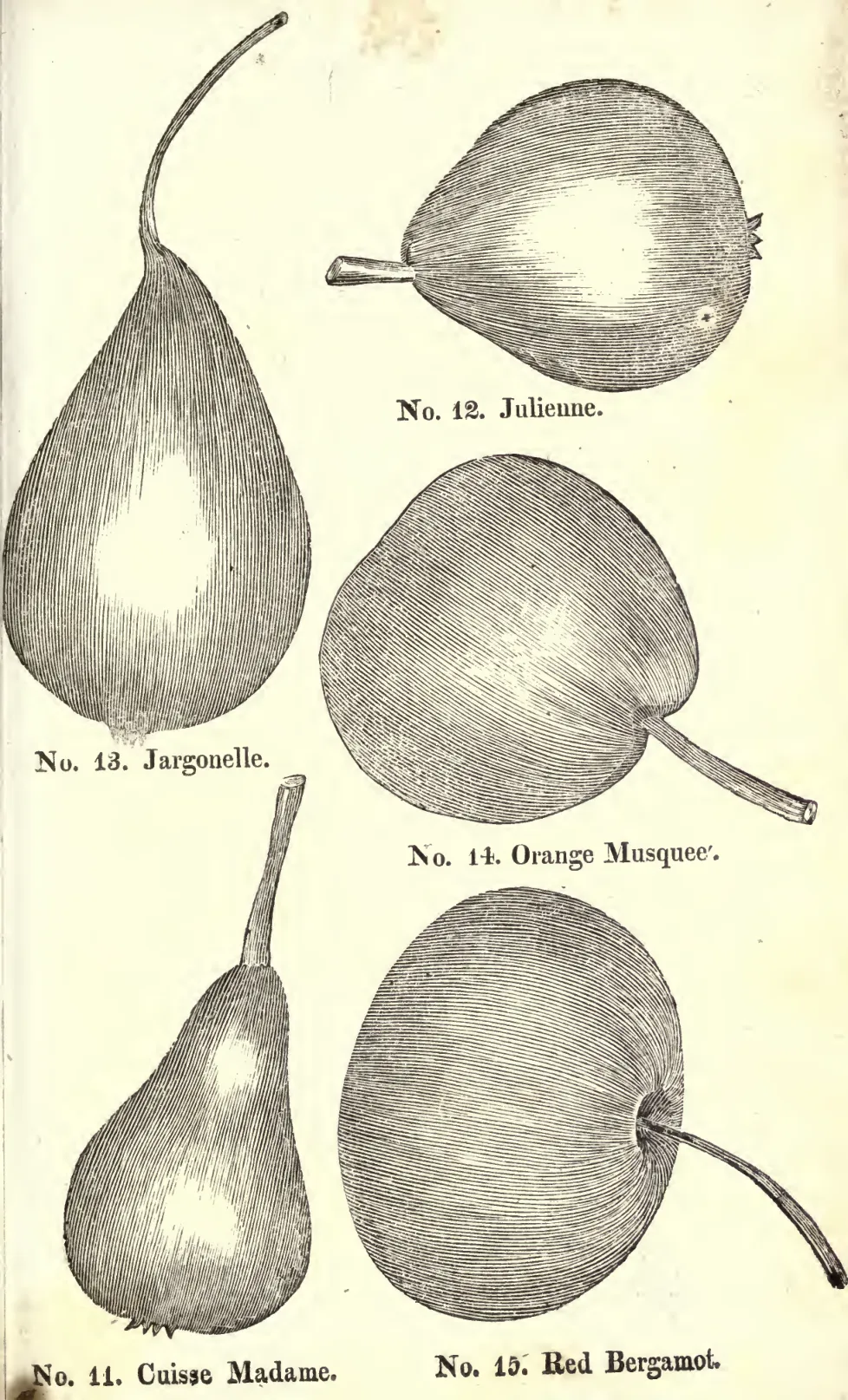
Orange Musquee
Origin / History
Old pear of uncertain origin, though probably French or Italian (Hedrick, 1921). Hedrick cites Duhamel, Traité des arbres fruitiers 2:140, Pl. X (1768), Hogg's Fruit Manual, p. 625 (1884), and Mathieu's Nomenclature Pomologique, p. 255 (1889). Coxe (1817) lists it as No. 14 in A View of the Cultivation of Fruit Trees, under the heading "Orange Musquee, or Musk Orange Pear."
Tree
Not described in source.
Fruit
Size: Medium (Downing, Hedrick); "of a moderate size" (Coxe).
Form: Round (Coxe, Downing); globular, more or less bossed, flattened at both ends though sometimes rather conic and obtuse at the top (Hedrick). Diminishing a little toward the stalk (Coxe).
Stem: Rather large and long (Coxe).
Cavity: Irregular; the stalk is planted in it (Coxe).
Calyx: Not described in source.
Basin: Not described in source.
Skin: Smooth. Ground yellow-green changing to fine lemon, with a lively red next the sun, but rather variable (Hedrick). Yellow, marbled and shaded with red in the sun (Downing). Greenish yellow (Coxe).
Dots: Skin punctured like an orange (Hedrick).
Flesh and flavor: Flesh white, coarse, breaking, gritty at center. Juice musky (Downing); not very abundant, rather saccharine, sweet, possessing a musky flavor and perfume (Hedrick). Coxe alone calls the flesh "juicy and well flavoured," and adds that it is "uncommonly subject to rot." Quality "Good" (Downing); "variable, on the whole, good" (Hedrick).
Core and seeds: Not described in source.
Season
August. Coxe gives August; Downing gives the last of August and Hedrick the end of August.
Uses
Not described in source.
Subtypes / Variants
Not described in source.
Other
Not described in source.
Book Sources
Described in 3 period pomological works
- Coxe, A View of the Cultivation of Fruit Trees (1817) — listed as Orange Musquee, Or Musk Orange Pear
- Downing, Fruits and Fruit Trees of America (1900)
- Hedrick, The Pears of New York (1921)
View original book sources (3)
— William Coxe, A View of the Cultivation of Fruit Trees (1817)
- ORANGE MUSQUEE, OR MUSK ORANGE PEAR.
This pear is of a moderate size, of a round form, diminishing a little towards the stalk, which is rather large and long, and planted in an irregular cavity. The flesh is juicy and well flavoured, but uncommonly subject to rot—the skin is a greenish yellow: it ripens in August.
[Additional entry in this volume: "Orange Musquee", pp. 274–274]
No. 14. Orange Musquee'.
— A.J. Downing, The Fruits and Fruit Trees of America (1900)Orange Musquee.
Orange Musk. Musk Orange. Orange d'Été.
Fruit medium, round, yellow, marbled and shaded with red in the sun. Flesh breaking, with a musky juice. Good. Last of August.
— U.P. Hedrick, The Pears of New York (1921)Orange Musquee.
- Duhamel Trait. Arb. Fr. 2:140, Pl. X. 1768. 2. Hogg Fruit Man. 625. 1884. Muskierte Pomeranzenbirne. 3. Mathieu Nom. Pom. 255. 1889.
This is an old pear of uncertain origin, though probably French or Italian. Fruit medium, globular, more or less bossed, flattened at both ends though sometimes rather conic and obtuse at the top; smooth skin punctured like an orange, yellow-green changing to fine lemon, with a lively red next the sun but rather variable; flesh white, coarse, breaking, gritty at center; juice not very abundant, rather saccharine, sweet, possessing a musky flavor and perfume; quality variable, on the whole, good; end of Aug.