Osceola
Apple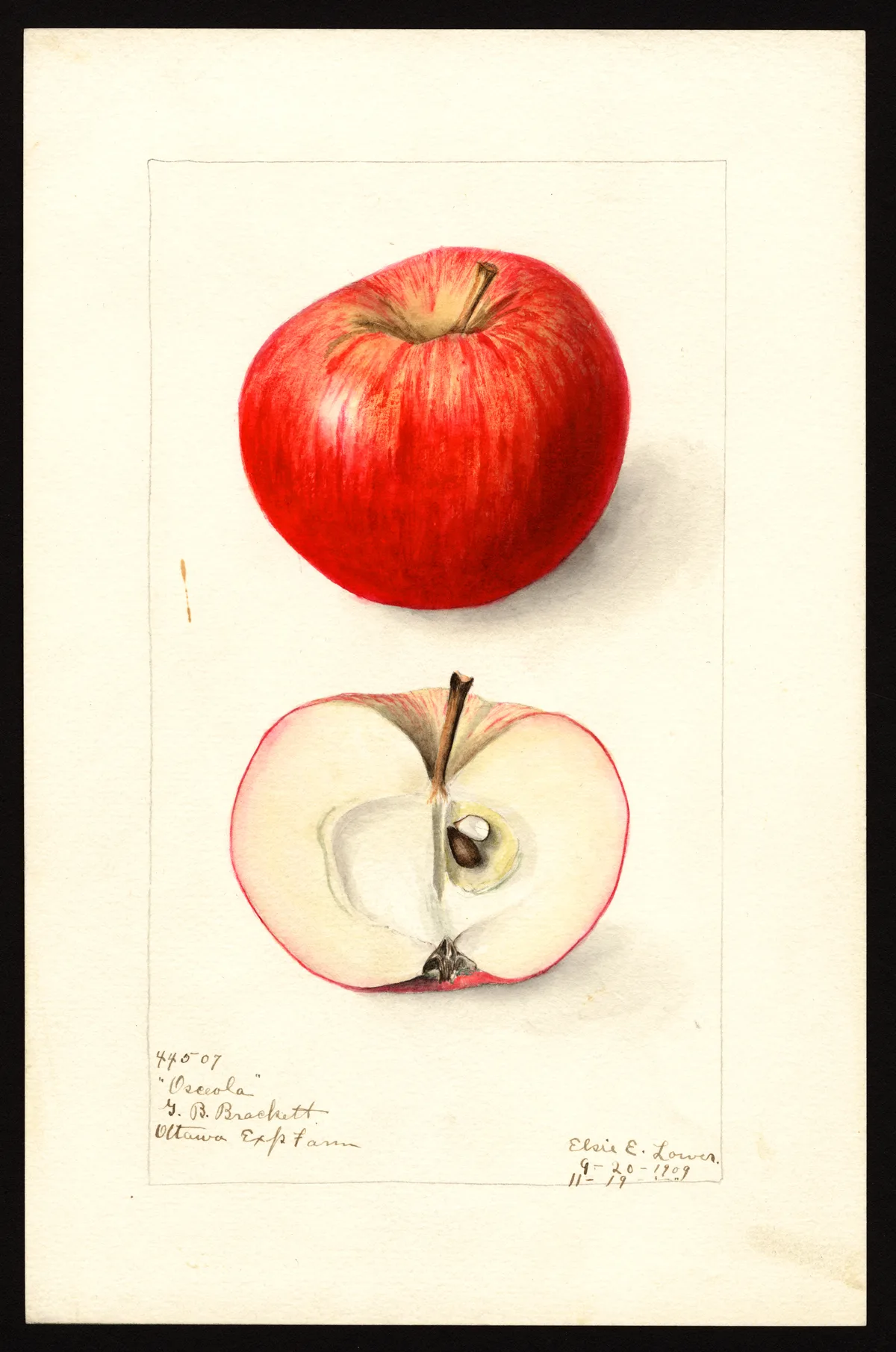
USDA Pomological Watercolor Collection
Origin & History
Originated in Putnam County, Indiana (Downing). Brought into notice by the earnest horticulturist Henry Ward Beecher, who did much to stimulate the culture of fine fruits when a resident of that state (Warder). Warder notes that the variety did not seem to have won its way into public favor to the extent that was expected for it some years ago.
Tree
Vigorous, upright spreading. Shoots dark reddish brown, grayish (Downing).
Fruit
Size: Medium, though Elliott describes it as above medium.
Form: Flattened or roundish oblate, sometimes unequal or angular. Downing specifies roundish oblate conic with sides unequal. Warder describes it as regular in outline despite occasional inequality.
Skin: Smooth, yellowish to pale yellow ground color, shaded, splashed, and striped with red. Warder describes it as slightly colored red and striped with the same. Dots vary by source: Warder describes them as scattered, irregular, more frequent and minute about the apex, few and larger at the base of the fruit; Downing describes large light dots; Elliott describes dark spots.
Stem: Sources disagree — Warder and Downing describe the stem as short; Thomas describes it as small; Elliott describes it as long.
Cavity: Sources vary. Warder describes it as medium and acute. Thomas describes it as large and russeted. Downing notes it as slightly russeted. Elliott describes it as deep.
Calyx/Eye: Small and closed (Warder). Downing confirms calyx closed.
Basin: Wide and regular according to Warder. Deep and uneven according to Downing. Deep according to Thomas.
Flesh & Flavor: Yellowish (Warder, Elliott, Thomas) to whitish (Downing), firm, juicy. Thomas adds crisp. Warder describes the flavor as sub-acid, mild, and rich. Downing calls it pleasant, mild subacid. Elliott says sub-acid. Thomas says mild sub-acid. Quality rated good (Warder), good to very good (Downing), or "very good" (Thomas).
Core & Seeds: Core small, round, closed, clasping. Seeds numerous, plump, dark (Warder).
Season
January to March (Warder, Downing). Elliott states it keeps till May. Thomas calls it a good keeper.
Uses
Table and market (Warder).
Other
Elliott notes it resembles the Newtown Spitzenberg. Thomas notes it resembles New York Vandevere.
Book Sources
Described in 4 period pomological works
Nursery Catalog Sources
Found in 5 catalogs (1891–1913) from Illinois, Missouri
- Missouri Nursery Co. , Louisiana , Missouri — 1891
- J.V. Cotta (Cotta Nursery) , Carroll County , Illinois — 1898
- Central Experimental Farm , Dominion Department of Agriculture, Agassiz, British Columbia (under test; Bulletin No. 3, Second Series) — 1900
- Benjamin Buckman (personal inventory) , Farmingdale , Illinois — 1901
- Benjamin Buckman (personal inventory) , Farmingdale , Illinois — 1913
View original book sources (4)
— John A. Warder, American Pomology: Apples (1867)Osceola.
Originated in Indiana, brought into notice by that earnest horticulturist, Henry Ward Beecher, who did much to stimulate the culture of fine fruits when a resident of that State.
Fruit medium, flattened, sometimes unequal, regular;
Fig. 103.—OSCEOLA.
Surface smooth, slightly colored red, and striped with the same; Dots scattered, irregular, more frequent and minute about the apex, few and larger at base of the fruit.
Basin wide, regular; Eye small, closed.
Cavity medium, acute; Stem short.
Core small, round, closed, clasping; Seeds numerous, plump, dark; Flesh yellowish, firm, rich, juicy; Flavor sub-acid, mild; Quality good; Use table and market; Season January to March.
This variety does not seem to have won its way into public favor to the extent that was expected for it some years ago.
— A.J. Downing, The Fruits and Fruit Trees of America (1900)Osceola. Young
Origin, Putnam Co., Ind. Tree vigorous, upright spreading, shoots dark reddish brown, grayish.
Fruit medium, roundish oblate conic, sides unequal, pale yellow, shaded, splashed, and striped with red, large light dots. Stalk short. Cavity slightly russeted. Calyx closed. Basin deep, uneven. Flesh whitish, firm, juicy, pleasant, mild subacid. Good to very good. January to March.
— F.R. Elliott, The Western Fruit Book (1865)Osceola.
From Indiana. Fruit, above medium, flat; yellow, striped with red, dotted with dark spots; stem, long; cavity, deep; flesh, yellowish, juicy, sub-acid: keeps till May. Resembles the Newtown Spitzenberg.
— John J. Thomas, The American Fruit Culturist (1903)Osceola. Size medium, roundish-oblate, angular; skin yellowish, shaded and striped with red; stalk small; cavity large, russeted; basin deep; flesh yellowish, firm, crisp, mild sub-acid, "very good." A good keeper. Indiana. Resembles New York Vandevere.