Palouse
Apple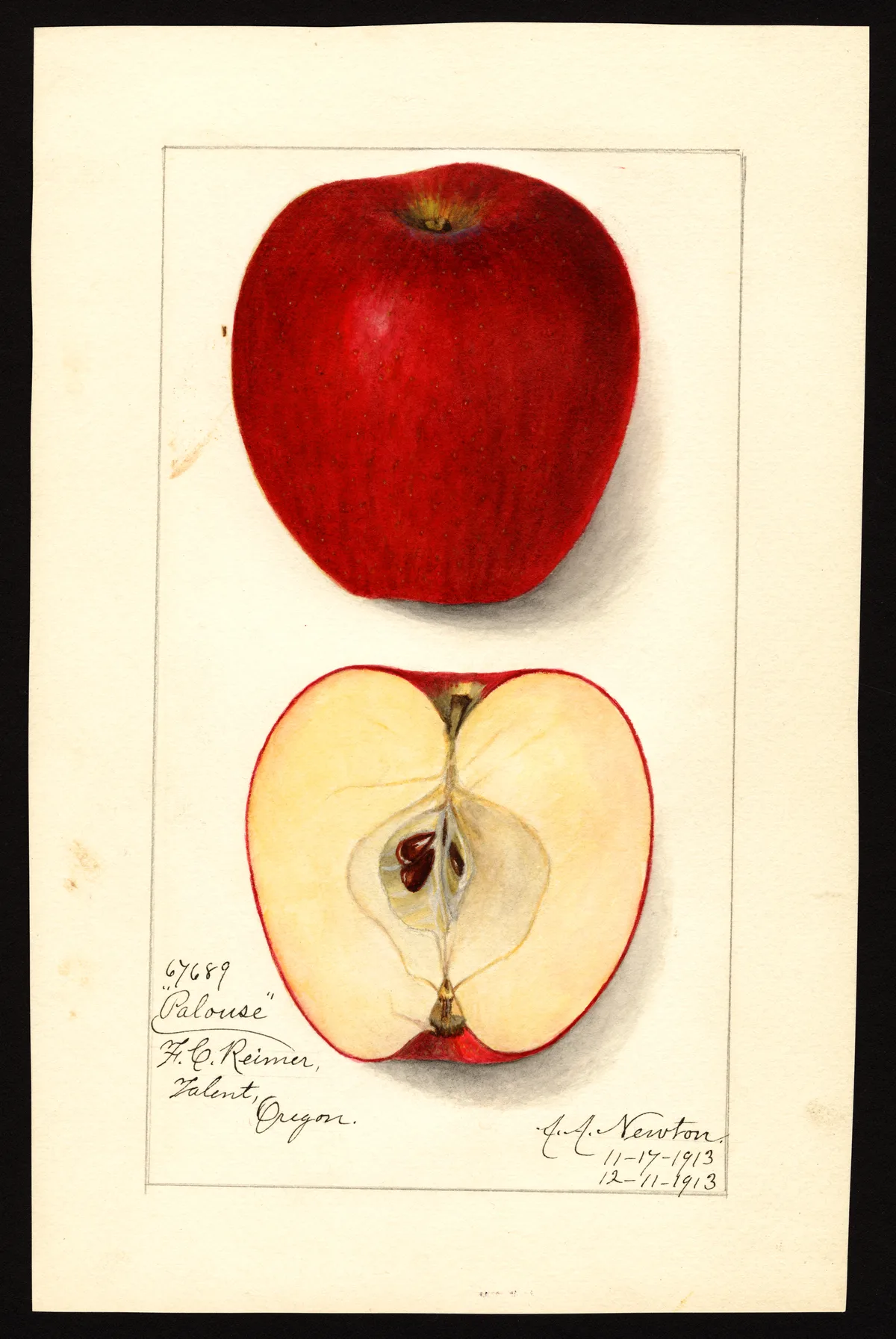
USDA Pomological Watercolor Collection
Palouse
Origin/History
Palouse originated in Whitman County, Washington, from seed brought from Illinois in 1879. The original tree is located five miles east of Colfax (Ruedy, Letter and Circular, 1904). It was introduced about 1892 by George Ruedy, Colfax, Washington. In color, texture, flavor, and aroma Palouse so closely resembles Tompkins King that some suppose it to be a seedling of that variety; Hedrick (1922) likewise describes it as supposed to be a seedling of Tompkins King. It is a comparatively new variety and a candidate for pomological recognition, coming from the Pacific Northwest.
Tree
Tree is a moderate grower (Central Experimental Farm, 1900). Palouse is more productive than Tompkins King and is being much planted in commercial orchards in Washington, where many regard it as one of the most valuable of the seedling varieties which have originated in that region (Beach). Hedrick notes the tree closely resembles Tompkins King. Planting has been largely confined to the Pacific Northwest (Hedrick).
Fruit
Size
Above medium size (Central Experimental Farm, 1900).
Form
Sources are not in full agreement. Craig (cited in Beach) and several other reporters describe typical fruit as oblong; the Central Experimental Farm catalog (1900) independently describes the fruit as oblong, tapering to the eye; and Hedrick notes the apples are more oblong than those of Tompkins King. However, Hexamer described the fruit as oblate or roundish oblate, and Macoun also described it as oblate (both cited in Beach). Beach regards the oblong form as typical, with the oblate descriptions representing a minority view.
Stem
Not described in source.
Cavity
Not described in source.
Calyx
Not described in source.
Basin
Not described in source.
Skin
Greenish yellow, splashed and streaked with red (Central Experimental Farm, 1900).
Flesh/Flavor
Flesh yellowish, a little coarse, juicy, sub-acid, with a very pleasant flavour; quality good (Central Experimental Farm, 1900). In color, texture, flavor, and aroma Palouse closely resembles Tompkins King (Beach; Hedrick).
Core/Seeds
Not described in source.
Season
Season October (Central Experimental Farm, 1900). Beach classes it as a late fall variety, in season from October to early winter, and notes it is hardly as good a keeper as Tompkins King.
Uses
Being much planted in commercial orchards in Washington (Beach). Beach notes it appears to be worthy of testing in New York.
Subtypes/Variants
Not described in source.
Book Sources
Described in 2 period pomological works
Nursery Catalog Sources
Found in 10 catalogs (1900–1913) from Illinois, Oregon, Washington
- Central Experimental Farm , Dominion Department of Agriculture, Agassiz, British Columbia (under test; Bulletin No. 3, Second Series) — 1900
- Washington Nursery Co. , Toppenish , Washington — 1901
- Benjamin Buckman (personal inventory) , Farmingdale , Illinois — 1901
- Washington Nursery Company , Toppenish , Washington — 1909
- Ballygreen Nurseries , Hanford , Washington — 1912
- Pacific Nursery Company , Portland , Oregon — 1912
- Vineland Nurseries Company , Clarkston , Washington — 1912
- Washington Nursery Company , Toppenish , Washington — 1912
- Benjamin Buckman (personal inventory) , Farmingdale , Illinois — 1913
- Washington Nursery Company , Toppenish, Washington (on Yakima Indian Reservation) - [undated; companion to the 1912 "Sixth Edition" descriptive catalogue; same cover design and incorporated 1903 date; dated as c.1912]
View original book sources (3)
— S.A. Beach, The Apples of New York, Vol. 2 (1905)PALOUSE.
REFERENCES. 1. Van Deman, U. S. Pom. Rpt., 1891:390. 2. Rural N. Y., 50:815. 1891. 3. Hexamer, Am. Pom. Soc. Rpt., 1891:159. 4. Williams, Gard. and For., 5:11. 1892. 5. Bailey, An. Hort., 1892:246. 6. Craig, Can. Dept. Agr. Rpt., 1896:133. 7. Macoun, Ib., 1901:197.
SYNONYMS. None.
Palouse is a comparatively new variety which originated in Washington. In color, texture, flavor and aroma it is so much like Tompkins King that some suppose it to be a seedling of that variety. Its form, however, is quite different from that of Tompkins King, typical fruit being oblong, as described by Craig (6) and others (1, 2), rather than oblate or roundish oblate, as described by Hexamer (3) and Macoun (7). It is hardly as good a keeper as Tompkins King and would probably be classed as a late fall variety, being in season from October to early winter. It is, however, more productive than Tompkins King and is being much planted in commercial orchards in Washington where many regard it as one of the most valuable of the seedling varieties which have originated in that region. It appears to be worthy of testing in New York.
Historical. Palouse originated in Whitman county, Washington, from seed brought from Illinois in 1879. The original tree is located five miles east of Colfax¹. It was introduced about 1892 by George Ruedy, Colfax, Wash., whose
¹ Ruedy, Letter and Circular, 1904.
— U.P. Hedrick, Cyclopedia of Hardy Fruits (1922)PALOUSE. Palouse is supposed to be a seedling of Tompkins King, which it closely resembles in tree and fruit. The apples of parent and offspring are much alike in color, texture, flavor, and aroma, but those of Palouse are more oblong and do not keep so long. The variety is a comparatively new candidate for pomological honors and comes from Whitman County, Washington. Palouse is being planted only in the Pacific Northwest.
— Central Experimental Farm, Central Experimental Farm, Agassiz BC — Catalogue of Fruit Trees under Test (Bulletin No. 3, 1900) (1900)Planted Spring 1894. Tree a moderate grower. Fruit above medium size, oblong, tapering to eye. Skin greenish yellow, splashed and streaked with red. Flesh yellowish, a little coarse, juicy, sub-acid, with a very pleasant flavour, quality good. Season October.