Passe Crassane
Pear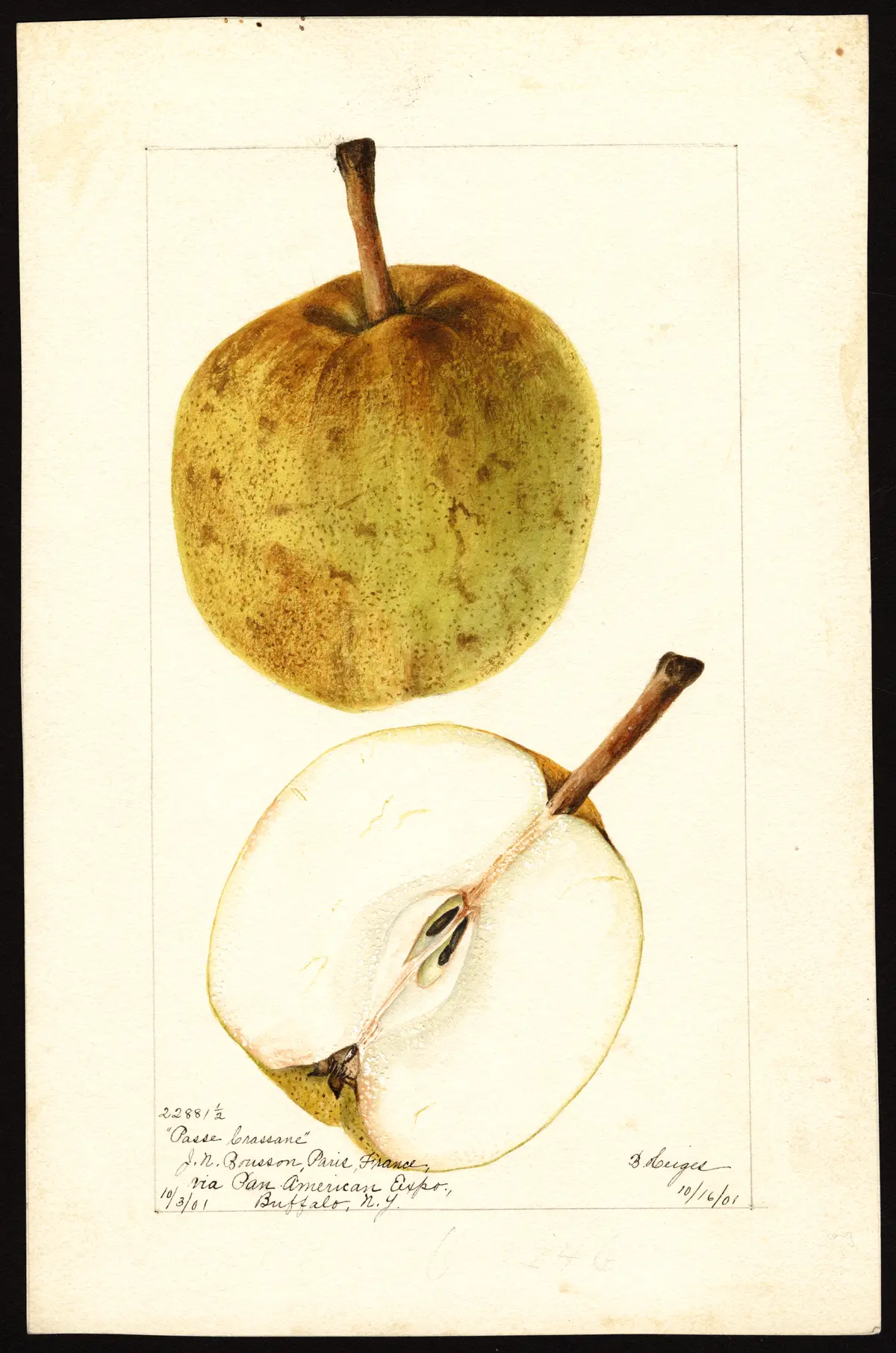
USDA Pomological Watercolor Collection
Passe Crassane
Origin / History
Passe Crassane originated in France. It was raised by M. Boisbunel, a nurseryman at Rouen, from a bed of mixed seeds which he made in 1845; it bore fruit and was first published at Rouen in 1855 (Hedrick; Bunyard).
Tree
Moderately vigorous, with young wood yellow olive brown (Downing). Growth compact and bushy, well spurred, making a dense bushy tree; fertility fair (Bunyard). An excellent bearer (Veitch). Leaf large, elliptical, tapering equally to each end, upfolded, undulating, hanging very late, almost entire, turning pale yellow (Bunyard). Requires a warmer position than most sorts for producing fine fruit; a good wall with plenty of water during the growing season are desirable, and it requires a warm wall (Bunyard; Veitch).
Fruit
Size: Medium (Downing; Veitch), or medium to rather large (Hedrick); large, 3 by 3½ inches (Bunyard).
Form: Sources describe the form variously: obtuse pyriform (Downing); round oval, uneven and bossed on the surface (Bunyard); turbinate or globular-conic, flattened in Bergamot fashion (Hedrick); roundish (Veitch).
Stem / Stalk: Long, rather stout, inclined, set in a medium cavity (Downing). Stem medium, stout and woody, in a narrow cavity (Bunyard).
Cavity: Medium (Downing); narrow (Bunyard).
Calyx / Eye: Calyx small and closed (Downing); eye large, closed (Bunyard).
Basin: Abrupt, uneven (Downing); wide and uneven (Bunyard).
Skin: Rough and thick (Bunyard; Hedrick). Sources describe the ground color differently: yellow, with slight nettings and patches of russet, and thickly sprinkled with russet dots (Downing); dull yellow brown, almost covered with rough russet (Bunyard); dull pale green, mottled with russet markings and passing to yellow on the side turned to the sun (Hedrick).
Flesh / Flavor: Flesh yellowish, gritty near the core, juicy, melting, slightly vinous; good (Downing). Pale yellow-white, fine grained, very sweet and juicy, nearly first class (Bunyard). White, fine, melting, very juicy, saccharine, perfumed, and agreeably sprightly; very good (Hedrick). Light flavoured and melting, with an aromatic flavour (Veitch).
Core / Seeds: Not described in source.
Season
December, January (Downing); January to March (Hedrick); March to April, dessert (Bunyard). A winter pear (Hedrick); an extremely fine late pear (Veitch).
Uses
Dessert (Bunyard). Fine for the table (Veitch). Described as "the greatest Parisian pear" and valuable for growing (Veitch). A very fine fruit when well grown and ripened (Bunyard).
Subtypes / Variants
Not described in source.
Other
Not described in source.
Book Sources
Described in 3 period pomological works
Nursery Catalog Sources
Found in 10 catalogs (1894–1917) from California, England
- Felix Gillet , Barren Hill Nursery, Nevada City , California — 1894
- Felix Gillet , Barren Hill Nursery, Nevada City , California — 1895
- Felix Gillet , Barren Hill Nursery, Nevada City , California — 1897
- Kelway & Son , Langport, Somerset , England — 1897
- George Bunyard & Co. , Royal Nurseries, Maidstone, Kent , England — 1900
- Central Experimental Farm , Dominion Department of Agriculture, Agassiz, British Columbia (under test; Bulletin No. 3, Second Series) — 1900
- James Veitch & Sons , Ltd., Royal Exotic Nursery, Chelsea, London (also Coombe Wood, Langley, and Feltham) , England — 1911
- Thomas Rivers & Son , Sawbridgeworth, Hertfordshire , England — 1913
- George Bunyard & Co. , Royal Nurseries, Maidstone, Kent , England — 1914
- George Bunyard & Co. , Royal Nurseries, Maidstone, Kent , England — 1917
View original book sources (4)
— A.J. Downing, The Fruits and Fruit Trees of America (1900)Passe Crassane.
Surpasse Crassane. Neue Crassane.
Originated in France. Tree moderately vigorous. Young wood yellow olive brown.
Fruit medium, obtuse pyriform, yellow, with slight nettings and patches of russet, and thickly sprinkled with russet dots. Stalk long, rather stout, inclined. Cavity medium. Calyx, small and closed. Basin abrupt, uneven. Flesh yellowish, gritty near the core, juicy, melting, slightly vinous. Good. December, January.
— E.A. Bunyard, A Handbook of Hardy Fruits (1920)PASSE CRASANNE. Verger, I., 38. G. Edel Crasanne. Dessert, March to April, large 3 by 3½, round oval, uneven and bossed on surface. Skin, rough. Colour, dull yellow brown, almost covered with rough russet. Flesh, pale yellow-white, fine grained, very sweet and juicy, nearly first class. Eye, large closed, in a wide uneven basin. Stem, medium, stout and woody, in a narrow cavity. Growth, compact and bushy; fertility fair. Leaf, large, elliptical, tapering equally to each end, upfolded, undulating, hanging very late, almost entire, turning pale yellow. Origin, raised by M. Boisbunel, of Rouen, and first fruited in 1855. Makes a dense bushy tree, well spurred. A very fine fruit when well grown and ripened. A good wall with plenty of water during the growing season are desirable.
— U.P. Hedrick, The Pears of New York (1921)Passe Crassane.
- Pom. France 2:No. 82, Pl. 82. 1863. 2. Bunyard Handb. Hardy Fr. 192. 1920.
This winter pear was raised by M. Boisbunel, a nurseryman at Rouen, Fr., from a bed of mixed seeds which he made in 1845; it bore fruit and was first published at Rouen in 1855. Fruit medium or rather large, turbinate or globular-conic, flattened in Bergamot fashion; skin rough, thick, of a dull pale green, mottled with russet markings and passing to yellow on the side turned to the sun; flesh white, fine, melting, very juicy, saccharine, perfumed, and agreeably sprightly; very good; Jan. to Mar.
— James Veitch & Sons, Veitch's Fruit Trees (1911) (1911)medium size, roundish, light flavoured and melting; the greatest Parisian pear, fine for the table and valuable for growing; requires a warmer position than most sorts for producing fine fruit. an extremely fine late pear with an aromatic flavour; an excellent bearer; requires a warm wall.