Payne
Apple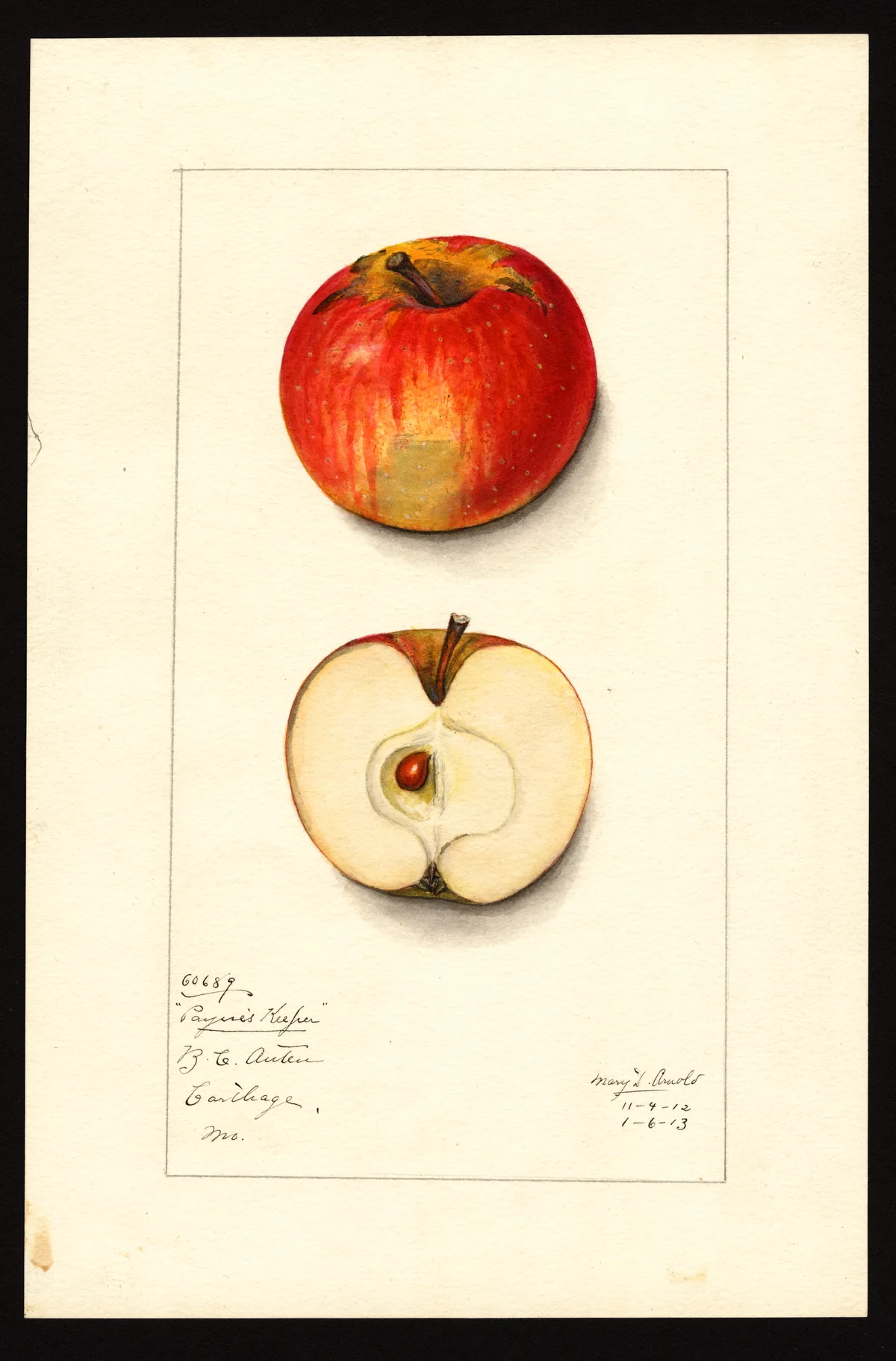
USDA Pomological Watercolor Collection
Origin and History
Originated on the Payne farm near Everton, Missouri. It is supposed to have originated from seed brought from North Carolina about 1840.
Tree
Not described in source.
Fruit
Size and Form
Fruit below medium to above medium, sometimes rather large. Form roundish conic, somewhat elliptical, ribbed very obscurely if at all.
Stem
Stem short, usually not exserted, rather slender.
Cavity
Cavity large, remarkably acuminate, very deep, often somewhat furrowed or compressed, usually covered with thin outspreading russet.
Calyx
Calyx small, closed or partly open; lobes often flat and convergent, sometimes separated at the base.
Basin
Basin commonly very small to medium, often oblique.
Skin
Skin smooth, moderately thick, very tough, yellow or greenish washed and blushed with red and pencilled with narrow, obscure, carmine stripes, more or less streaked over the base with thin, dull scarf-skin. Highly colored specimens are almost wholly covered with bright deep red. Dots scattering, moderately conspicuous, rather large, pale gray or whitish often with russet point.
Core and Seeds
Calyx tube small, funnel-form or nearly so. Stamens median to basal. Core medium in size, slightly abaxile; cells often not quite uniform in size but usually symmetrical, partly open or closed; core lines clasp the funnel cylinder. Carpels tender, slightly tufted, ovate, mucronate, but slightly emarginate if at all. Seeds medium or above, wide, rather flat, obtuse, tufted, often adhering to the carpels, rather dark.
Flesh and Flavor
Flesh tinged with yellow, firm, a little coarse, moderately juicy to somewhat dry, moderately tender, pleasant in flavor, mild subacid becoming nearly sweet, good to very good.
Season
January to June.
Uses
An attractive apple, valued in the Ozark region because of its excellent keeping qualities.
Other
It is somewhat deficient in size, good in quality and nearly sweet. It is duller in color than Ben Davis, but better in flavor and quality. It has not yet been sufficiently tested in New York to indicate its value for this region, but it is probably not well suited to the conditions existing in this state.
Book Sources
Described in 1 period pomological work
Nursery Catalog Sources
Found in 1 catalog (1901) from Missouri
- Mountain Grove Nurseries (Tippin & Moore , Proprietors; Geo. T. Tippin, J. W. Tippin, J. C. Moore), Mountain Grove , Missouri — 1901
View original book sources (1)
— S.A. Beach, The Apples of New York, Vol. 1 (1905)PAYNE.
REFERENCES. 1. Bailey, An. Hort., 1892:246. 2. Wild, Mo. Hort. Soc. Rpt., 1902:203. 3. Stinson, Mo. Fr. Sta. Bul., 3:23. 1902. fig. 4. Budd-Hansen, 1903:146.
SYNONYMS. PAYNE'S KEEPER (1, 2, 3). Payne Late Keeper (4).
An attractive apple, valued in the Ozark region because of its excellent keeping qualities. It is somewhat deficient in size, good in quality and nearly sweet. It is duller in color than Ben Davis, but better in flavor and quality. It has not yet been sufficiently tested in New York to indicate its value for this region, but it is probably not well suited to the conditions existing in this state.
Historical. Originated on the Payne farm near Everton, Missouri. It is supposed to have originated from seed brought from North Carolina about 1840.
FRUIT.
Fruit below medium to above medium, sometimes rather large. Form roundish conic, somewhat elliptical, ribbed very obscurely if at all. Stem short, usually not exserted, rather slender. Cavity large, remarkably acuminate, very deep, often somewhat furrowed or compressed, usually covered with thin outspreading russet. Calyx small, closed or partly open; lobes often flat and convergent, sometimes separated at the base. Basin commonly very small to medium, often oblique. Skin smooth, moderately thick, very tough, yellow or greenish washed and blushed with red and pencilled with narrow, obscure, carmine stripes, more or less streaked over the base with thin, dull scarf-skin. Highly colored specimens are almost wholly covered with bright deep red. Dots scattering, moderately conspicuous, rather large, pale gray or whitish often with russet point. Calyx tube small, funnel-form or nearly so. Stamens median to basal. Core medium in size, slightly abaxile; cells often not quite uniform in size but usually symmetrical, partly open or closed; core lines clasp the funnel cylinder. Carpels tender, slightly tufted, ovate, mucronate, but slightly emarginate if at all. Seeds medium or above, wide, rather flat, obtuse, tufted, often adhering to the carpels, rather dark. Flesh tinged with yellow, firm, a little coarse, moderately juicy to somewhat dry, moderately tender, pleasant in flavor, mild subacid becoming nearly sweet, good to very good. Season January to June.