Pease Walter
Apple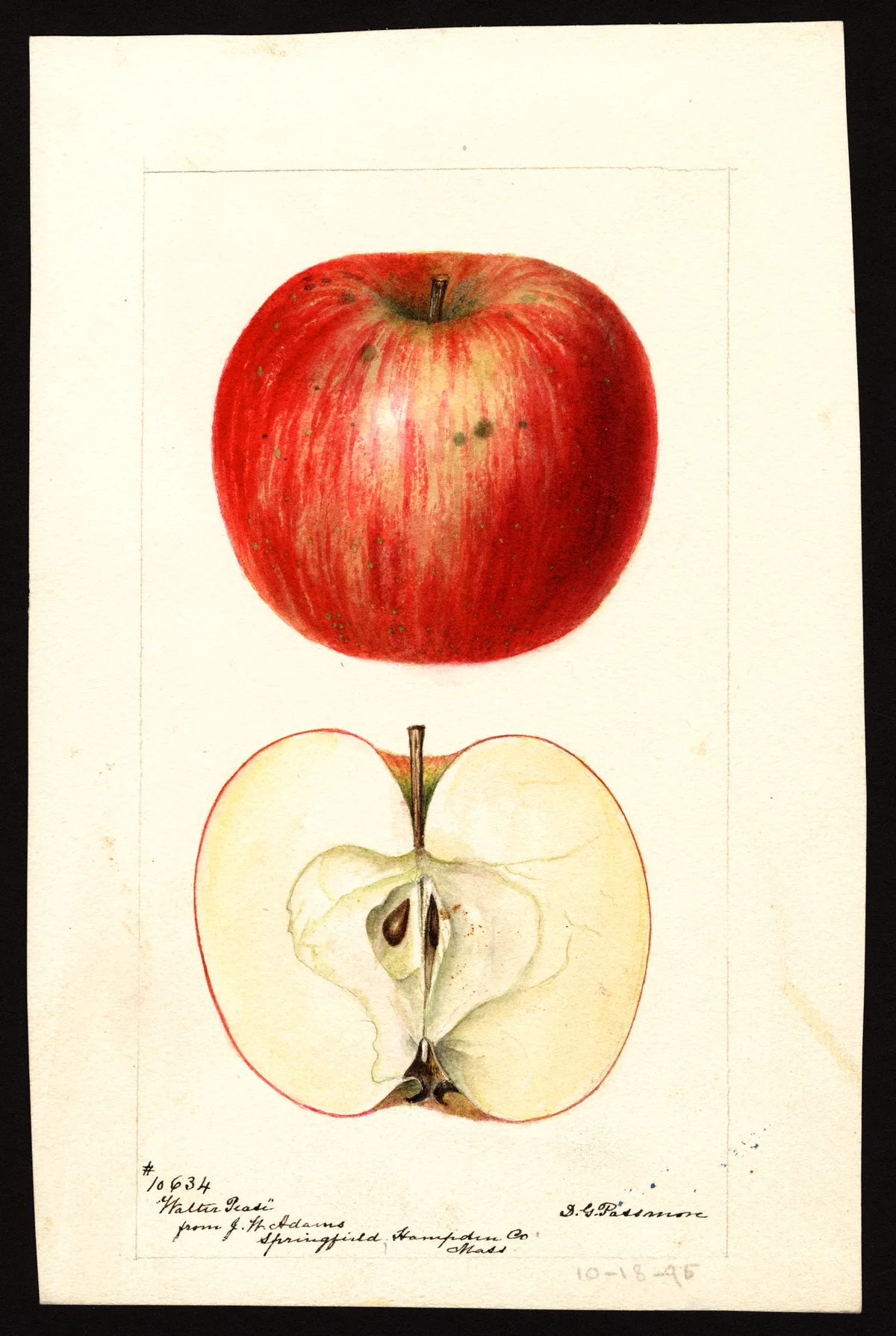
USDA Pomological Watercolor Collection
Pease Walter
Origin / History
Originated in the seedling orchard of Walter Pease, Somers, Conn., "in the early part of the last century" (Beach); "about the first of the nineteenth century" (Budd and Hansen). At first propagated by the Shakers near the place of its origin, and there recognized locally as a valuable variety. Within recent years propagated to a considerable extent by nurserymen and more widely disseminated. Beach calls it "a pleasant-flavored apple of good size, attractive appearance and excellent dessert quality," and "worthy of the attention of New York fruit growers where a dessert apple of this type is desired."
Tree
Tree rather large, moderately vigorous to vigorous, a good grower, hardy. Form upright to roundish. Twigs moderately long, a little curved, stout; internodes medium to short. Bark clear brownish-red, heavily coated with scarf-skin; pubescent. Lenticels scattering, below medium to above medium, roundish, slightly raised. Buds below medium to above, broad, plump, rather obtuse, free or nearly so, slightly pubescent.
Comes into bearing moderately young; a pretty reliable cropper, alternating light with heavier crops. Sometimes there is considerable loss from premature dropping of the fruit during September wind storms.
Fruit
Size: Large or above medium, somewhat variable in size and shape.
Form: Flattened at base, varying from oblate to roundish oblong and often inclined to conic; sides often unequal. Budd and Hansen give roundish.
Stem: Below medium to long, slender (Beach); short, of medium caliper, curved (Budd and Hansen).
Cavity: Obtuse to acute, moderately deep to deep, broad, sometimes lipped, often somewhat russeted (Beach). Budd and Hansen: large, regular, deep, flaring, greenish, very slightly russeted.
Calyx: Usually medium to large, closed or nearly so; lobes leafy (Beach). Segments long, narrow, converging, reflexed at point (Budd and Hansen). Calyx tube small, conical (Beach).
Basin: Moderately deep or sometimes shallow, rather narrow, abrupt, often compressed or furrowed, wrinkled (Beach); medium to large, regular, medium to deep, abrupt, furrowed (Budd and Hansen).
Skin: Thin, tough, smooth, somewhat glossy; slight bloom. Ground color pale green or yellowish (Beach), greenish yellow (Budd and Hansen). In highly colored specimens largely covered with bright red, striped with bright carmine and flecked with whitish scarf-skin (Beach); washed with pale brick red, splashed and striped with crimson (Budd and Hansen). Prevailing effect greenish yellow more or less striped with red.
Dots: Numerous, often submerged, whitish or russet, sometimes areolar (Beach); light russet or gray (Budd and Hansen).
Flesh and flavor: Flesh whitish, slightly tinged with yellow, firm, rather fine (Beach) or moderately fine-grained (Budd and Hansen), crisp, tender, juicy, aromatic, sprightly; mild pleasant subacid. Beach: "excellent dessert quality" but "too mild in flavor to excel for culinary uses"; quality "good to very good for dessert." Budd and Hansen: very good.
Core and seeds: Core small to medium, axile (Beach); medium, oval (Budd and Hansen). Cells partly open or sometimes closed (Beach); nearly closed (Budd and Hansen). Core lines meeting. Carpels small, roundish, somewhat tufted. Seeds rather large, narrow, long, somewhat tufted, dark; often some are abortive (Beach). Budd and Hansen: seeds few, medium size, angular, brown.
Season
October to midwinter (Beach); Budd and Hansen give autumn. The crop ripens unevenly: the earliest fruit comes in season the latter part of September or early in October, while a considerable portion of the later ripening fruit may remain sound till midwinter or later.
Uses
Dessert apple. Too mild in flavor to excel for culinary uses. The fruit, being rather tender, requires careful handling and is on this account better adapted for local than for distant markets.
Subtypes / Variants
Not described in source.
Other
Not described in source.
Book Sources
Described in 2 period pomological works
- Beach, The Apples of New York Vol. 2 (1905)
- Budd & Hansen, Systematic Pomology (1914) — listed as Pease, Walter
Nursery Catalog Sources
Found in 10 catalogs (1890–1921) from Illinois, Maryland, Massachusetts, New Jersey, Oregon, Pennsylvania
- William H. Moon Co. , Morrisville, Bucks County , Pennsylvania — 1890 — listed as Walter Pease
- Rogers Nursery Co. , Moorestown , New Jersey — 1893 — listed as Walter Pease
- Reading Nursery , Jacob W. Manning, Proprietor, Reading , Massachusetts — 1898 — listed as Walter Pease
- Brown Brothers Co. , Continental Nurseries, Rochester, NY (also operated from Toronto, Canada) — 1899 — listed as Walter Pease
- Brown Brothers Co. , Continental Nurseries, Rochester, NY (also operated from Toronto, Canada) — 1901 — listed as Walter Pease
- Benjamin Buckman (personal inventory) , Farmingdale , Illinois — 1901 — listed as Walter Pease
- Wm. J. Corse (successor to Robert Sinclair / Sinclair Nurseries) , Baltimore , Maryland — 1909 — listed as Walter Pease
- Benjamin Buckman (personal inventory) , Farmingdale , Illinois — 1913 — listed as Walter Pease
- Union Nurseries , J.B. Weaver & Sons, Union , Oregon — 1915 — listed as Walter Pease
- Benedict Nursery Co. , Portland , Oregon — 1921 — listed as Walter Pease
View original book sources (2)
— S.A. Beach, The Apples of New York, Vol. 2 (1905)PEASE WALTER
[Additional entry in this volume: "Pease", pp. 274–275]
PEASE.
References. 1. Rural N. Y., 54:776. 1895. fig. 2. Heiges, U. S. Pom. Rpt., 1895:136. 3. Rural N. Y., 56:222. 1897. 4. Am. Pom. Soc. Cat., 1899:19. 5. Rural N. Y., 61:249. 1902. 6. Budd-Hansen, 1903:147. 7. J. W. Adams and Co., Springfield, Mass., Cat.
Synonyms. Pease, Walter (4, 6). Walter Pease (1, 2, 3, 5, 7).
A pleasant-flavored apple of good size, attractive appearance and excellent dessert quality, but too mild in flavor to excel for culinary uses. The fruit being rather tender requires careful handling and on this account is better adapted for local than for distant markets. It is worthy of the attention of New York fruit growers where a dessert apple of this type is desired. The crop ripens unevenly. The earliest fruit comes in season the latter part of September or early in October, while a considerable portion of the later ripening fruit may remain sound till midwinter or later. Sometimes there is considerable loss from premature dropping of the fruit during September wind storms. The tree is a good grower, hardy, comes into bearing moderately young and is a pretty reliable cropper, alternating light with heavier crops.
Historical. Originated in the seedling orchard of Walter Pease, Somers, Conn., in the early part of the last century (3). It was at first propagated by the Shakers near the place of its origin and there came to be recognized locally as a valuable variety. Within recent years it has been propagated to a considerable extent by nurserymen and is being more widely disseminated.
Tree. Tree rather large, moderately vigorous to vigorous. Form upright to roundish. Twigs moderately long, a little curved, stout; internodes medium to short. Bark clear brownish-red, heavily coated with scarf-skin; pubescent. Lenticels scattering, below medium to above medium, roundish, slightly raised. Buds below medium to above, broad, plump, rather obtuse, free or nearly so, slightly pubescent.
Fruit. Fruit large or above medium, somewhat variable in size and shape. Form flattened at base, varying from oblate to roundish oblong and often inclined to conic; sides often unequal. Stem below medium to long, slender. Cavity obtuse to acute, moderately deep to deep, broad, sometimes lipped, often somewhat russeted. Calyx usually medium to large, closed or nearly so; lobes leafy. Basin moderately deep or sometimes shallow, rather narrow, abrupt, often compressed or furrowed, wrinkled. Skin thin, tough, smooth, somewhat glossy, with pale green or yellowish ground color which in highly colored specimens is largely covered with bright red, striped with bright carmine and flecked with whitish scarf-skin. Dots numerous, often submerged, whitish or russet, sometimes areolar. Prevailing effect greenish-yellow more or less striped with red. Calyx tube small, conical. Core small to medium, axile; cells partly open or sometimes closed; core lines meeting. Carpels small, roundish, somewhat tufted. Seeds rather large, narrow, long, somewhat tufted, dark; often some are abortive. Flesh whitish, slightly tinged with yellow, firm, rather fine, crisp, tender, juicy, aromatic, sprightly, mild pleasant subacid, good to very good for dessert. Season October to midwinter.
— J.L. Budd & N.E. Hansen, American Horticultural Manual, Part II: Systematic Pomology (1914)Pease, Walter.—Originated in Somers, Connecticut, by Walter Pease, about the first of the nineteenth century.
Fruit large, roundish; surface smooth, greenish yellow, washed with pale brick red, splashed and striped with crimson; slight bloom; dots numerous, light russet or gray; cavity large, regular, deep, flaring, greenish, and very slightly russeted; stem short, of medium caliper, curved; basin medium to large, regular, medium to deep, abrupt, furrowed; calyx medium size, nearly closed; segments long, narrow, converging, reflexed at point. Core medium, oval, meeting, nearly closed; seeds few, medium size, angular, brown; flesh whitish, moderately fine-grained, tender, juicy, subacid, very good. Autumn. (U. S. Div. of Pomology, 1895.)