Peffer
Apple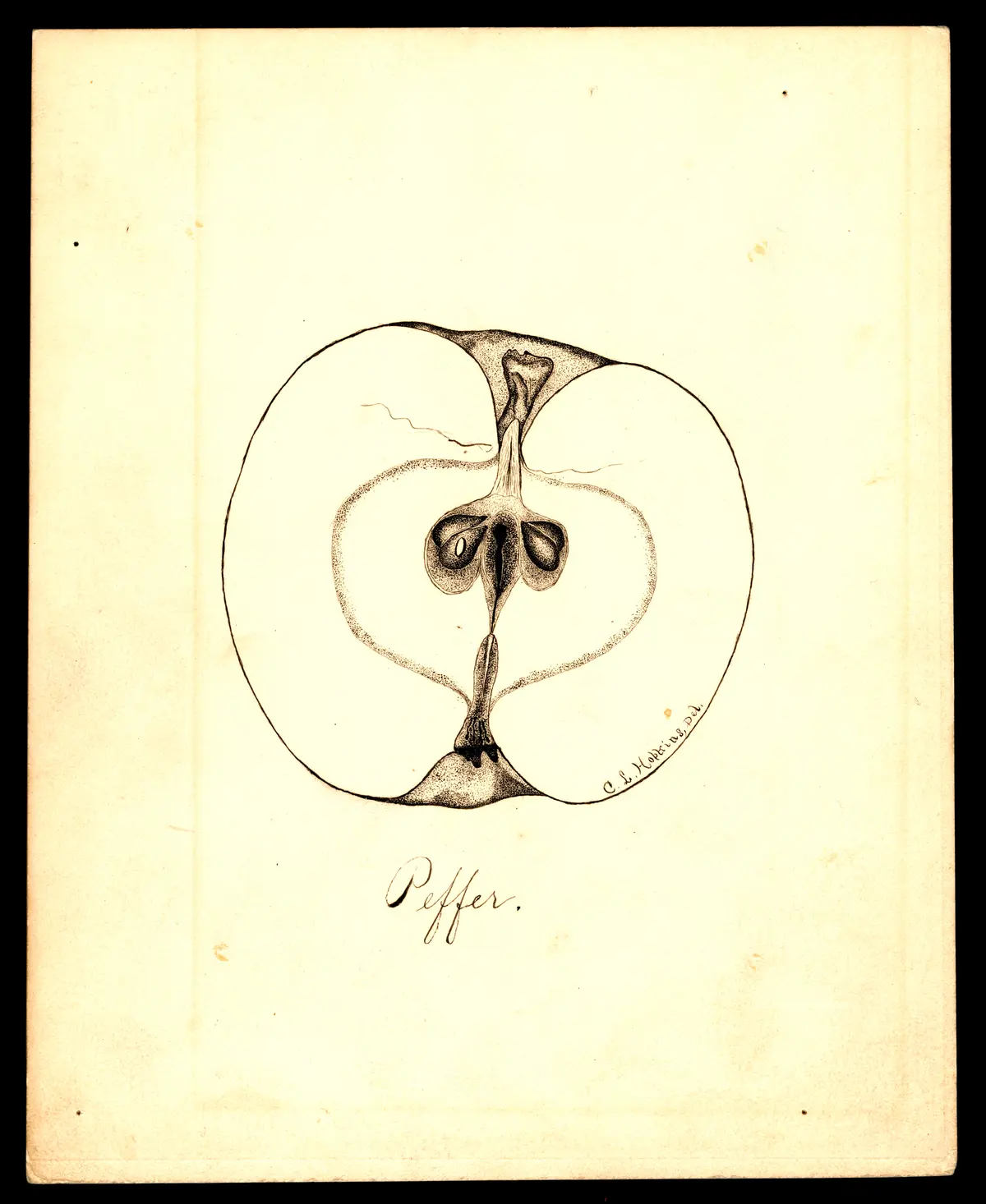
USDA Pomological Watercolor Collection
Peffer
Origin and History
The Peffer originated with Mr. George P. Peffer of Pewaukee, Wisconsin, from seeds of the Pewaukee apple and was named in his honor. It is thought to be better than its parent variety in some respects, and was recommended for trial in the colder States.
Tree
Not described in source.
Fruit
Size and Form: Medium to large. Shape with diameters nearly equal, angular, irregular, and slightly lop-sided.
Surface and Color: Polished, yellow, with abundant splashes and specks of bright red and scarlet, handsome in appearance. Dots numerous, brown or gray.
Cavity: Medium, sloping, nearly regular, very slightly russeted.
Stem: Short, thick, fleshy.
Basin: Deep, abrupt, irregular or ribbed.
Eye (Calyx): Open, large, with reflexed sepals.
Flesh and Flavor: White, tender, fine-grained, juicy. Flavor subacid. Quality fair to good.
Core and Seeds: Core open and small, meeting the deep eye cavity. Seeds many, large, and plump.
Season
Early winter in Wisconsin.
Uses
Not described in source.
Subtypes and Variants
Not described in source.
Description recorded by H. E. Van Deman, U.S. Pomologist, in 1889, as published in J.L. Budd & N.E. Hansen, American Horticultural Manual, Part II: Systematic Pomology (1914).
Book Sources
Described in 1 period pomological work
Nursery Catalog Sources
Found in 3 catalogs (1900–1913) from Illinois
- Central Experimental Farm , Dominion Department of Agriculture, Agassiz, British Columbia (under test; Bulletin No. 3, Second Series) — 1900
- Benjamin Buckman (personal inventory) , Farmingdale , Illinois — 1901
- Benjamin Buckman (personal inventory) , Farmingdale , Illinois — 1913
View original book sources (1)
— J.L. Budd & N.E. Hansen, American Horticultural Manual, Part II: Systematic Pomology (1914)Peffer.— "A variety originated by Mr. George P. Peffer, of Pewaukee, Wis., from seeds of Pewaukee apple, and named in his honor. It is thought to be better than the parent variety in some respects, and I bespeak for it a trial in the colder States. Size medium to large; shape, diameters nearly equal, angular, irregular, slightly lop-sided; surface polished, yellow, with abundant splashes and specks of bright red and scarlet, handsome; dots numerous, brown or gray; basin deep, abrupt, irregular or ribbed; eye open, large, with reflexed sepals; cavity medium, sloping, nearly regular, very slightly russeted; stem short, thick, fleshy; core open, small, meeting the deep eye cavity; seeds many, large, plump; flesh white, tender, fine-grained, juicy; flavor subacid; quality fair to good. Season, early winter in Wisconsin." (H. E. Van Deman, U. S. Pomologist, 1889.)