Peter
Apple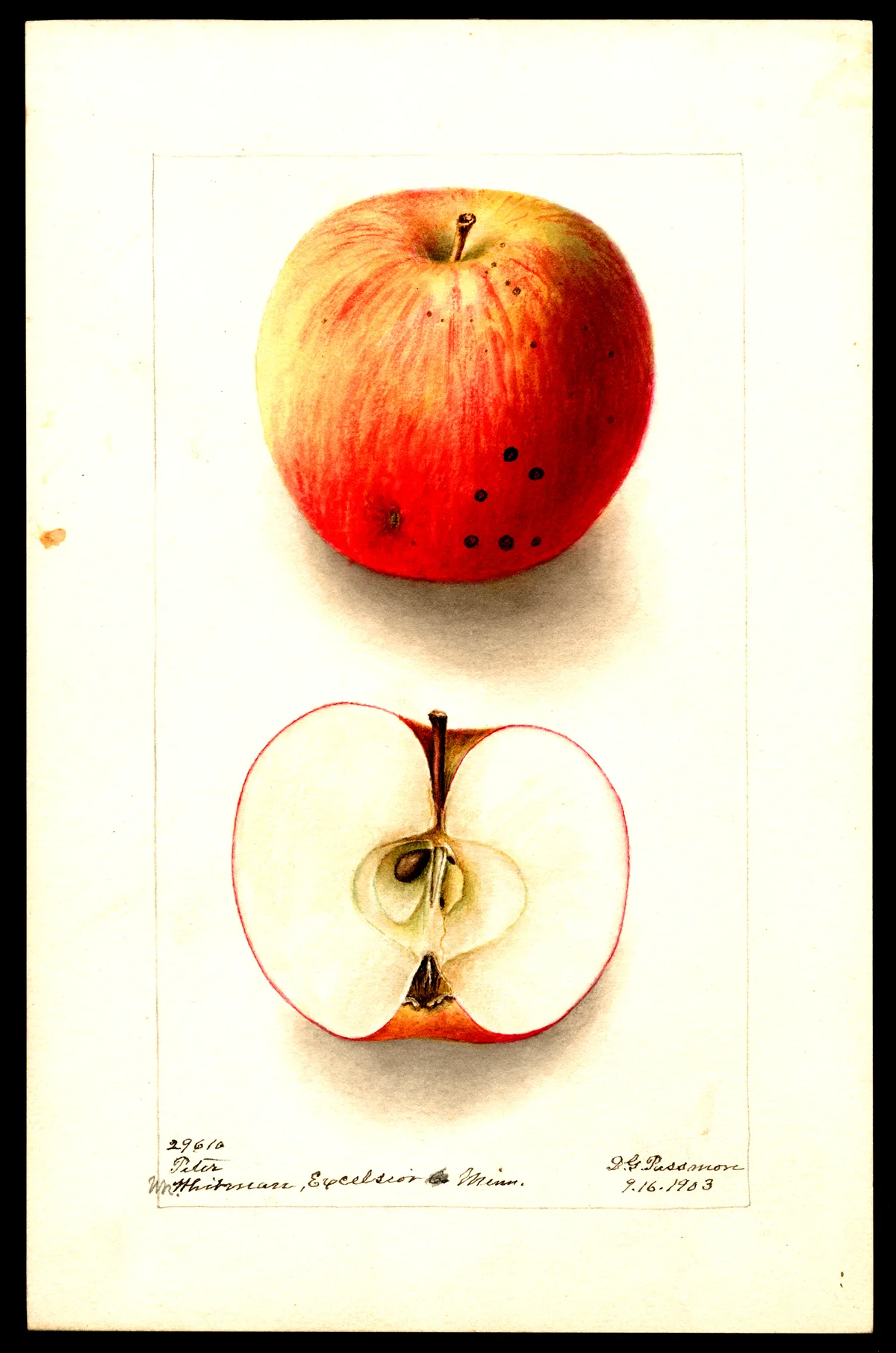
USDA Pomological Watercolor Collection
Peter
Origin / History
Peter originated from seed of Wealthy, raised by the late Peter M. Gideon of Excelsior, Minnesota. Hedrick states the variety was first distributed in 1886. Beach reports it was received at the New York Agricultural Experiment Station from Gideon in 1888 for testing.
The fruit so closely resembles its parent Wealthy that distinguishing the two is very difficult. Gideon himself could not distinguish the two varieties by the fruit, but claimed Peter was hardier in tree. Hansen states that even if really distinct, the two varieties are now mixed to a considerable extent (a point Beach also repeats from Hansen). Wyman Elliott of Minneapolis, one of the most prominent members of the Minnesota Horticultural Society, after a careful examination of many specimens, found the Wealthy seeds smaller and more pointed, and the Peter seeds larger, broader, less pointed, and a little darker when fully ripe.
According to Hedrick, the two apples differ in quality, in season, in color of flesh, and in the seeds (those of Peter being larger). Peter serves the same purposes and is adapted to the same conditions as its well-known parent.
Tree
Beach: a fairly strong grower in the nursery; in the orchard it makes a moderately vigorous growth and eventually becomes rather large with moderately stout, somewhat drooping branches. Form upright spreading to roundish, open. The tree is a moderate grower, comes into bearing young, and yields full crops biennially.
Hedrick: tree large, upright-spreading, with stout, drooping branches.
Twigs: Short, straight, slender, with large terminal buds; internodes medium. Bark brown tinged with red, lightly streaked with scarf-skin; pubescent near tips. Lenticels quite numerous, medium size, oval, not raised. Buds medium size, plump, obtuse, free, slightly pubescent.
Fruit
Size: Medium or above (Beach); medium or large (Hedrick). Uniform in size and shape.
Form: Oblate or roundish oblate, a little inclined to conic (Beach) / oblate or round-oblate, conic (Hedrick); regular.
Stem: Long to medium, sometimes short, slender (Beach); long, sometimes short, slender (Hedrick).
Cavity: Acuminate, deep, medium to rather broad (Beach) / broad (Hedrick), compressed, lightly russeted or nearly smooth (Beach) / russeted or smooth (Hedrick).
Calyx: Small, closed; lobes medium in length, rather broad, acute (Beach) / broad, acute (Hedrick). Hansen and Budd-Hansen note that calyx segments are connivent (whereas in Wealthy the tube is funnel-shaped and stamens median or basal).
Basin: Deep to moderately deep (Beach) / deep (Hedrick), narrow to medium in width (Beach) / narrow (Hedrick), abrupt, gently furrowed, sometimes compressed.
Skin: Thin, moderately tough (Beach) / tough (Hedrick), nearly smooth (Beach) / smooth (Hedrick), clear pale yellow washed and mottled with bright red conspicuously striped and splashed with deep carmine. Highly colored specimens are nearly covered with deep red. Dots medium size, scattering, brown, mingled with some that are whitish and submerged (Beach) / scattering, brown, or white and submerged (Hedrick). Prevailing effect red or striped red.
Calyx tube: Small, funnel-shape (Beach and Hedrick). Hansen and Budd-Hansen, however, describe the tube as conical with stamens median (contrasting it with Wealthy's funnel-shaped tube).
Stamens: Median to marginal (Beach); median (Hedrick, Hansen, Budd-Hansen).
Core: Medium to below (Beach), usually axile; cells symmetrical, closed or partly open; core lines clasping. Carpels roundish, emarginate (Beach) / round, emarginate (Hedrick).
Seeds: Above medium to large, moderately wide, long, flat, moderately acute (Beach); large, wide, long, flat, acute (Hedrick). Hansen and Budd-Hansen describe the seeds as large, broad, and plump, about ten in number. By comparison with Wealthy, Peter's seeds are larger, broader, less pointed, and a little darker when fully ripe.
Flesh: Slightly tinged with yellow (Beach) / yellow (Hedrick), sometimes stained with red, firm, medium-grained, tender, juicy, with a pleasant, mild subacid, somewhat aromatic (Beach) / aromatic (Hedrick) flavor. Good to very good. As fruited at the New York Station, the flesh of Peter is not so white as that of Wealthy but somewhat milder and better in quality (Beach).
Season
September and October or later. In ordinary storage its commercial season is September and October. In cold storage it extends to about January 1. Sometimes a portion of the fruit may keep into or through the winter. The fruit does not ripen uniformly, and on this account there is apt to be some loss from drops unless more than one picking is made.
Uses
Peter serves the same purposes and is adapted to the same conditions as its well-known parent Wealthy (Hedrick).
Subtypes / Variants
Not described in source.
Other
Not described in source.
Book Sources
Described in 4 period pomological works
Nursery Catalog Sources
Found in 15 catalogs (1896–1920) from Illinois, Missouri, Oregon, Washington
- Stark Bros. Nurseries & Orchards Co. , Louisiana , Missouri — 1896
- Central Experimental Farm , Dominion Department of Agriculture, Agassiz, British Columbia (under test; Bulletin No. 3, Second Series) — 1900
- Washington Nursery Co. , Toppenish , Washington — 1901
- Benjamin Buckman (personal inventory) , Farmingdale , Illinois — 1901
- Washington Nursery Company , Toppenish , Washington — 1909
- Island Nurseries & Fruit Farm , Vashon (Vashon Island) , Washington — 1910
- Pacific Nursery Company , Portland , Oregon — 1912
- Vineland Nurseries Company , Clarkston , Washington — 1912
- Washington Nursery Company , Toppenish , Washington — 1912
- Benjamin Buckman (personal inventory) , Farmingdale , Illinois — 1913
- Island Nurseries & Fruit Farm , Vashon (Vashon Island) , Washington — 1914
- Island Nurseries & Fruit Farm , Vashon (Vashon Island) , Washington — 1915
- Island Nurseries & Fruit Farm , Vashon (Vashon Island) , Washington — 1916
- Island Nurseries & Fruit Farm , Vashon (Vashon Island) , Washington — 1917
- Oregon Nursery Co. , Orenco , Oregon — 1920
View original book sources (4)
— S.A. Beach, The Apples of New York, Vol. 2 (1905)PETER.
REFERENCES.
- Iowa Hort. Soc. Rpt., 1886:180. 2. N. Y. Sta. An. Rpt., 7:50, 90. 1888. 3. Bailey, An. Hort., 1892:246. 4. Beach, N. Y. Sta. An. Rpt., 12:601. 1893. 5. Heiges, U. S. Pom. Rpt., 1895:31. 6. Munson, Me. Sta. Rpt., 1896:75. 7. Beach, W. N. Y. Hort. Soc. Rpt., 41:52. 1896. 8. Am. Pom. Soc. Cat., 1899:19. 9. Hansen, S. D. Sta. Bul., 76:84. 1902. 10. Munson, Me. Sta. An. Rpt., 18:84, 95. 1902. 11. Farrand, Mich. Sta. Bul., 205:46. 1903. 12. Budd-Hansen, 1903:149. 13. Powell and Fulton, U. S. B. P. I. Bul., 48:52. 1903. 14. Beach and Clark, N. Y. Sta. Bul., 248:137. 1904.
SYNONYMS. None.
This fruit resembles its parent Wealthy so closely that it is very difficult to distinguish between the two. It is similar to Wealthy in season as well as in the appearance and quality of the fruit. In ordinary storage its commercial season is September and October (14). In cold storage it extends to about January 1 (13). Sometimes a portion of the fruit may keep into or through the winter (14). Hansen states that even if really distinct the two varieties are now mixed to a considerable extent. As fruited at this Station the flesh of Peter is not so white as that of Wealthy but somewhat milder and better in quality (4). It has been found that the seeds of Peter are larger, broader, less pointed and a little darker than those of Wealthy. The tree is a moderate grower, comes into bearing young and yields full crops biennially. The fruit does not ripen uniformly and on this account there is apt to be some loss from drops unless more than one picking is made.
Historical. Originated from seed of Wealthy by Peter M. Gideon, Excelsior, Minn. (1), from whom this variety was received in 1888 for testing at this Station.
TREE.
Tree a fairly strong grower in the nursery; in the orchard it makes a moderately vigorous growth and eventually becomes rather large with moderately stout, somewhat drooping branches. Form upright spreading to roundish, open. Twigs short, straight, slender, with large terminal buds; internodes medium. Bark brown tinged with red, lightly streaked with scarf-skin; pubescent near tips. Lenticels quite numerous, medium size, oval, not raised. Buds medium size, plump, obtuse, free, slightly pubescent.
FRUIT.
Fruit medium or above, uniform in size and shape. Form oblate or roundish oblate, a little inclined to conic, regular. Stem long to medium, sometimes short, slender. Cavity acuminate, deep, medium to rather broad, compressed, lightly russeted or nearly smooth. Calyx small, closed; lobes medium in length, rather broad, acute. Basin deep to moderately deep, narrow to medium in width, abrupt, gently furrowed, sometimes compressed. Skin thin, moderately tough, nearly smooth, clear pale yellow washed and mottled with bright red conspicuously striped and splashed with deep carmine. Highly colored specimens are nearly covered with deep red. Dots medium size, scattering, brown, mingled with some that are whitish and submerged. Prevailing effect red or striped red. Calyx tube small, funnel-shape. Stamens median to marginal. Core medium to below, usually axile; cells symmetrical, closed or partly open; core lines clasping. Carpels roundish, emarginate. Seeds above medium to large, moderately wide, long, flat, moderately acute. Flesh slightly tinged with yellow, sometimes stained with red, firm, medium-grained, tender, juicy, with a pleasant, mild subacid, somewhat aromatic flavor, good to very good. Season September and October or later (14).
— N.E. Hansen, A Study of Northwestern Apples (1902)Peter—Originated from seed of Wealthy by the late Peter M. Gideon, Excelsior, Minnesota. In fruit this appears nearly if not quite identical with Wealthy. Mr. Gideon himself could not distinguish the two varieties by the fruit, but claimed Peter was hardier in tree. The seeds of the Peter are large, broad and plump, about ten in number; calyx segments connivent; tube conical and stamens median. In Wealthy the tube is funnel-shaped; stamens median or basal. Wyman Elliott of Minneapolis, one of the most prominent members of the Minnesota Horticultural Society, after a careful examination of many specimens finds the Wealthy seeds smaller and more pointed; the Peter seeds larger, broader, less pointed and a little darker when fully ripe. Even if really distinct, the two varieties are now mixed to a considerable extent.
— J.L. Budd & N.E. Hansen, American Horticultural Manual, Part II: Systematic Pomology (1914)Peter.— Originated from seed of Wealthy by the late Peter M. Gideon, Excelsior, Minn. In fruit this appears nearly, if not quite, identical with Wealthy. Mr. Gideon himself could not distinguish the two varieties by the fruit, but claimed Peter was hardier in tree; the seeds of the Peter are large, broad, and plump, about ten in number; calyx segments connivent; tube conical and stamens median. In Wealthy the tube is funnel-shaped; stamens median or basal. Wyman Elliott, of Minneapolis, one of the most prominent members of the Minnesota Horticultural Society, after a careful examination of many specimens finds the Wealthy seeds smaller and more pointed; the Peter seeds larger, broader, less pointed, and a little darker when fully ripe. Even if really distinct, the two varieties are now mixed to a considerable extent.
— U.P. Hedrick, Cyclopedia of Hardy Fruits (1922)PETER.
Peter is a seedling of Wealthy, which outwardly in fruit it closely resembles. The two apples differ in quality, in season, in color of flesh, and in the seeds, those of Peter being larger. Peter serves the same purposes and is adapted to the same conditions as its well-known parent. The variety was grown by Peter Gideon, Excelsior, Minnesota, and was first distributed in 1886.
Tree large, upright-spreading, with stout, drooping branches. Fruit medium or large, uniform in size and shape, oblate or round-oblate, conic, regular; stem long, sometimes short, slender; cavity acuminate, deep, broad, compressed, russeted or smooth; calyx small, closed; lobes broad, acute; basin deep, narrow, abrupt, gently furrowed, sometimes compressed; skin thin, tough, smooth, pale yellow washed and mottled with red, conspicuously striped and splashed with deep carmine; dots scattering, brown, or white and submerged; prevailing effect red or striped-red; calyx-tube small, funnel-shape; stamens median; core usually axile; cells symmetrical, closed or partly open; core-lines clasping; carpels round, emarginate; seeds large, wide, long, flat, acute; flesh yellow, sometimes stained with red, firm, medium-grained, tender, juicy, with a pleasant, mild subacid, aromatic flavor; good to very good; September and October or later.