Pomme Water
Apple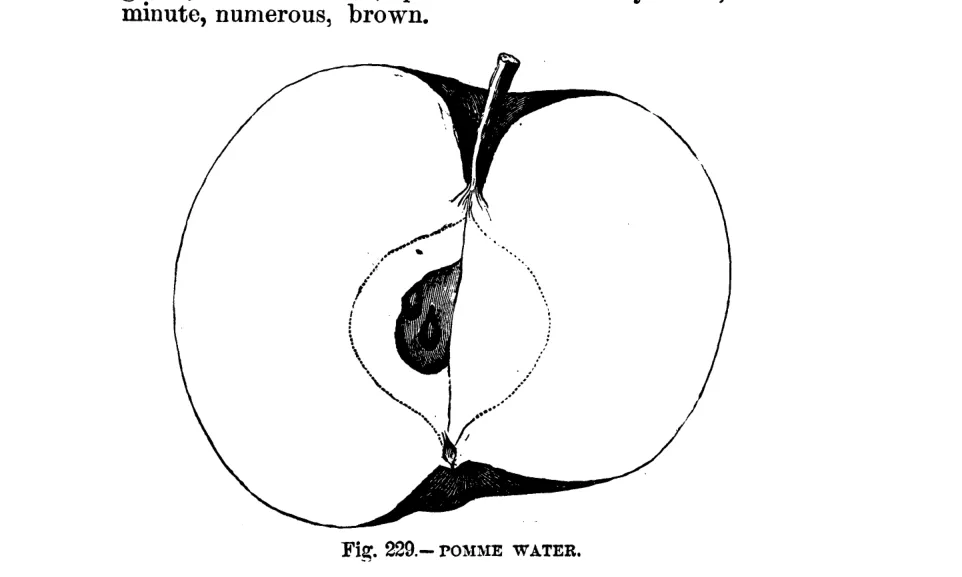
Pomme Water
Origin/History
An old apple, described by Kenrick, Hogg, and others (Downing). It has travelled considerably but is not generally known, nor very highly appreciated (Downing). A specimen under this name was also found in Northern Illinois, though little is known of its origin or history there (Warder). Specimens were obtained from Henry Kimball, of Rockford, Winnebago County, Illinois (Warder).
Tree
Vigorous, spreading, moderately productive (Downing).
Fruit
Size: Warder describes the fruit as full medium; Downing as medium to large.
Form: Globular truncate, slightly conic, regular (Warder). Roundish, slightly conical (Downing).
Stem: Short, thick, green (Warder). Rather short (Downing).
Cavity: Medium, regular (Warder).
Calyx: Large, closed (Warder). Closed (Downing).
Basin: Wavy, medium (Warder).
Skin: Surface mixed, splashed scarlet on yellow (Warder). Greenish yellow, shaded and splashed with red or crimson in the sun (Downing). Dots minute, numerous, brown (Warder).
Flesh/Flavor: Warder describes the flesh as yellow, breaking, fine grained, juicy, with a sub-acid flavor. Downing describes the flesh as yellowish white, breaking, juicy, pleasant, and sweet. The two sources conflict on both flesh color (yellow vs. yellowish white) and flavor character (sub-acid vs. sweet).
Core/Seeds: Core medium, round, closed, scarcely meeting the eye. Seeds numerous, angular, imperfect (Warder).
Season
Warder places the season in September and October. Downing gives October through December. The two sources thus conflict on the early end of the season (Warder's September vs. Downing's October) and especially on the late end (Downing's December extending well past Warder's October close).
Uses
Table use (Warder). Fine for baking (Downing).
Subtypes/Variants
Downing lists a closely associated variety called Pomme Water Sweet immediately following this entry, suggesting either a distinct sweet-fleshed strain or an alternate name for the same apple under a sweet-fruited selection. Downing's own description of the main entry as "pleasant, sweet" may reflect the Sweet strain rather than the sub-acid type documented by Warder.
Other
Quality rated good to very good by both sources.
Book Sources
Described in 2 period pomological works
View original book sources (2)
— John A. Warder, American Pomology: Apples (1867)Pomme Water.
An apple by this name is found in Northern Illinois; little is known of its origin or history.
Fruit full medium, globular truncate, slightly conic, regular; Surface mixed, splashed scarlet on yellow; Dots minute, numerous, brown.
Fig. 229.— POMME WATER.
Basin wavy, medium; Eye large, closed.
Cavity medium, regular; Stem short, thick, green.
Core medium, round, closed, scarcely meeting the eye; Seeds numerous, angular, imperfect; Flesh yellow, breaking, fine grained, juicy; Flavor sub-acid; Quality good to very good; Use, table; Season, September and October.
Specimens obtained from Henry Kimball, of Rockford, Winnebago County, Illinois.
— A.J. Downing, The Fruits and Fruit Trees of America (1900)Pomme Water.
Pomme Water Sweet.
An old Apple, described in Kenrick, Hogg, and others. It has travelled considerably, but is not generally known, nor very highly appreciated. Tree vigorous, spreading, moderately productive.
Fruit medium to large, roundish, slightly conical, greenish yellow, shaded and splashed with red or crimson in the sun. Stalk rather short. Calyx closed. Flesh yellowish white, breaking, juicy, pleasant, sweet. Good to very good. Fine for baking. October, December.