Président Drouard
Pear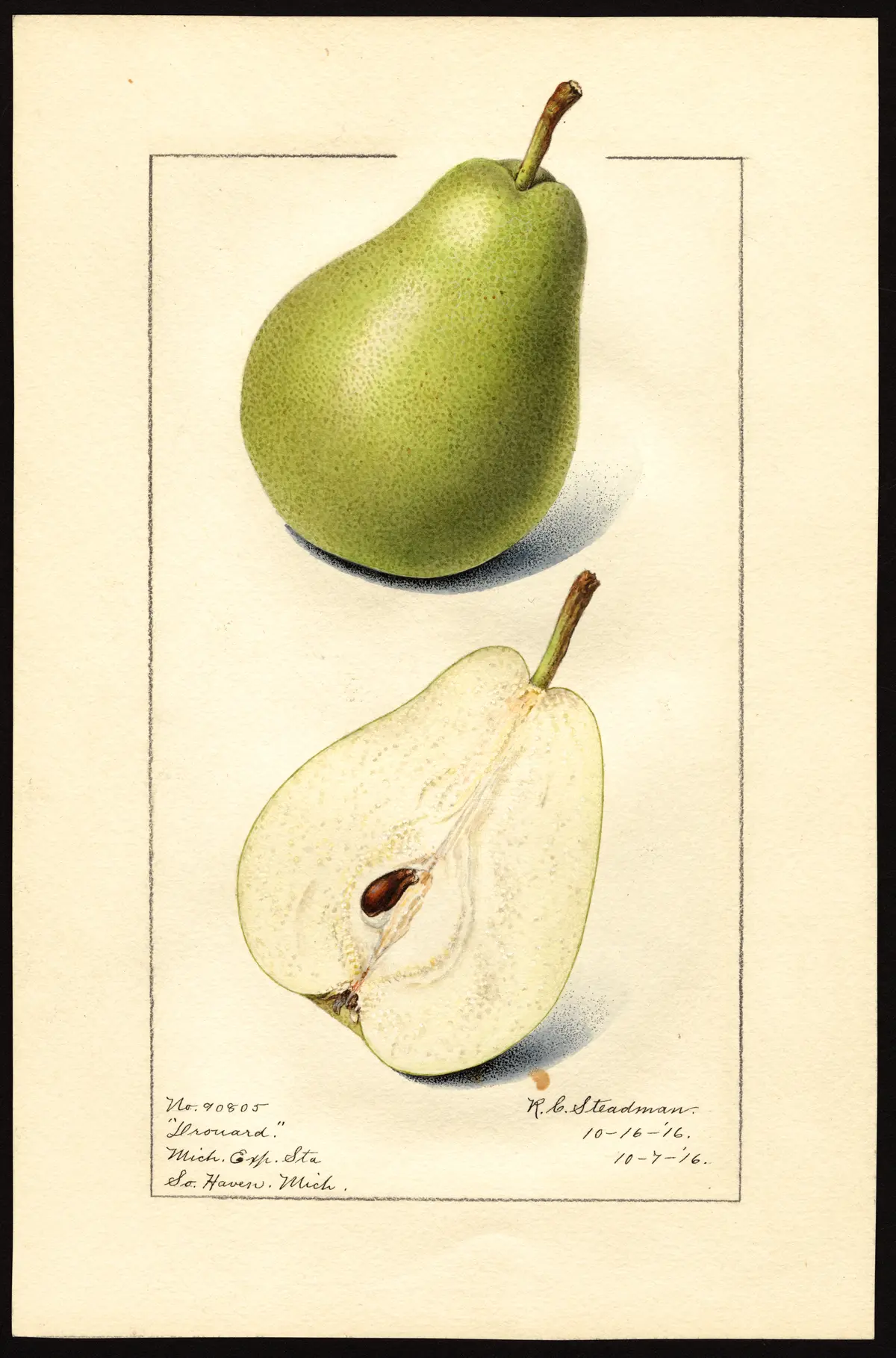
USDA Pomological Watercolor Collection
PRÉSIDENT DROUARD (Pear)
Origin and History
Président Drouard is a chance seedling discovered in the suburbs of Pont-de-Cé, Maine-et-Loire, France, by M. Olivier, gardener at the Fruit-Garden at Angers. It was sent out by M. Louis Leroy of Angers and formally described in 1886. The variety was introduced to the United States by Charles A. Green of Rochester, New York, and was added to the American Pomological Society's list of fruits in 1899 under the name "Drouard." As of 1921, it had been on probation in the United States for nearly thirty years, though it has scarcely achieved popularity even in major pear-growing regions.
Tree
Tree of medium size, spreading, open-topped, and usually hardy. Branches reddish-brown, nearly covered with gray scarf-skin and marked with small lenticels. Branchlets thick and long, greenish-brown mingled with red, dull, smooth, pubescent on new growth, with numerous small, brownish, raised, conspicuous lenticels.
Leaf-buds small, short, pointed, plump, and free. Leaf-scars with very prominent shoulders. Leaves 3 inches long, 1½ inches wide, oval, thick, and leathery; apex taper-pointed; margin glandless or with but few glands, entire or closely serrate. Petiole glabrous, greenish, thick, ¾ inch long, tinged red. Stipules very short, tinged with pink.
Flower-buds short, conical, very plump, and free, arranged singly on short spurs. Flowers 1¼ inches across, in dense clusters of 6 to 9 buds. Pedicels ¾ inch long, lightly pubescent, greenish.
Note on growth: The trees lack vigor, blight badly, and are niggardly in bearing—significant drawbacks for commercial cultivation.
Fruit
Size and Form: Large, 3½ inches long, 3 inches wide, oblong-obovate-pyriform with unequal sides, uniform in shape.
Stem: 1 inch long, very thick and woody.
Cavity: Obtuse, deep, irregular, furrowed, usually lipped.
Calyx: Large, open; lobes separated at the base, long, narrow, and acuminate.
Basin: Deep, abrupt, usually smooth but sometimes gently furrowed.
Skin: Thick, tough, rough, dull. Color clear lemon-yellow with nettings and streaks of russet. Dots numerous, small, russet, obscure.
Flesh and Flavor: Tinged with yellow, very granular at the core, tender and melting, buttery, juicy, aromatic, and sweet. Quality good.
Core and Seeds: Core large, closed, axile, with clasping core-lines. Calyx-tube short, wide, conical. Seeds large, wide, long, plump, acute, occasionally abortive.
Season
Fruit in season from late November to December.
Uses
While the fruits possess all the requisites of a good pear—juicy, melting, saccharine, rich, and perfumed flesh—the tree's deficiencies render it unsuitable for commercial plantations. It may, however, be planted in home orchards and variety collections where the superior flavor compensates for reduced productivity and disease susceptibility.
Book Sources
Described in 1 period pomological work
Nursery Catalog Sources
Found in 15 catalogs (1891–1917) from Alabama, Illinois, Missouri, Washington
- Missouri Nursery Co. , Louisiana , Missouri — 1891
- J.V. Cotta (Cotta Nursery) , Carroll County , Illinois — 1898
- Alabama Nursery Co. , Huntsville , Alabama — 1900
- Benjamin Buckman (personal inventory) , Farmingdale , Illinois — 1901
- Mountain Grove Nurseries (Tippin & Moore , Proprietors; Geo. T. Tippin, J. W. Tippin, J. C. Moore), Mountain Grove , Missouri — 1901
- Phoenix Nursery Company (W. E. Rossney , President; Sidney Tuttle, Vice-President), Bloomington , Illinois — 1904
- Island Nurseries & Fruit Farm , Vashon (Vashon Island) , Washington — 1910
- Island Nurseries & Fruit Farm , Vashon (Vashon Island) , Washington — 1911
- Vineland Nurseries Company , Clarkston , Washington — 1912
- *Better Fruit* magazine article — 1913
- Van Holderbeke Nursery Co. , Incorporated, Spokane, Washington (nurseries at Otis Orchards WA, Pasadena WA, Kennewick WA) — 1913
- Island Nurseries & Fruit Farm , Vashon (Vashon Island) , Washington — 1914
- Island Nurseries & Fruit Farm , Vashon (Vashon Island) , Washington — 1915
- Island Nurseries & Fruit Farm , Vashon (Vashon Island) , Washington — 1916
- Island Nurseries & Fruit Farm , Vashon (Vashon Island) , Washington — 1917
View original book sources (1)
— U.P. Hedrick, The Pears of New York (1921)PRÉSIDENT DROUARD
- Gard. Chron. N. S. 25:431. 1886. 2. Guide Prat. 51. 1895. 3. Cat. Cong. Pom. France 331, fig. 1906. Président Drouard. 4. Lucas Tafelbirnen 211, fig. 1894. Drouard. 5. Am. Pom. Soc. Cat. 35. 1899. 6. Budd-Hansen Am. Hort. Man. 2:241. 1903. 7. Mich. Sta. Sp. Bul. 27:22. 1903.
Président Drouard has been on probation in the United States for nearly thirty years, but does not seem to be in great demand in any part of the country. In the pear-growing region of New York to which it first came, it is scarcely known. The accompanying description shows that the fruits contain all of the requisites of a good pear. The flesh is juicy, melting, saccharine, rich, and perfumed. The trees, however, are not satisfactory. They lack vigor, blight badly, and are niggardly in bearing. With these faults, there is no place for the variety in commercial plantations, but it may well be planted in home orchards and in collections.
Président Drouard is a chance seedling found in the suburbs of Pont-de-Cé, Maine-et-Loire, France, by M. Olivier, gardener at the Fruit-Garden at Angers. It was sent out by M. Louis Leroy of Angers and was described in 1886 as a new pear. It seems to have been introduced in this country by Charles A. Green, Rochester, New York. The American Pomological Society added the variety to its list of fruits under the name Drouard in 1899.
Tree of medium size, spreading, open-topped, usually hardy; branches reddish-brown, nearly covered with gray scarf-skin, marked with small lenticels; branchlets thick, long, greenish-brown mingled with red, dull, smooth, pubescent on the new growth, with numerous small, brownish, raised, conspicuous lenticels.
Leaf-buds small, short, pointed, plump, free; leaf-scars with very prominent shoulders; Leaves 3 in. long, 1½ in. wide, oval, thick, leathery; apex taper-pointed; margin glandless or with but few glands, entire or closely serrate; petiole glabrous, greenish, thick, ¾ in. long, tinged red; stipules very short, tinged with pink. Flower-buds short, conical, very plump, free, arranged singly on short spurs; flowers 1¼ in. across, in dense clusters, 6 to 9 buds in a cluster; pedicels ¾ in. long, lightly pubescent, greenish.
Fruit in season from late November to December; large, 3½ in. long, 3 in. wide, oblong-obovate-pyriform, with unequal sides, uniform in shape; stem 1 in. long, very thick and woody; cavity obtuse, deep, irregular, furrowed, usually lipped; calyx large, open; lobes separated at the base, long, narrow, acuminate; basin deep, abrupt, usually smooth but sometimes gently furrowed; skin thick, tough, rough, dull; color clear lemon-yellow, with nettings and streaks of russet; dots numerous, small, russet, obscure; flesh tinged with yellow, very granular at the core, tender and melting, buttery, juicy, aromatic, sweet; quality good. Core large, closed, axile, with clasping core-lines; calyx-tube short, wide, conical; seeds large, wide, long, plump, acute, occasionally abortive.