QUINCE (of Coxe)
Apple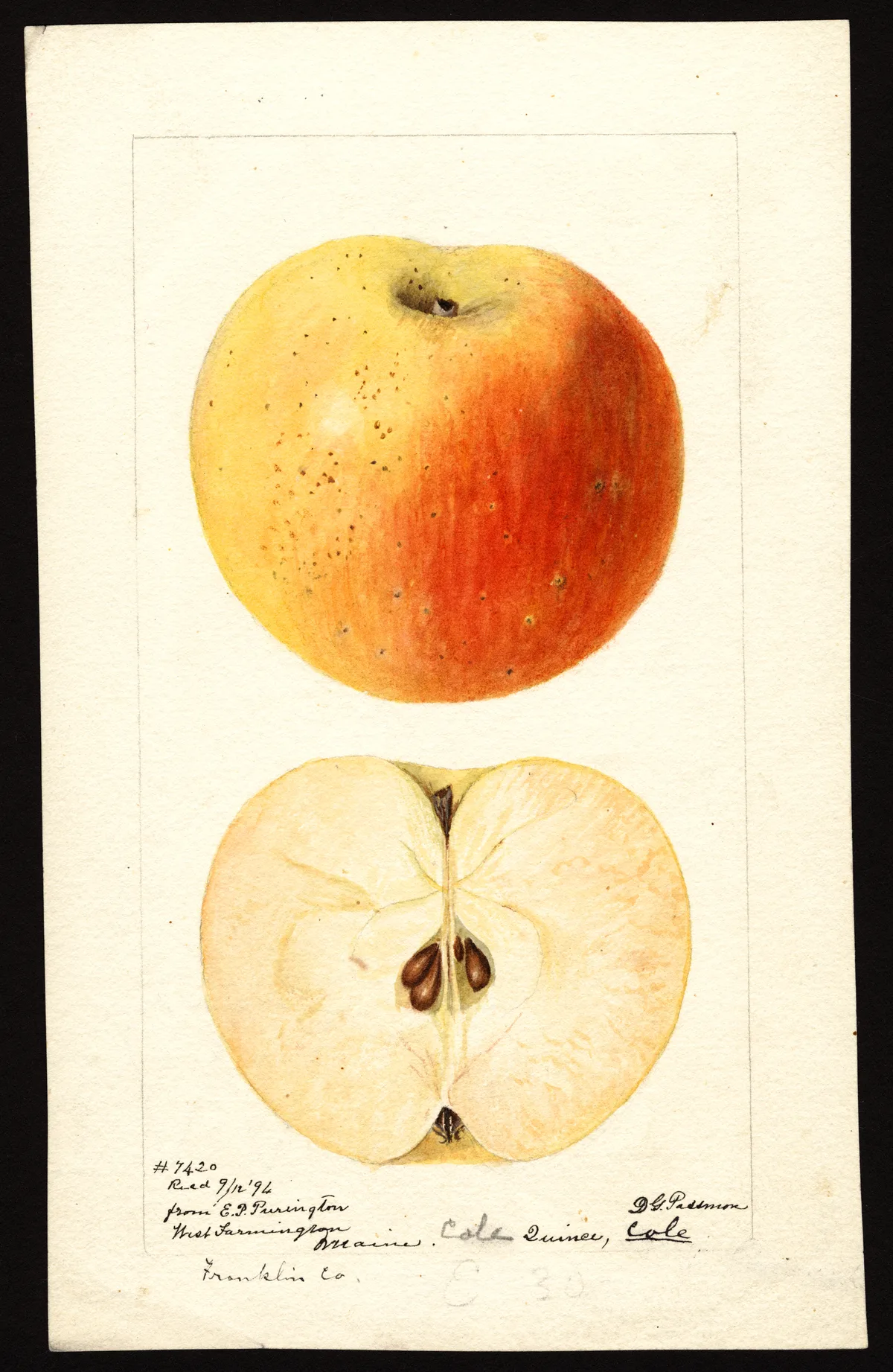
USDA Pomological Watercolor Collection
Quince (of Coxe)
Origin/History
Originally described by William Coxe in 1817 (A View of the Cultivation of Fruit Trees, No. 65), with an earlier reference in M'Mahon's American Gardener's Calendar (1806). The variety came originally from the state of New York. It is distinct from the Quince of Cole, which is a separate variety despite sharing a common name. By 1905, Beach reported it unknown to him and unconfirmed by any correspondents, suggesting the variety had become rare or lost from cultivation by that time.
Tree
The tree is of large and vigorous growth. According to Downing (as cited by Beach), the young wood is dull reddish-brown — distinguished from the Quince of Cole, whose young wood is clear reddish-brown. Buds are small, reddish, and pointed, in contrast to the Quince of Cole's buds, which are short, abrupt, and prominent.
Fruit
Size: Large.
Form: Flat. In appearance it somewhat resembles a large Yellow Newtown Pippin.
Stem: Not described in source.
Cavity: Not described in source.
Calyx: Not described in source.
Basin: Not described in source.
Skin: Yellow when fully ripe.
Flesh/Flavor: Flesh rich, yellow, and juicy.
Core/Seeds: Not described in source.
Season
Ripens in November.
Uses
Not described in source.
Subtypes/Variants
Not described in source.
Other
Coxe's description was accompanied by a figure (cited as "fig." in Beach's reference list under entry 2). The variety is referenced across a substantial run of 19th-century pomological literature (M'Mahon 1806, Coxe 1817, Thacher 1822, Cole 1849, Thomas 1849, Downing 1857 and 1869, Horticulturist 1868, Fitz 1872), indicating it was recognized and discussed through much of the century even if rarely grown.
Book Sources
Described in 2 period pomological works
- Beach, The Apples of New York Vol. 2 (1905)
- Coxe, A View of the Cultivation of Fruit Trees (1817) — listed as Quince Apple
View original book sources (2)
— William Coxe, A View of the Cultivation of Fruit Trees (1817)NO. 65. QUINCE APPLE.
The tree is of large and vigorous growth—the size of the apple is large; the shape flat; the skin, when fully ripe, is yellow; the flesh rich, yellow and juicy—in appearance, it somewhat resembles a large yellow Newton Pippin. It came originally from the state of New-York—ripens in November.
— S.A. Beach, The Apples of New York, Vol. 2 (1905)QUINCE (of Coxe).
REFERENCES. 1. M'Mahon, Am. Gard. Cal., 1806:585. 2. Coxe, 1817:138. fig. 3. Thacher, 1822:132. 4. Cole, 1849:115. 5. Thomas, 1849:158. 6. Downing, 1857:181. 7. Horticulturist, 23:146. 1868. fig. 8. Downing, 1869:319. 9. Fitz, 1872:153. 10. Downing, 1872:10 index, app. 11. Ragan, U. S. B. P. I. Bul., 56:246. 1905.
SYNONYMS. Pear Apple (8, 11). QUINCE (1, 2, 3, 5, 6, 8, 9, 10). Quince Apple (11). QUINCE (Coxe) (11). QUINCE OF COXE (4, 7). Quince of Coxe (11). Seneca Favorite (10). Seneca Spice (11, ?8).
A variety which is distinct from the Quince of Cole was described by Coxe in 1817. According to Downing, it is in appearance much like a large Yellow Newtown, and the young wood is of a different shade of color from that of the Quince of Cole, being dull reddish-brown instead of clear reddish-brown, with buds small, reddish and pointed, instead of short, abrupt and prominent. The following is the description of the fruit given by Coxe (2): "The size of the apple is large; the shape flat; the skin, when fully ripe, is yellow; the flesh rich, yellow and juicy; in appearance it somewhat resembles a large yellow Newtown Pippin. It came originally from the state of New York; ripens in November."
This variety is unknown to us, and we have received no report concerning it from any of our correspondents.