Rainier
Apple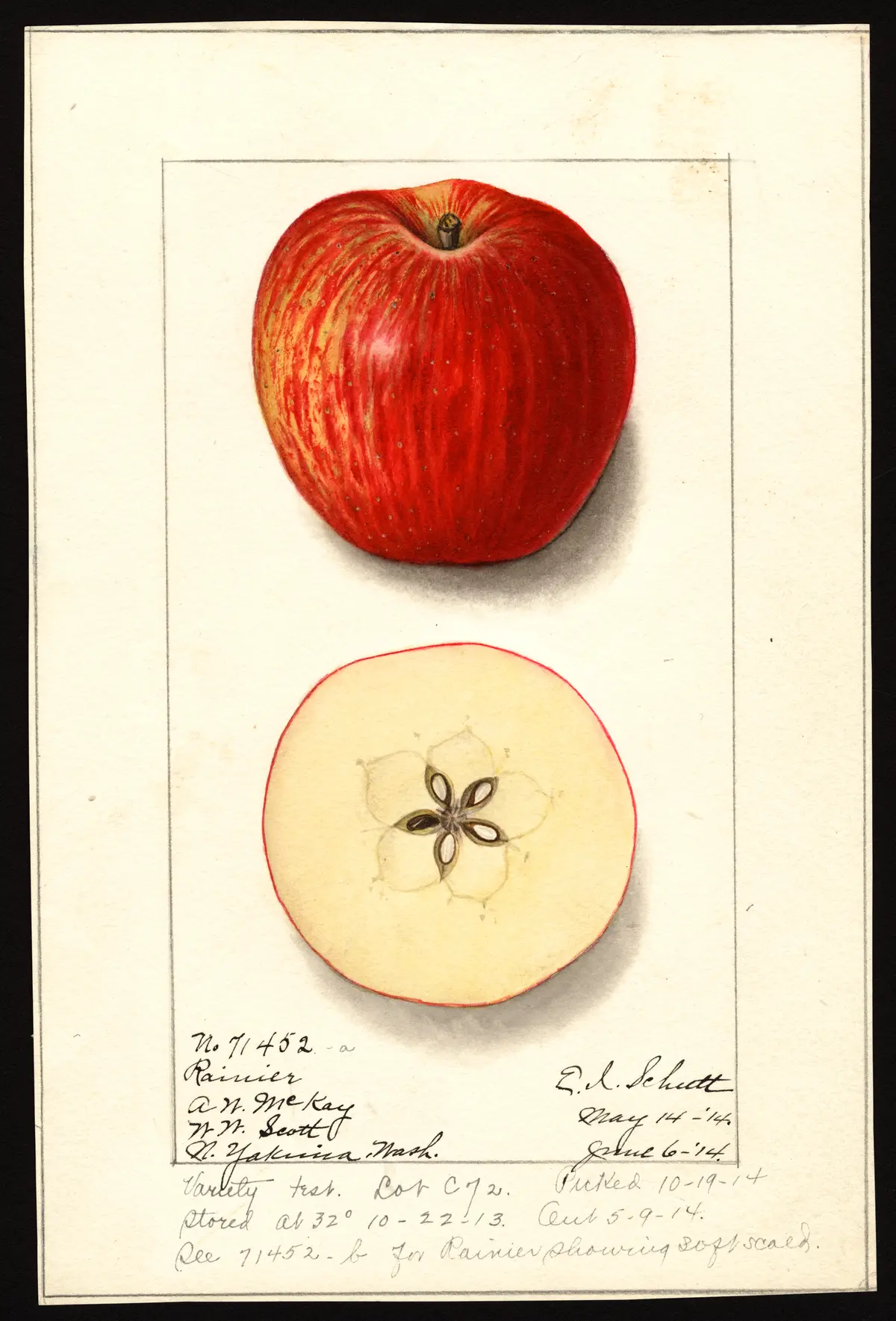
USDA Pomological Watercolor Collection
Rainier
Origin/History
The original 54 trees were planted approximately 30 years before this account (c. 1884) by a man whose identity is now lost. Despite thorough investigation, no information could be found regarding the source of the original scions or nursery stock. Prior to the present owner's acquisition, the fruit had been marketed under various names. The previous owner of the orchard had decided to graft the trees to Spitzenburg varieties, and Spitzenburg scions had been grafted in before W. W. Scott took possession of the orchard. When it came time to prune, Mr. Scott considered whether to retain the original trees or allow the Spitzenburg grafts to mature. He chose to keep the original trees, determining that waiting the several years required for the Spitzenburg scions to come into bearing would be impractical. The variety was named "Rainier" to be suggestive of the locality.
Tree
The tree is a vigorous grower with a spreading habit, capable of bearing heavy crops. Twigs are quite long and slender. Bark is light in color with a few dots.
Fruit
Form: Oblong in shape, slightly inclined to conical. The fruit displays five distinct points at the blossom end, characteristic of the Delicious type.
Skin: Yellowish green underneath, with an over-coloring of dark red. Slightly streaked.
Flesh and Flavor: Yellowish with practically no grain, better described as "buttery." Quality much resembles the Delicious, but the Rainier is a much better cold storage apple.
Stem, Cavity, Calyx/Basin, Core/Seeds: Not described in source.
Season
In common storage: October to February. In cold storage: October to October (full-year storage capacity).
Uses
Not described in source.
Subtypes/Variants
Not described in source.
Other
The Rainier is exceptional among apples for its storage qualities. Fruit picked in October 1912 was displayed at the banquet of the International Refrigerator Congress in Chicago in September 1913, and remained in perfect condition. Government pomologists identified the Rainier as "the one apple which does not show some defect from cold storage." Scald is unknown in the variety; decay is practically unknown. Unlike most apples, eating quality improves rather than deteriorates in storage.
Book Sources
Described in 1 period pomological work
View original book sources (1)
— Granville Lowther (ed.), Encyclopedia of Practical Horticulture (1914)Rainier
Historical.—The original 54 trees were planted some 30 years ago by a man now dead and, after a very thorough investigation, no information was found that would lead to a knowledge of the source of the original scions or nursery stock. Up to the time the present owner, W. W. Scott, came into possession of the orchard the fruit was marketed under various names. The gentleman owning the orchard at that time had decided to graft over the trees to Spitzenburgs, and when Mr. Scott moved on to the place he found that the Spitzenburg scions had been grafted in. When it came time to prune Mr. Scott was undecided whether to leave the Spitzenburg scions or the original trees but, owing to the fact that it would take several years for the scions to come into bearing and that Mr. Scott was no longer a young man, he at last made up his mind to leave the original trees and take a chance on the fruit. The name "Rainier" was selected as being suggestive of the locality.
Tree.—The tree is a vigorous grower and is inclined to be spreading, therefore, capable of bearing a heavy crop. Twigs quite long and slender. Bark light and showing a few dots.
Fruit.—The fruit is oblong and slightly inclined to conical. Flesh, yellowish with practically no grain. Probably better described as "buttery." Skin, yellowish green underneath with an over-coloring of dark red. Slightly streaked. Quality, much resembling the Delicious, but a much better cold storage apple. Fruit picked during October, 1912, was placed on the table at the banquet of the International Refrigerator Congress, Chicago, in September of 1913, in perfect condition. The Government pomologists say it is the one apple which does not show some defect from cold storage. Scald is unknown, decay practically so. Eating quality seems to improve rather than deteriorate. Should also say in regard to the shape of the fruit that it shows the five distinct points at the blossom end which is so distinctive of the Delicious.
Season.—In common storage from October to February. In cold storage from October to October.