Rambour Papeleu
Apple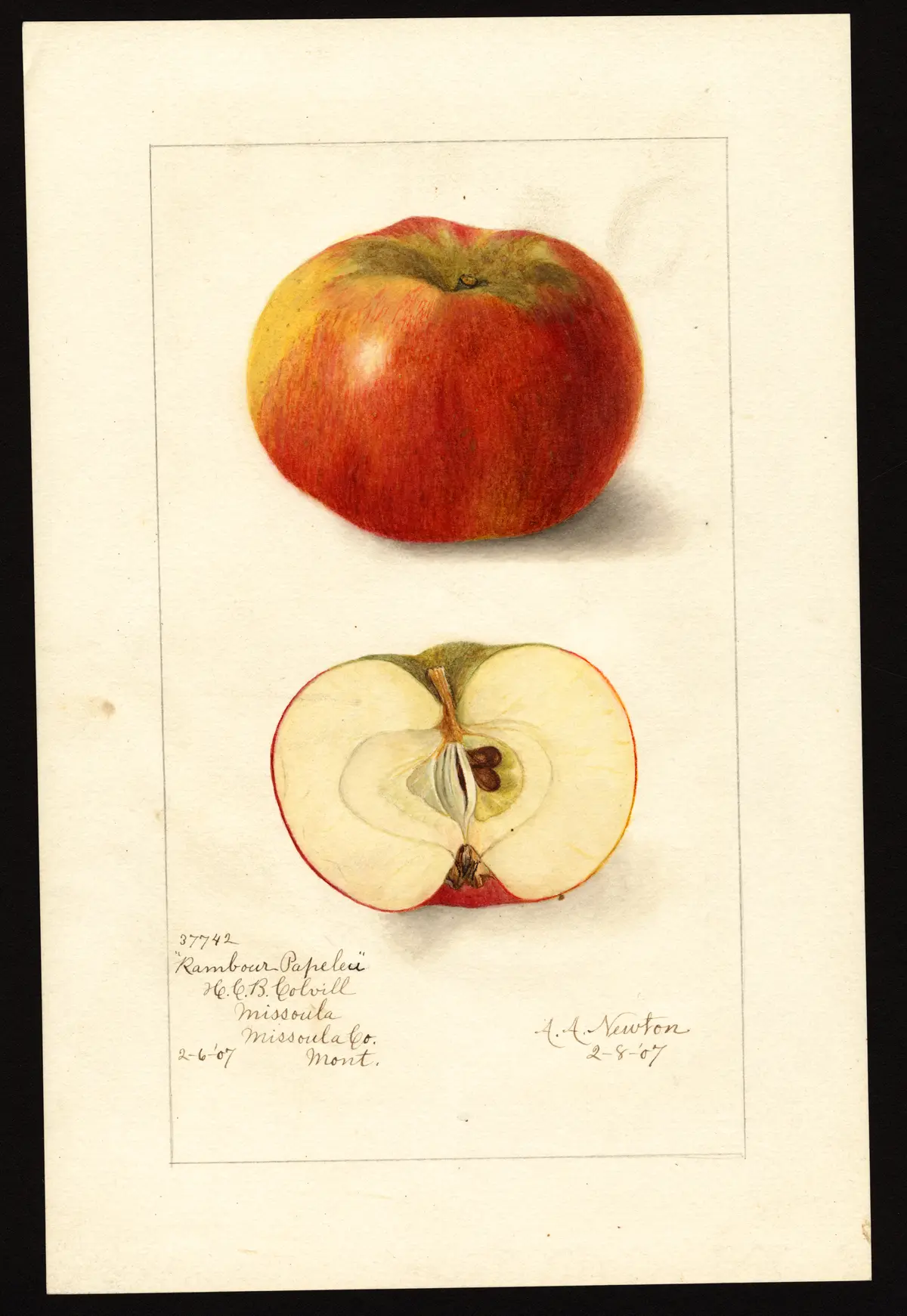
USDA Pomological Watercolor Collection
Rambour Papeleu
Origin/History
Rambour Papeleu is of Russian origin, raised by Col. Hartwiss, of Nitika, in the Crimea, about 1853, and named after M. Papaleu, of Ghent. The variety was first published in Arbor. Belge (1882, p. 33). Downing notes it as "An Apple of good promise for market."
Tree
The tree is vigorous (Downing) with very stout and compact, upright growth (Bunyard). Productive and fertile — Bunyard rates fertility as excellent.
Leaves: Large, dark, flat, and regularly serrate (Bunyard).
Fruit
Size: Very large. Bunyard gives specific measurements of 3½ inches by 3 inches.
Form: The two sources conflict. Downing describes the fruit as roundish oblate conical; Bunyard describes it as oblong-conical.
Stem: Downing describes the stalk as medium. Bunyard describes the stem as rather short, set in a shallow cavity.
Cavity: Shallow (Bunyard). Not described by Downing.
Calyx/Eye: The sources conflict. Downing states the calyx is closed; Bunyard states the eye is open.
Basin: Wide and ribbed (Bunyard). Not described by Downing.
Skin: The sources give somewhat differing ground color descriptions. Downing describes the skin as deep rich yellow, spotted, striped, and splashed with shades of rich red, with small light russet dots. Bunyard describes the color as pale yellow and green with bold red striping and flush.
Flesh/Flavor: The sources conflict substantially. Downing describes the flesh as yellowish white, rather coarse, breaking, and sharp subacid, rating it Good. Bunyard describes the flesh as pale yellow, crisp, juicy, and sweet.
Season
Downing gives the season as November through January. Bunyard lists the variety as a culinary or dessert apple keeping till March.
Uses
Suitable for culinary use and dessert (Bunyard). Downing notes it as an apple of good promise for market.
Subtypes/Variants
Not described in source.
Other
Not described in source.
Book Sources
Described in 2 period pomological works
- Downing, Fruits and Fruit Trees of America (1900)
- Bunyard, A Handbook of Hardy Fruits (1920) — listed as RAMBOUR PAPALEU
Nursery Catalog Sources
Found in 2 catalogs (1900) from England
- George Bunyard & Co. , Royal Nurseries, Maidstone, Kent , England — 1900 — listed as Rambour Papelen
- Central Experimental Farm , Dominion Department of Agriculture, Agassiz, British Columbia (under test; Bulletin No. 3, Second Series) — 1900
View original book sources (2)
— A.J. Downing, The Fruits and Fruit Trees of America (1900)Rambour Papeleu.
Rambourg Papeleu.
Of Russian origin. Tree vigorous, productive.
Fruit large, roundish oblate conical, deep rich yellow, spotted, striped, and splashed with shades of rich red, small light russet dots. Stalk medium. Calyx closed. Flesh yellowish white, rather coarse, breaking, sharp subacid. Good. November, January. An Apple of good promise for market.
— E.A. Bunyard, A Handbook of Hardy Fruits (1920)RAMBOUR PAPALEU. Arbor. Belge, 1882, p. 33. Culinary or dessert, till March, very large, 3½ by 3, oblong-conical. Colour, pale yellow, green with bold red striping and flush. Flesh, pale yellow, crisp, juicy, sweet. Eye, open, in a wide ribbed basin. Stem, rather short, in a shallow cavity. Growth, very stout and compact, upright; fertility, excellent. Leaf, large, dark, flat, regularly serrate. Origin, raised by Col. Hartwiss, of Nitika, in the Crimea, about 1853, and named after M. Papaleu, of Ghent.
Red Astrachan: see Astrachan Red. Red Beefing: see Norfolk Beefing. Red Flanders: see Hollandbury. Red Hawthornden: see Yorkshire Beauty.
[Additional entry in this volume: "Rambour Papeleu", pp. 116–116]
RAMBOUR PAPALEU. Arbor. Belge, 1882, p. 33. Culinary or dessert, till March, very large, 3½ by 3, oblong-conical. Colour, pale yellow, green with bold red striping and flush. Flesh, pale yellow, crisp, juicy, sweet. Eye, open, in a wide ribbed basin. Stem, rather short, in a shallow cavity. Growth, very stout and compact, upright ; fertility, excellent. Leaf, large, dark, flat, regularly serrate. Origin, raised by Col. Hartwiss, of Nitika, in the Crimea, about 1853, and named after M. Papaleu, of Ghent.