Rawle's Janet
Apple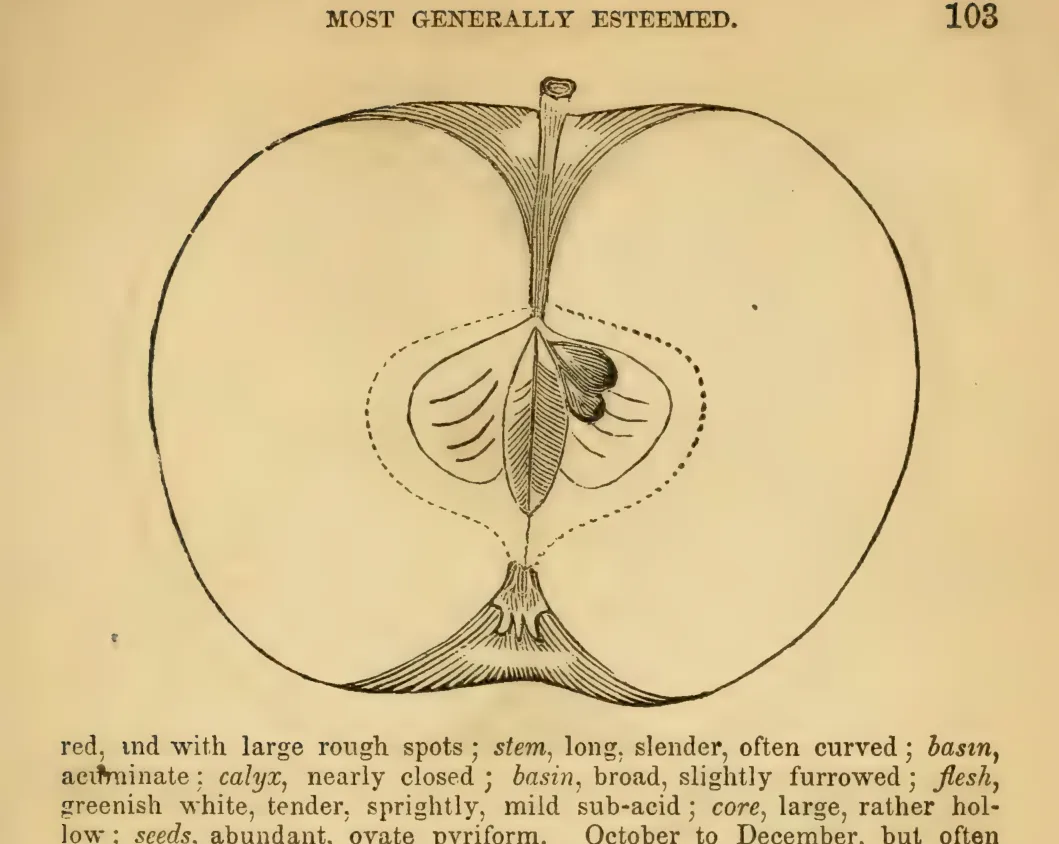
Rawle's Janet
Origin and History
According to H.P. Byram, Esq., this variety was first brought to the southwestern sections from Amherst County, Virginia, near the Blue Ridge, where it was originated by Caleb Raules, who named it Janet. According to Geo. Hoadley, Esq., Governor Worthington had it in his orchard forty years prior, and from thence it was brought to northern Ohio. The variety became known by the Scriptural name Rock-Rimmon in the Sciota valley, probably on account of its sure bearing and long keeping qualities.
Tree
The tree is tardy in Spring in leaving out, blossoming some ten days after other varieties, thus escaping late Spring frosts.
Fruit
Fruit medium to large; form roundish conical, flattened at stem end. Skin thick and tough. Color a ground of light pale yellowish green, mostly overspread, striped and stained with dull red, with a blue or grayish shade lying within as of a bloom. Small russet dots are present, showing most prominently when the fruit is highly colored; in the South, many patches of mould or fungus appear on the surface. Stem slender and rather long. Cavity deep and regular. Calyx nearly closed, with short segments. Basin open, regular, not deep, sometimes slightly furrowed near the calyx. Flesh yellowish, tender, mild sub-acid. Core medium. Seeds angular ovate.
Season
Late Spring.
Uses
Not described in source.
Other
In quality Rawle's Janet is only second rate. At the North it is not desirable, but south of Cincinnati it is highly desirable, as it succeeds when many others often fail. In Missouri it is regarded as essential to every orchard.
Book Sources
Described in 1 period pomological work
Nursery Catalog Sources
Found in 13 catalogs (1886–1921) from Alabama, Illinois, Missouri, Nebraska, Oregon, Virginia, Washington
- Huntsville Wholesale Nurseries (Jessie S. Moss , Proprietor; W.F. Heikes, Manager), Huntsville , Alabama — 1886
- The Salem Nursery (John A. Francis , Proprietor), Salem , Virginia — 1897
- Alabama Nursery Co. , Huntsville , Alabama — 1900
- Washington Nursery Co. , Toppenish , Washington — 1901
- Mountain Grove Nurseries (Tippin & Moore , Proprietors; Geo. T. Tippin, J. W. Tippin, J. C. Moore), Mountain Grove , Missouri — 1901
- Benjamin Buckman (personal inventory) , Farmingdale , Illinois — 1901
- The Dalles Nurseries , The Dalles , Oregon — 1906
- Washington Nursery Company , Toppenish , Washington — 1909
- Galbraith Nursery Co. (DeWitt Hansen , Pres.-Mgr.), Fairbury , Nebraska — 1911
- Pacific Nursery Company , Portland , Oregon — 1912
- Washington Nursery Company , Toppenish , Washington — 1912
- Union Nurseries , J.B. Weaver & Sons, Union , Oregon — 1915
- Benedict Nursery Co. , Portland , Oregon — 1921
View original book sources (1)
— F.R. Elliott, The Western Fruit Book (1865)Raules' Janet.
Rawl's Gennetting, Jennette, Rock-Rimmon, Rawl's Janet, Jeniton, Neverfail, Winter Genneting, Rawle's Janette, Yellow Janette, Rock Remain, Rawle's Jennette, Indiana Jannetting.
This variety, according to H. P. Byram, Esq., was first brought to the South-western sections, from Amherst Co., Va., near the Blue Ridge, where it was originated by Caleb Raules, who named it Janet, hence the name. According to Geo. Hoadley, Esq., Gov. Worthington had it in his orchard 40 years since, and from thence it was brought to northern Ohio. The Scriptural name of Rock-Rimmon, given it in the Sciota valley, was probably on account of its sure bearing, and long keeping qualities. The tree is tardy in Spring in leaving out, and blossoms some ten days after other varieties; thus escaping late Spring frosts. In quality it is only second rate, and at the North is not desirable, but south of Cincinnati is highly so, as it succeeds when many others often fail. In Missouri it is regarded as essential to every orchard.
Fruit, medium to large; form, roundish conical, flattened at stem end; skin, thick, tough; color, a ground of light pale yellowish green, mostly overspread, striped and stained with dull red, and with a blue or grayish shade lying within as of a bloom: small russet dots, that show most when the fruit is high colored — South, many patches of mould or fungus; stem, slender, rather long; cavity, deep, regular; calyx, nearly closed, short segments; basin, open, regular, not deep, sometimes slightly furrowed near the calyx; flesh, yellowish, tender, mild sub-acid; core, medium; seeds, angular ovate. Late Spring.