Red Delicious*
Apple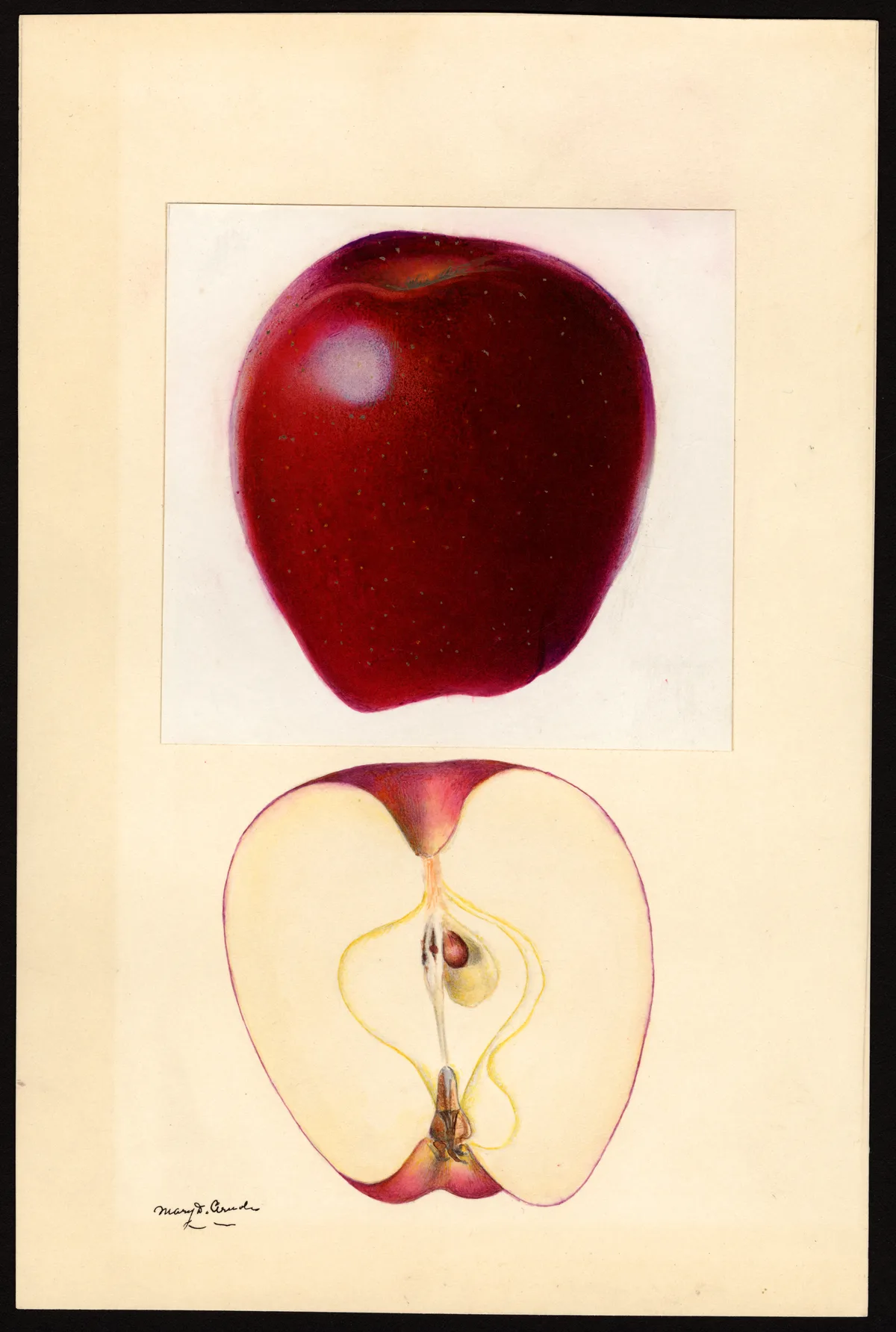
USDA Pomological Watercolor Collection
Red Delicious*
Origin / History
The original Delicious apple originated as a seedling in Iowa in 1895. Since then a number of strains or varieties have appeared, particularly during the past 25 years. Collectively they constitute the most important group of apples in the Pacific Northwest.
Tree
Trees are vigorous, upright-growing, with narrow-angled, weak crotches being somewhat characteristic.
Fruit
Size: Fruit, when properly grown, is very attractive, medium to large in size. Fruit size often is small on older trees.
Form: Fruit is characteristically conic shaped and distinctly crowned.
Stem: Not described in source.
Cavity: Not described in source.
Calyx: Not described in source.
Basin: Not described in source.
Skin: Skin is thick, fairly tender, greenish-yellow, overlaid either with nearly continuous striping or solid red. It is one of the most attractive red varieties.
Dots: Not described in source.
Flesh and flavor: Flesh is yellowish-white, firm, moderately fine, crisp, moderately tender, juicy, aromatic, and mild in flavor. When the fruit is in prime condition, quality is excellent.
Core and seeds: Water coring is a problem in some areas.
Season
Storage life is short while the fruit is in prime eating condition.
Uses
Red Delicious* is a dessert apple only and must be grown to perfection to be marketed profitably. Low grades are not saleable, and they do not cook well. Despite its enormous popularity, the variety has many defects.
Subtypes / Variants
Within the past 10 years an entire new series of red sports has occurred, originating out of Starking, Richared, and other red-colored types. At the present time, 24 of these newer sports are being tested in the Experiment Station's variety testing orchards. Nearly all of them are earlier with more intense coloration. Considerable variation exists among them, and each must be recognized as a separate variety. Certain of these types are darker in color, with more black pigment blended with red. Others are a distinctly solid color in contrast to some of the more striped types. The range and shades of red color found among the individual types are also noted. Many of these strains are of such recent origin that little can be said specifically about their potential value for particular areas. Market requirements must be considered carefully to determine the relative importance of early fruit coloration versus shade and intensity of full color development when harvested somewhat later. Every bud sport of separate origin must be tested in the orchard before it can be recommended as an improvement over any other color sport for a particular area. Growers of this variety or of others are urged to watch for new types that might occur in their orchards.
Other
Fruit is susceptible to scab infection.
Book Sources
Described in 1 period pomological work
View original book sources (1)
— Quentin B. Zielinski, Apple Varieties for Oregon (1964)Red Delicious*
The original Delicious apple originated as a seedling in Iowa in 1895. Since then a number of strains or varieties have appeared, particularly during the past 25 years. Collectively they constitute our most important group of apples in the Pacific Northwest.
Characteristics
Trees are vigorous, upright-growing, with narrow-angled, weak crotches being somewhat characteristic. Fruit, when properly grown, is very attractive, medium to large in size, characteristically conic shaped, and distinctly crowned. Skin is thick, fairly tender, greenish-yellow, overlaid either with nearly continuous striping or solid red. Flesh is yellowish-white, firm, moderately fine, crisp, moderately tender, juicy, aromatic, and mild in flavor. When the fruit is in prime condition, quality is excellent. It is one of our most attractive red varieties.
Limitations
In spite of its enormous popularity this variety has many defects, among which are: ¶ It is a dessert apple only, and must be grown to perfection to be marketed profitably. ¶ Storage life is short while the fruit is in prime eating condition. ¶ Fruit is susceptible to scab infection. ¶ Fruit size often is small on older trees. ¶ Low grades are not saleable. They do not cook well. ¶ In some areas, water coring is a problem.
Red sports
Within the past 10 years an entire new series of red sports has occurred, originating out of Starking, Richared, and other red-colored types. At the present time, 24 of these newer sports are being tested in the Experiment Station's variety testing orchards. Nearly all of them are earlier with more intense coloration. Considerable variation exists among them, and each must be recognized as a separate variety. Certain of these types are darker in color with more black pigment blended with red. Others are a distinctly solid color in contrast to some of the more striped types. Notable too are the range and shades of red color found among the individual types. Many of these strains are of such recent origin that little can be said specifically at this time about their potential value for particular areas. Consider market requirements carefully to determine the relative importance of early fruit coloration versus shade and intensity of full color development when harvested somewhat later. Every bud sport of separate origin must be tested in the orchard before it can be recommended as an improvement over any other color sport for a particular area. Growers of this variety or of others are urged to watch for new types that might occur in their orchards.