Red Foxwhelp
Apple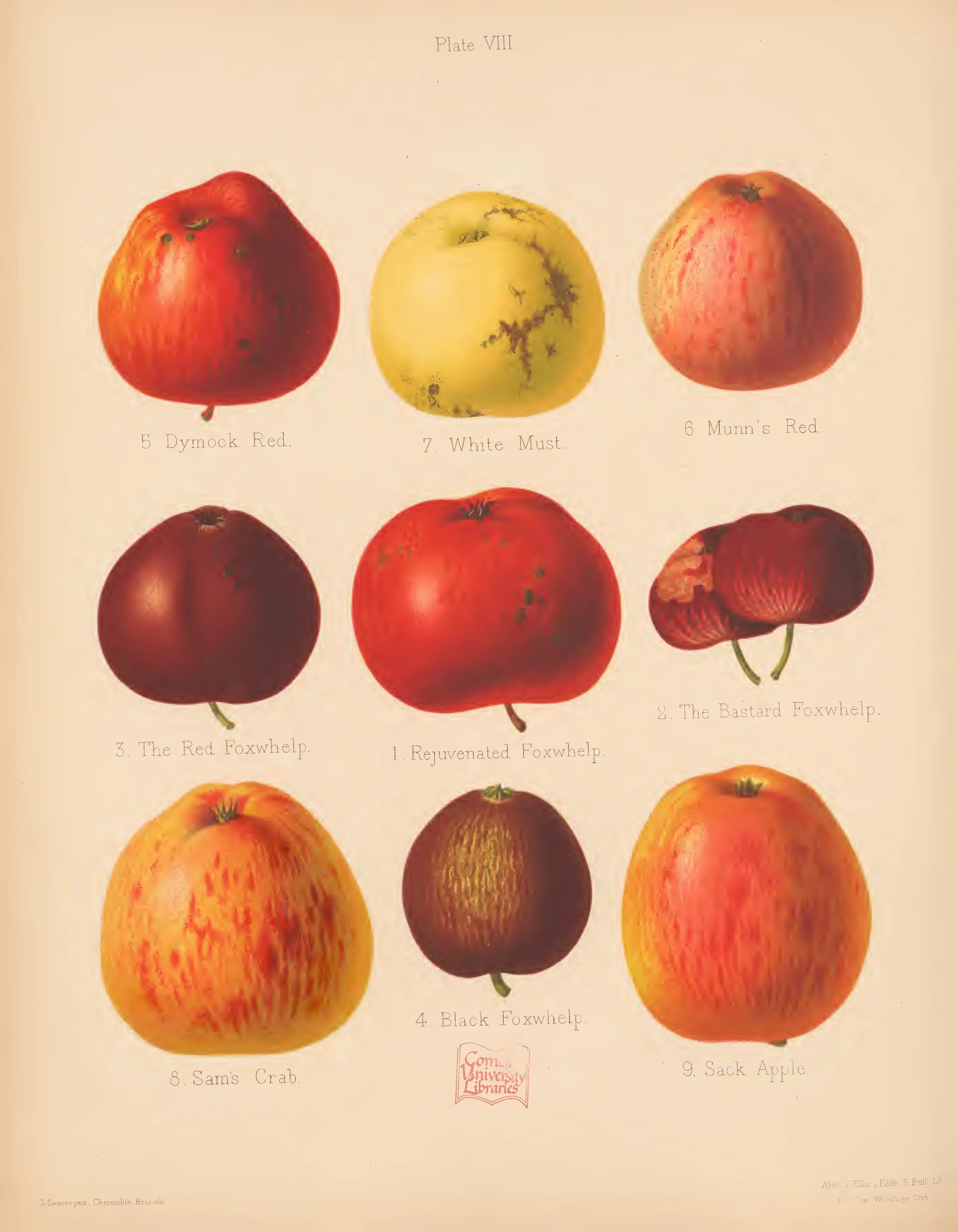
Red Foxwhelp
Origin / History
Chiefly grown in the Bodenham and Harden districts (Herefordshire).
Tree
Not described in source.
Fruit
Size: Small.
Form: Roundish ovate, even and regular in outline.
Skin: Uniformly very dark crimson, almost of a chestnut or mahogany colour over the whole surface, except a small portion on the shaded side, which is slightly, but very slightly, paler.
Stem: Not described in source.
Cavity: Not described in source.
Calyx / Eye: Small and slightly open, with short rather erect segments, set in a shallow, plaited basin. Tube short conical; stamens rather marginal.
Basin: Shallow, plaited.
Flesh: Yellow, deeply stained with crimson both under the skin and at the core. Very tender, pleasantly flavoured, with a slight acidity.
Core / Seeds: Cells of the core open; cell-walls ovate.
Season
Not described in source.
Uses
Valued as a cider apple. Pleasant to eat. Cooks well.
Other
The fruit's small size and want of sufficient character prevent it from being generally grown. Chemical analysis shows it to be rich in sugar and mucilage.
Book Sources
Described in 1 period pomological work
View original book sources (1)
— Woolhope Naturalists Field Club, The Herefordshire Pomona (1885)
- RED FOXWHELP.
This apple is chiefly grown in the Bodenham and Harden districts. It is pretty, well-shaped, and very rich in colour. It is pleasant to eat, cooks well, and its growers value it as a cider apple.
Description.—Fruit small, roundish ovate, even and regular in its outline. Skin, uniformly very dark crimson, almost of a chestnut or mahogany colour over its whole surface, except a small portion on the shaded side, which is a little, but very little paler. Eye, small and slightly open, with short rather erect segments, and set in a shallow, plaited basin ; tube, short conical; stamens, rather marginal. Flesh, yellow, deeply stained with crimson, both under the skin and at the core ; very tender, pleasantly flavoured, and with a slight acidity. Cells of the core, open ; cell-walls, ovate.
The want of size in the Red Foxwhelp, and its want of sufficient character too, will prevent its being generally grown. Its chemical analysis, however, shows it to be rich in sugar and mucilage.