Red Rome Beauty
Apple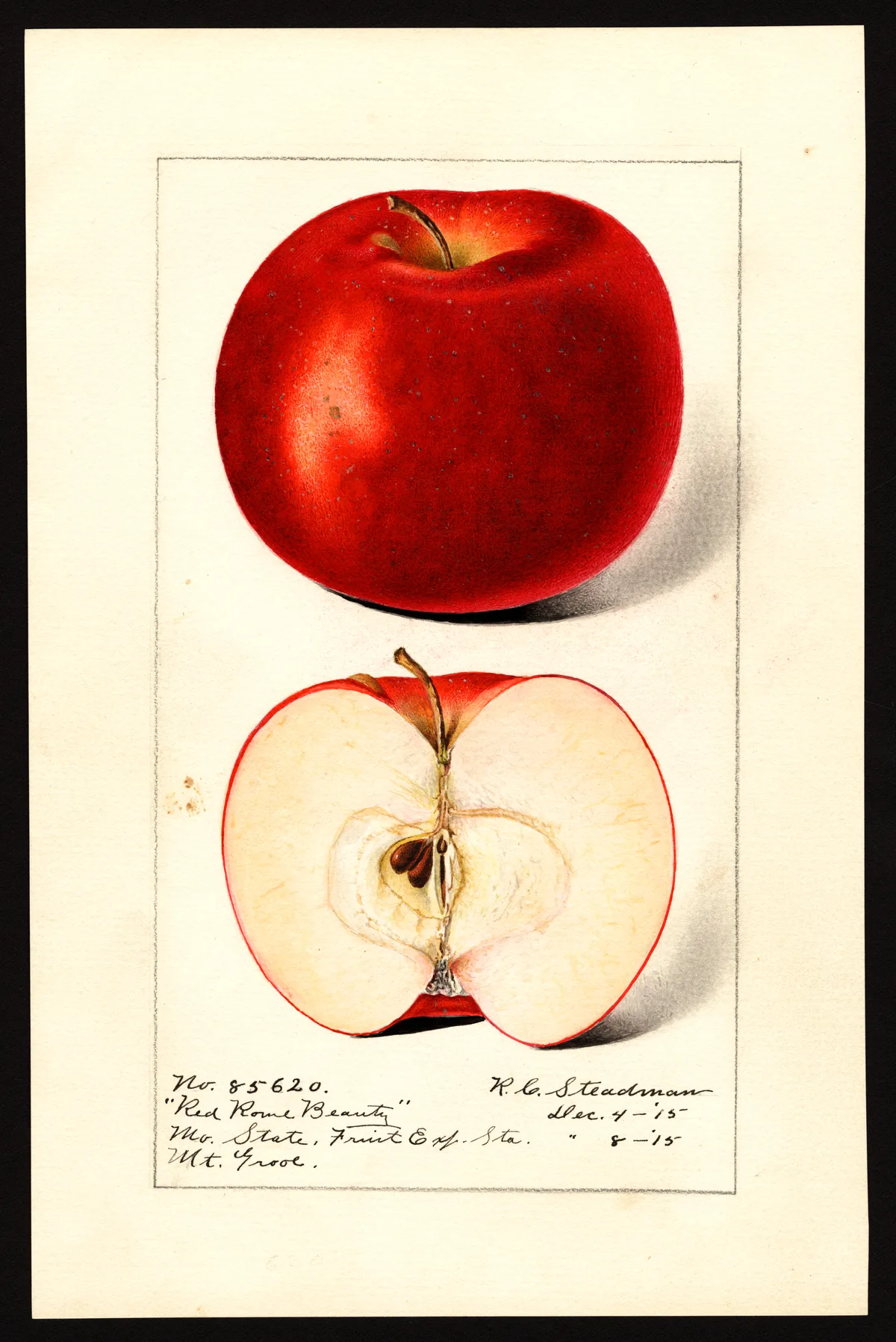
USDA Pomological Watercolor Collection
Red Rome Beauty
Origin/History
Red Rome Beauty is a sport of the Rome Beauty apple, discovered by J. Howard Wright in his orchard at North Yakima, Washington. Wright observed a single tree among a row of standard Rome Beauty trees producing fruit of significantly deeper red coloring. The original trees were purchased from C. L. Whitney of Walla Walla, Washington, in 1895. Wright first noticed the red-fruited tree some years before documenting it in November 1912. He verified the variety's stability through successive propagation: grafting was performed approximately nine years prior (c. 1903), with resulting trees identical to the parent; a second generation of grafts followed three years prior (c. 1909); and a third generation of grafts was undertaken in the spring of 1911, though these had not yet borne fruit at the time of writing.
An apparently identical tree of the same variety was discovered growing near North Yakima, owned by Harry Maxted, with stock apparently originating from the same nursery and period as Wright's original tree. The variety's origin through consistent propagation from a single tree demonstrates that the deeper coloration is stable and heritable.
Tree
The tree exhibits all characteristics of the Rome Beauty in shape, growth habit, form of twigs, and leaf morphology. The tree cannot be distinguished from a standard Rome Beauty when the fruit has been removed; the distinguishing feature is solely in fruit coloration.
Fruit
Size and Form: Identical in shape and size to the ordinary Rome Beauty apple.
Skin: The fruit displays a solid red color, distinguishing it markedly from the typical Rome Beauty. This consistent, uniform red coloration is the defining characteristic of the variety.
Flesh/Flavor: Not described in source.
Core/Seeds: Not described in source.
Season
Characterized as an early-market apple.
Uses
The solid red color makes the fruit highly desirable for early market sales, where appearance is a primary selling point. The variety is valued for commercial purposes on account of its uniform, deep red appearance.
Propagation Stability
The variety has been demonstrated to breed true through multiple generations of grafting, confirming that the sport is stable and can be reliably perpetuated.
Other
Not described in source.
Book Sources
Described in 1 period pomological work
Nursery Catalog Sources
Found in 4 catalogs (1926–1955) from Missouri, Oregon
- Hudson's Wholesale Nurseries , Tangent , Oregon — 1926
- Stark Bro's Nurseries , Louisiana , Missouri — 1932 — listed as Red Home Beauty
- Milton Nursery Co. , Milton-Freewater , Oregon — 1947
- Carlton Nursery Co. , Forest Grove , Oregon — 1955
View original book sources (1)
— Granville Lowther (ed.), Encyclopedia of Practical Horticulture (1914)Red Rome Beauty
The "Red Rome Beauty" was one that I discovered in my orchard a number of years ago. I noticed in one of the rows of Rome Beauties a tree the fruit of which was much redder than on any of the others. This particular tree has the characteristics of a Rome Beauty except in the coloring of the apple. The shape of the tree, the manner of growth, the shape of the twigs and leaves are all of the Rome Beauty. In fact when the fruit is off the trees there is no difference that any one can detect.
The apple is the same in shape and size as the ordinary Rome Beauty but has a solid red color. This coloring makes it a very desirable apple for early market.
The trees in which this tree appeared were purchased from Mr. C. L. Whitney of Walla Walla, Wash., in 1895. Nine years ago I grafted a number of trees from this tree, and after these came into bearing I found that they were the same as of the parent tree. Three years ago I took scions from these and grafted other trees with the same result. Last spring I grafted from the third generation and while these have not borne, yet I do not fear but that I shall get the same 'Red Rome Beauty.'
J. Howard Wright North Yakima, Wash., November 26, 1912.
Another tree of this same variety, and to all appearances identical, is owned by Mr. Harry Maxted near North Yakima. The original stock seems to have come from the same nursery and about the same time as that of Mr. Wright's, described above.—Ed.