Red Royal
Apple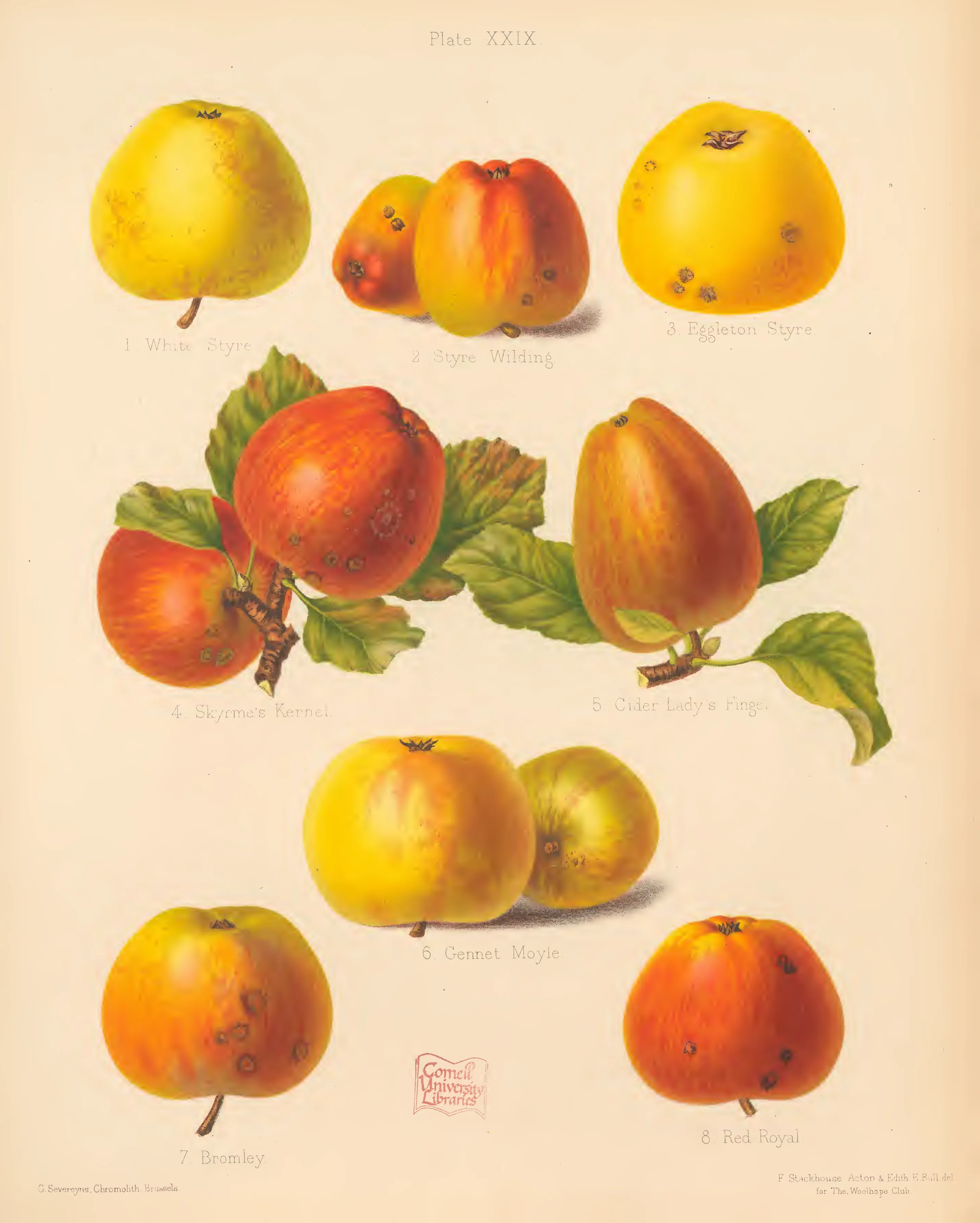
Red Royal
Origin / History
The history of the Red Royal has been lost. It is a favorite of some standing in the Gloucestershire orchards. It was described by the Woolhope Naturalists' Field Club in The Herefordshire Pomona (1885), where it is figured as No. 8 on Plate XXIX.
Tree
The tree is hardy and bears well. It likes a high situation and a strong, deep loam that is well drained, as do most apples that make cider worth drinking.
Fruit
Size: Small.
Form: Roundish, inclining to oblate and sometimes to ovate, bluntly angular on the sides.
Stem: Short and slender.
Cavity: Rather deep, in which the stalk is inserted.
Calyx: Eye quite closed, with convergent segments. Tube funnel shaped. Stamens median.
Basin: Not described in source.
Skin: Almost entirely covered with dark crimson, except on the shaded side, where it is yellow.
Dots: Sprinkled with russety dots.
Flesh and flavor: White and tender. Juice plentiful, pale in color, sweet but slightly bitter, and pleasantly subacid.
Mr. With's analysis of the Red Royal (season 1880) gave a density of fresh juice of 1.035, and 1.037 after 24 hours' exposure. One hundred parts by weight of fresh juice yield sugar 13.70, tannin, mucilage, salts, etc. 0.26, and water 86.04.
Core and seeds: Cells of the core open.
Season
Not described in source.
Uses
This Apple is highly esteemed in East Gloucestershire, where it is thought to make cider of the first quality, of good color and flavor, and very sweet and pleasant to drink. The analysis given does not indicate so high a character, and it is very probable that this variety owes much of its favor to its brilliant color and the ready sale it meets with in the market as an edible or culinary fruit.
Subtypes / Variants
Not described in source.
Other
Not described in source.
Book Sources
Described in 1 period pomological work
Nursery Catalog Sources
Found in 1 catalog (1901) from Illinois
- Benjamin Buckman (personal inventory) , Farmingdale , Illinois — 1901 — listed as Royal Red
View original book sources (1)
— Woolhope Naturalists Field Club, The Herefordshire Pomona (1885)PLATE XXIX.
- RED ROYAL.
This Apple is a favourite of some standing in the Gloucestershire Orchards. Its history has been lost.
Description.—Fruit : small, roundish, inclining to oblate and sometimes to ovate, bluntly angular on the sides. Skin : almost entirely covered with dark crimson, except on the shaded side where it is yellow ; the surface sprinkled with russety dots. Eye : quite closed with convergent segments ; tube, funnel shaped ; stamens, median. Stalk : short and slender, inserted in a rather deep cavity. Flesh : white and tender. Juice : plentiful, pale in colour, sweet but slightly bitter, and pleasantly subacid. Cells of the core, open.
Mr. With's analysis of the Red Royal (season 1880), is as follows :—
Density of fresh juice ... ... ... ... 1·035 Ditto after 24 hours exposure ... ... ... 1·037 One hundred parts by weight of fresh juice yield :— Sugar ... ... ... ... ... 13·70 Tannin, Mucilage, Salts, &c. ... ... ... 00·26 Water ... ... ... ... ... 86·04
This Apple is highly esteemed in East Gloucestershire, where it is thought to make cider of the first quality ;—of good colour and flavour, and very sweet and pleasant to drink. The analysis here given does not indicate so high a character, and it is very probable that this variety owes much of its favour to its brilliant colour, and the ready sale it meets with in the market as an edible, or culinary fruit.
The tree is hardy and bears well. It likes a high situation and a strong deep loam, well drained ; as indeed do most apples that make cider worth drinking.