Rejuvenated Foxwhelp
Apple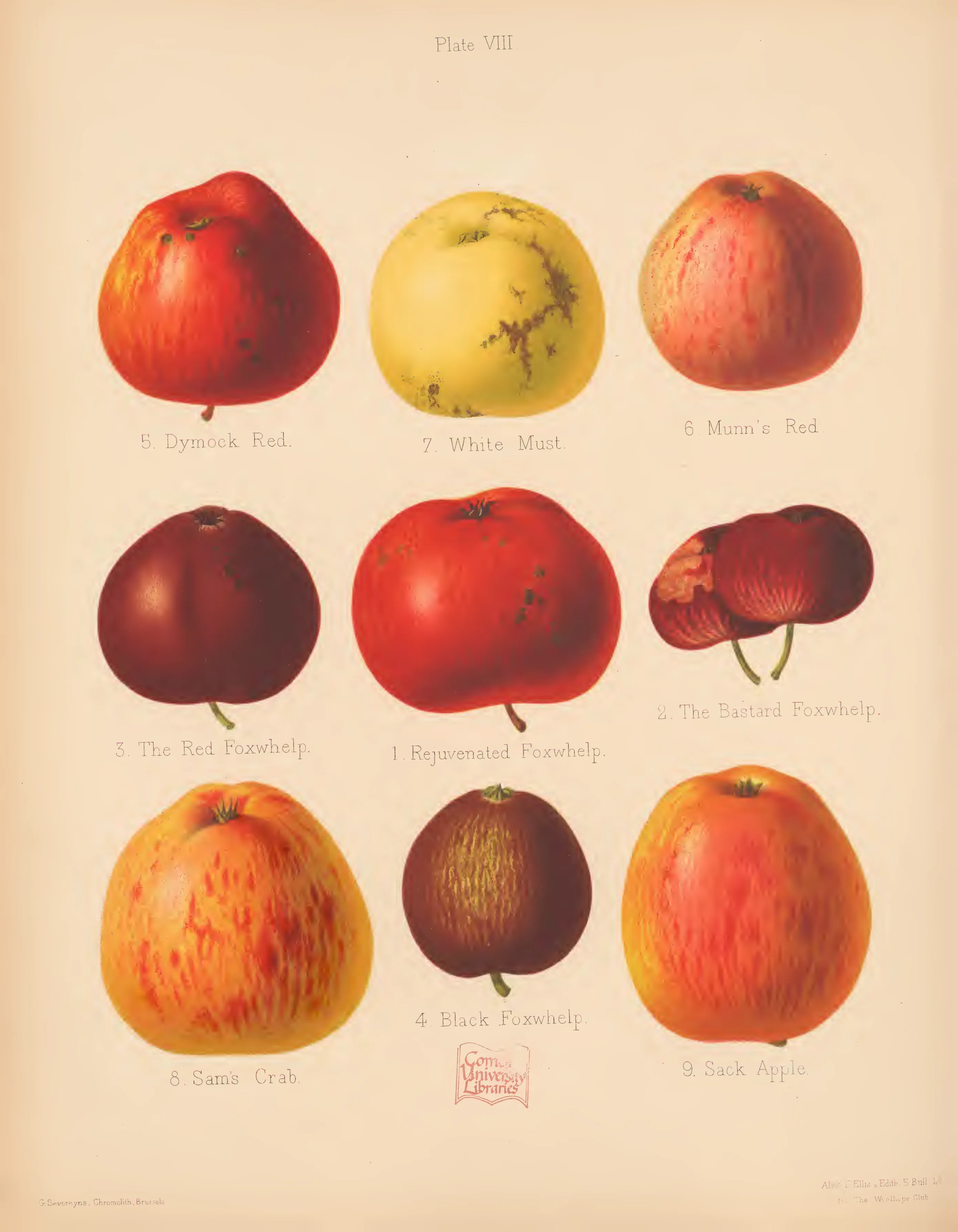
Rejuvenated Foxwhelp
Origin and History
The Rejuvenated Foxwhelp—also known as The Canon Apple and Crowes Kernel—originated in Herefordshire through deliberate rejuvenation of the old Foxwhelp variety via successive grafting. A farmer named Yeomans, living at Cowarne between 60 and 70 years before 1885 (approximately 1815–1825), undertook a careful system of grafting and regrafting the old Foxwhelp on healthy stocks to restore its vigorous growth. He worked both in Cowarne and at Canon Pyon.
Following Yeomans' pioneering work, other growers systematically continued the regrafting program. Mr. Crowe and the wheelwrights Messrs. Skidmore, Miles, and Williams of Canon Pyon separately and independently carried on the work, beginning with seedlings of the old Foxwhelp at Canon Pyon. Their efforts were well established by 1823, when Mr. Jay of Lyde obtained grafts; subsequently Mr. Bosley of Lyde and Mr. Hill of Eggleton likewise received propagating material. From these two centers at Cowarne and Canon Pyon, the grafts were distributed throughout the region to intelligent fruit growers, establishing the modern luxuriant form.
Tree
More vigorous and luxuriant in growth habit than the old Foxwhelp variety. No further tree characteristics described in source.
Fruit
Size and Form: Above the medium size. The fruit is broad in shape, with its lateral diameter greater than its longitudinal diameter—distinctly broader and larger than the old Foxwhelp, which is typically smaller and oblong in form. However, when examined carefully, the apples of the Rejuvenated and old Foxwhelp are so similar in appearance they could not be distinguished if mixed together. The difference in size and overall shape is due entirely to the improved vitality and luxuriant growth of the tree rather than to true variety distinction.
Skin: Brilliant color. Tough, leather-like skin.
Stem: Long and slender, set in a deep narrow channel.
Calyx (Eye): The same eye as the old Foxwhelp.
Maturity Period: Arrives at maturity at the same period as the old Foxwhelp.
Flavor and Eating Quality: Piquant acid rough flavor, which would not please all palates as a raw-eating apple. Excellent as a cooking apple for pies and puddings. Described as "the apple of all others to make sauce for the Michaelmas goose, or for a roast leg of pork."
Cider Character: The cider from the Rejuvenated Foxwhelp is notably more sweet and luscious than that made from the old Foxwhelp, resembling the cider of the Cowarne Red apple rather than the distinctive and prized Foxwhelp character. The absence or weakness of true Foxwhelp flavor in the new cider has prompted years of discussion among growers as to whether this is genuinely the old variety rejuvenated or a new seedling. However, the documented history of grafting and regrafting by named individuals across multiple locations strongly indicates rejuvenation of the original. It should be noted that the old Foxwhelp itself sometimes yields cider with only a faint suggestion of its characteristic flavor for years at a time, and the distinctive Foxwhelp cider character developed only after the trees reached considerable age. The true Foxwhelp flavor in the cider of the rejuvenated form may therefore be expected to develop as these trees mature.
Season
Arrives at maturity at the same period as the old Foxwhelp. Sells well in September as a "pot fruit" (cooking fruit).
Uses
Recommended as an excellent cooking apple for pies, puddings, and particularly for sauce to accompany Michaelmas goose or roast pork. The brilliant color and durability in storage recommend it to market buyers. Suitable for both household and commercial orchard planting.
Debate Regarding Identity
The question of whether the Rejuvenated Foxwhelp is truly the old historic Foxwhelp restored to vigor through careful management, or alternatively a new seedling variety, has been warmly discussed by growers for some years. The clear historical record—tracing grafting and regrafting by named individuals (Yeomans, Crowe, Skidmore, Miles, Williams, and subsequent distributors) across identified parishes (Cowarne, Canon Pyon, Lyde, Eggleton)—demonstrates continuity and deliberate rejuvenation rather than new seedling origin. The vigorous, luxuriant growth and improved fruit size are consistent with the effects of grafting on healthy stocks and improved tree management rather than a distinct variety.
Chemical Composition
Analysis by Mr. G. H. With, F.R.A.S.:
- Density of fresh juice: 1.043
- After 24 hours exposure: 1.044
Per 100 parts of juice:
- Sugar: 8.000
- Tannin, Mucilage, Salts, etc.: 4.301
- Water: 87.699
The chemical composition differs from that of the old Foxwhelp only in the proportion of water, which is greater in the more vigorously growing tree—a difference accounted for by improved vitality rather than variety distinction.
Recommendation
The Rejuvenated Foxwhelp possesses intrinsic merits sufficient to warrant wider cultivation than has been historically practiced. Every orchard should include it. Owners may await with good faith the development of the true Foxwhelp cider character as the trees age.
Book Sources
Described in 1 period pomological work
View original book sources (1)
— Woolhope Naturalists Field Club, The Herefordshire Pomona (1885)
- REJUVENATED FOXWHELP.
[Syn : The Canon Apple; Crowes Kernel.]
This apple is one of peculiar interest in Herefordshire, and is therefore represented here. The epithet "new" will be used in treating of it but merely to prevent any confusion in discussing the question, as to whether it is "new," that is, a seedling ; or whether it is the true "old" Foxwhelp restored to a flourishing rejuvenated form by a careful system of grafting and regrafting. This is a question that has been warmly discussed by the growers for some years past.
At first sight the distinction between them seems very marked ; both the tree of the "new" Foxwhelp and its apple, are much more luxuriant than the "old" Foxwhelp. The apple of the "new" Foxwhelp is not only larger, but in its general character it is broad in shape—or in other words, its lateral is greater than its longitudinal diameter—whilst the apple of the "old" Foxwhelp is smaller and usually oblong in shape ; but on a careful examination of the trees of either kind the apples are so similar in shape and appearance that it would be impossible to distinguish them if thrown together. The difference in size and shape is due simply to the improved vitality and luxuriance of growth of the tree. The points of similarity between them are very striking. There is the same brilliant colour ; the same tough, leather-like skin ; the same eye ; the same long slender stalk set in its deep narrow channel; and to this it may be added they have the same period of arriving at maturity. Then again the chemical analysis shews no greater difference between them, than may be accounted for by the more watery juice of the fruit of the more free growing tree.
The history of the "new" Foxwhelp can be traced with some clearness. A farmer of the name of Yeomans living at Cowarne between 60 and 70 years ago, took an unusual interest in the "old" Foxwhelp, and both in that parish, and at Canon Pyon, to which he afterwards migrated, he grafted and regrafted it on healthy stocks, until he restored its luxuriance of growth. Another farmer, a Mr. Crowe, and Messrs. Skidmore, Miles, and Williams, wheelwrights of Canon Pyon, systematically but separately carried on the system of regrafting, beginning at Canon Pyon on seedlings of the "old" Foxwhelp. Their success had been well established by 1823 when Mr. Jay, of Lyde, got grafts, and afterwards Mr. Bosley, of Lyde, and Mr. Hill, of Eggleton, and thus from the centres of Cowarne and Canon Pyon, intelligent fruit growers got their supply of grafts, and we have the handsome, luxuriant, and useful fruit of this time. With this distinct history there can scarcely be a doubt but that the "new" Foxwhelp is simply the "old" historic variety rejuvenated by careful management, but the doubt in it has arisen from the absence in part or altogether of the true Foxwhelp flavour in the cider made from it, which is so remarkable and characteristic in the "old" Foxwhelp. As a matter of fact, its cider is more sweet and luscious than that made from the "old" Foxwhelp, and in flavour resembling far more the cider made from the Cowarne Red apple.
It must be remembered, however, that sometimes for years together, the cider from the "old" Foxwhelp itself gives but a faint suspicion of the true Foxwhelp flavour which is so highly esteemed, and moreover that it is only of late years, comparatively speaking,—that is, after the trees had become of considerable age—that the cider gained the pride of place it now so deservedly holds. In Evelyn's time, the "old" Foxwhelp was merely considered a first-class cider fruit. It must be left therefore for time to develope the true flavour of the Foxwhelp in its rejuvenated form.
The analysis of this apple by Mr. G. H. With, F.R.A.S., is as follows :—
Density of Fresh Juice ... ... ... ... 1·043 After 24 hours exposure ... ... ... ... 1·044 100 parts of the juice contains :— Sugar ... ... ... ... ... ... 8·000 Tannin, Mucilage, Salts, &c. ... ... ... ... 4·301 Water ... ... ... ... ... ... 87·699
The rejuvenated Foxwhelp has intrinsic merits of its own, and for this cause alone it should be grown much more plentifully than it has been hitherto. Every orchard should possess it, and its owners may await with good faith the development of the true Foxwhelp flavour in its cider, as the trees grow older. Speaking of it as an apple, it may be said, that it is above the medium size, and its brilliant colour recommends it to every one. It sells well in September as a "pot fruit." It has a piquant acid rough flavour, which would not please all palates to eat raw, but as a cooking apple, it is excellent for pies and puddings; and "the apple of all others to make sauce for the Michaelmas goose, or for a roast leg of pork."