Royal Jubilee
Apple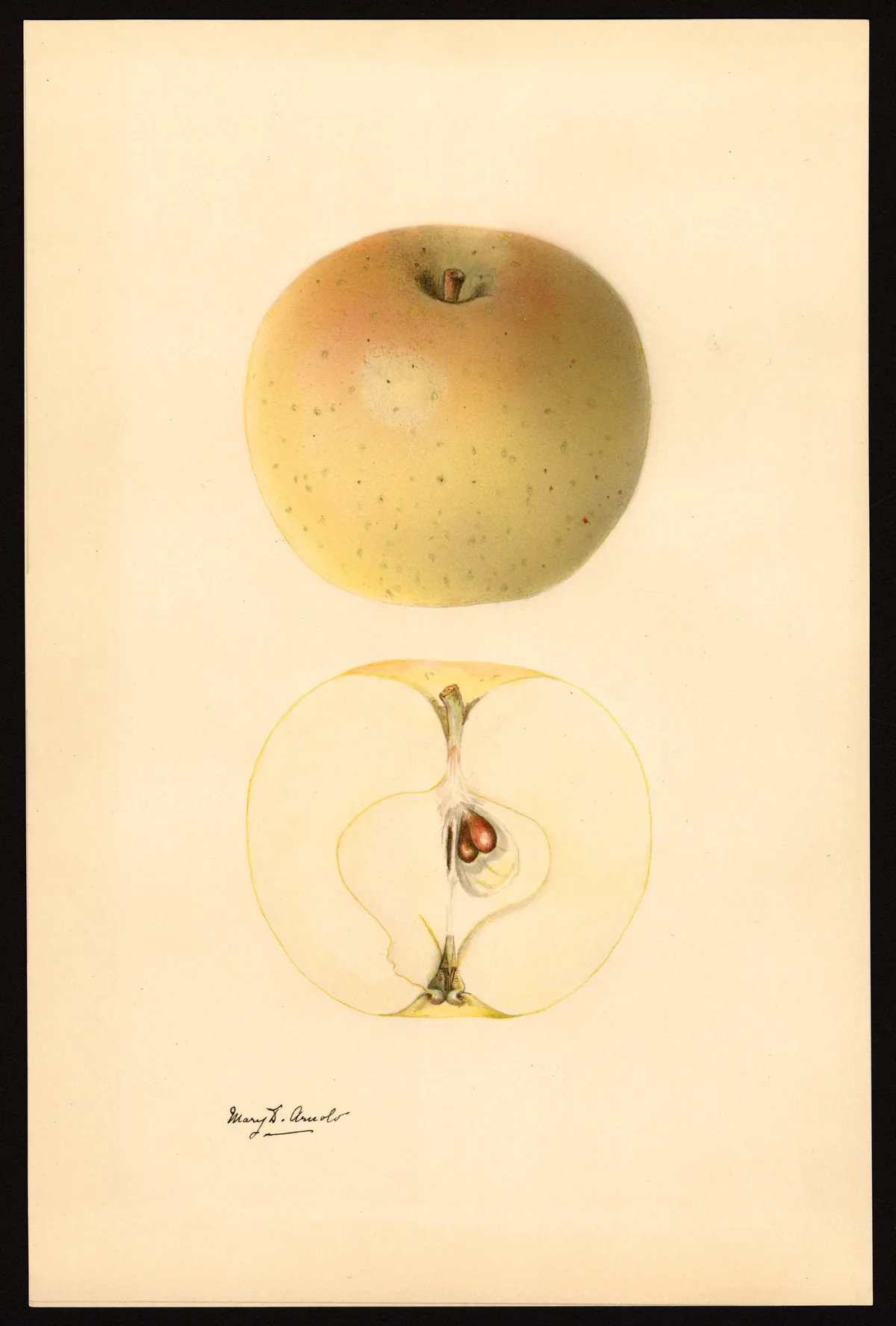
USDA Pomological Watercolor Collection
Royal Jubilee
Origin / History
Raised by Mr. John Graham, of Hounslow, and introduced by Messrs. G. Bunyard & Co., Maidstone, in 1893. Bunyard (1920) calls it "valuable for its late flowering and regular cropping habits." Veitch (1911) calls it "a valuable kitchen apple." The Bunyard catalog (1914) calls it "a useful market Apple."
Tree
Growth very dwarf (Bunyard 1920); the Bunyard catalog says it grows very sturdy and forms a flat-headed standard. Extremely fertile; regular cropping habit. Flowers very late, thus escaping late spring frosts, and "seldom fails to produce a good crop" (Veitch). Free from canker (Bunyard catalog). Leaf medium, tapering to petiole, little down-folded, coarsely crenate.
Fruit
Size: Medium, 2½ by 2¼ (Bunyard 1920); large (Veitch; Bunyard catalog).
Form: Oval, conical, very slightly ribbed (Bunyard 1920); conical, even (Bunyard catalog).
Stem: Short and stout.
Cavity: Rather wide, slightly russet.
Calyx: Eye closed.
Basin: Narrow, much ribbed.
Skin: Clear lemon-yellow; pale lemon yellow, occasionally with the faintest orange flush (Bunyard 1920).
Dots: Not described in source.
Flesh and flavor: Flesh firm, yellow, subacid.
Core and seeds: Not described in source.
Season
October to March in the longest record. Bunyard (1920) and the Bunyard catalog give October to December; Veitch gives October to March.
Uses
Culinary; cooks well. A kitchen apple (Veitch); a market apple (Bunyard catalog).
Subtypes / Variants
Not described in source.
Other
Not described in source.
Book Sources
Described in 1 period pomological work
Nursery Catalog Sources
Found in 6 catalogs (1901–1917) from England, Illinois
- Benjamin Buckman (personal inventory) , Farmingdale , Illinois — 1901
- James Veitch & Sons , Ltd., Royal Exotic Nursery, Chelsea, London (also Coombe Wood, Langley, and Feltham) , England — 1911
- Thomas Rivers & Son , Sawbridgeworth, Hertfordshire , England — 1913
- Benjamin Buckman (personal inventory) , Farmingdale , Illinois — 1913
- George Bunyard & Co. , Royal Nurseries, Maidstone, Kent , England — 1914
- George Bunyard & Co. , Royal Nurseries, Maidstone, Kent , England — 1917
View original book sources (3)
— E.A. Bunyard, A Handbook of Hardy Fruits (1920)ROYAL JUBILEE. Culinary, October to December, medium, 2½ by 2¼, oval, conical, very slightly ribbed. Colour, pale lemon yellow occasionally with the faintest orange flush. Flesh, firm, yellow, sub-acid : cooks well. Eye, closed, in a narrow much ribbed basin. Stem, short and stout, in a rather wide, slightly russet cavity. Growth, very dwarf ; extremely fertile. Leaf, medium, tapering to petiole, little down-folded, coarsely crenate. Origin, raised by Mr. John Graham, of Hounslow, was introduced by Messrs. G. Bunyard & Co., Maidstone, in 1893. Valuable for its late flowering and regular cropping habits.
— James Veitch & Sons, Veitch's Fruit Trees (1911) (1911)large, clear lemon colour, a valuable kitchen apple, being a late-flowering variety it escapes the late spring frosts and seldom fails to produce a good crop ... Oct. to Mar.
— George Bunyard & Co., George Bunyard Catalog of Fruit Trees (1914) (1914)Culinary; Oct.-Dec. Large, conical, even, clear lemon-yellow; cooks well, grows very sturdy; forms a flat-headed standard, and flowers very late, thus escaping late frost; free from canker; a useful market Apple. Raised by Mr. John Graham, nr. Hounslow, and introduced by our firm in 1893.