Russell
Apple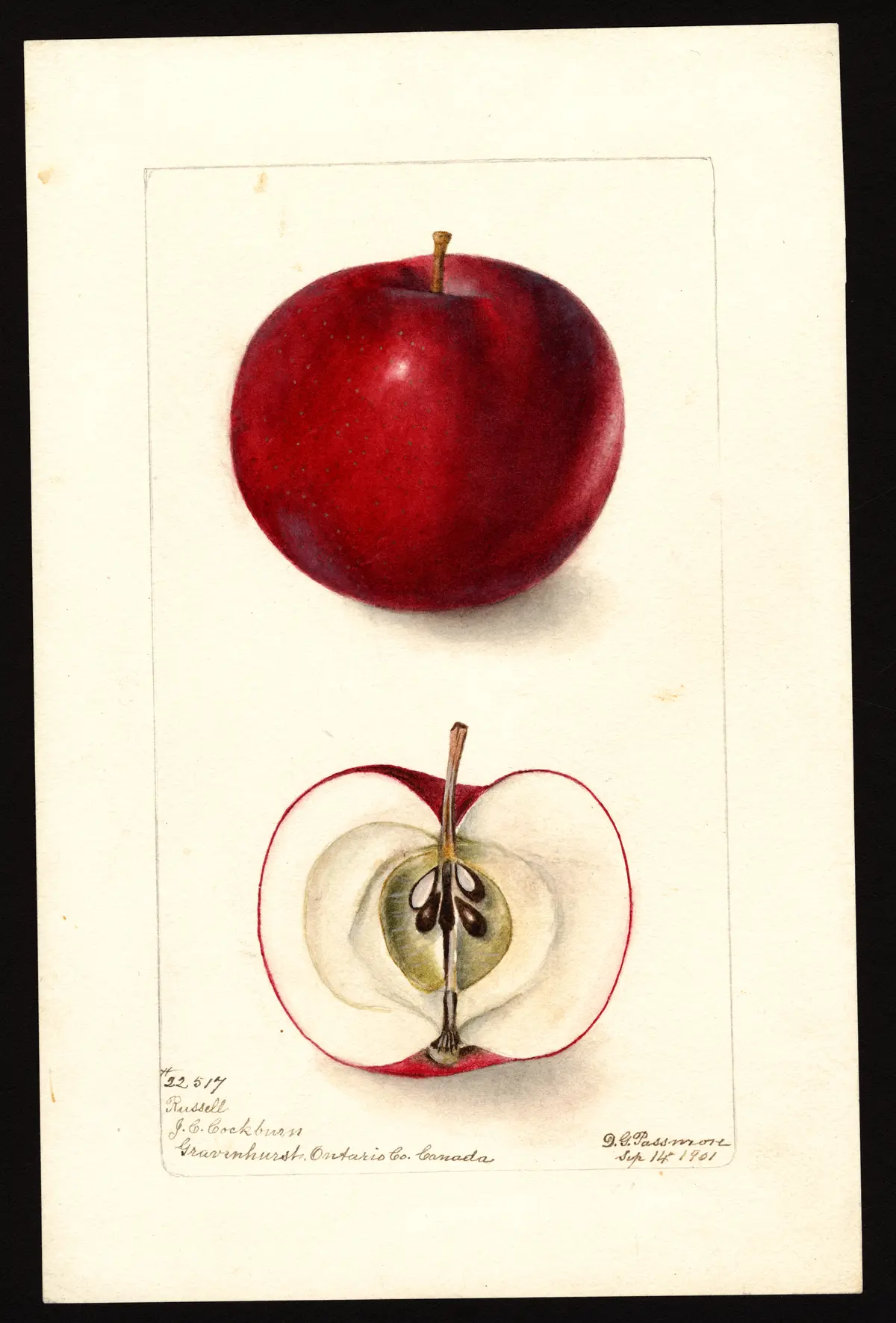
USDA Pomological Watercolor Collection
Russell
Origin and History
This variety has been traced to the farm of Captain William Russell in Farmington, Maine, where it was known to be in fruit more than sixty-five years prior to 1914. According to local tradition, Captain Russell was an early settler who walked from Massachusetts to his farm and brought a collection of apple seeds in his pockets; this variety is believed to be one of the seedlings from those seeds.
Tree
Spreading in habit. An early and regular bearer.
Fruit
Form and Size: Large; round ovate, sometimes oblong conical; somewhat flattened at base; nearly regular.
Skin: Waxen surface, smooth except for raised dots and occasional russet knobs. Bright yellow with a red cheek in the sun; obscurely striped. Dots brown with light bases.
Stem: Very short and stout.
Cavity: Small, regular, narrow, russeted.
Basin: Regular, deep, abrupt, furrowed.
Calyx: Closed; segments erect and convergent.
Core and Seeds: Core medium, oval, clasping. Seeds few, imperfect, light brown.
Flesh and Flavor: Yellowish, fine-grained, tender, moderately juicy, pleasant subacid. Quality good to very good.
Season
September.
Uses
Not described in source.
Subtypes and Variants
Canadian Russell
Originated in Russell County, Ontario. As described by W. T. Macoun:
Form and Size: Medium to above medium in size; roundish to oblate.
Skin: Pale yellow, almost or completely covered with deep red. Dots few, gray, not prominent.
Stem: Long and slender.
Cavity: Shallow, open.
Basin: Shallow, open, slightly wrinkled.
Calyx: Closed.
Core and Seeds: Core large. Quality good.
Flesh and Flavor: White, tender, melting, juicy, subacid. Pleasant flavor with a suggestion of Fameuse; slightly astringent.
Season: Middle of August to middle of September.
Tree: Vigorous.
Cultivation and Use: Top-grafted on Wealthy at the Central Experimental Farm, the tree has produced good crops every other year. The fruit ripens unevenly, making this variety more desirable for home use than for commercial purposes.
Book Sources
Described in 1 period pomological work
Nursery Catalog Sources
Found in 3 catalogs (1900–1913) from Illinois
- Central Experimental Farm , Dominion Department of Agriculture, Agassiz, British Columbia (under test; Bulletin No. 3, Second Series) — 1900
- Benjamin Buckman (personal inventory) , Farmingdale , Illinois — 1901
- Benjamin Buckman (personal inventory) , Farmingdale , Illinois — 1913
View original book sources (1)
— J.L. Budd & N.E. Hansen, American Horticultural Manual, Part II: Systematic Pomology (1914)Russell.—This variety has been traced to the farm of Capt. William Russell, Farmington, Maine, where it was known to be in fruit over sixty-five years ago. The local tradition is that Capt. Russell, an early settler, walked from Massachusetts to his farm and brought in his pockets a lot of apple-seed, and this is one of the seedlings. Tree spreading, an early and regular bearer.
Fruit large, round ovate, sometimes oblong conical, somewhat flattened at base, nearly regular; surface waxen, smooth, except for the raised dots and occasional russet knobs, bright yellow, with red cheek in the sun, obscurely striped; dots brown with light bases; cavity small, regular, narrow, russeted; stem very short and stout; basin regular, deep, abrupt, furrowed; calyx closed; segments erect convergent. Core medium, oval, clasping; seeds few, imperfect, light brown; flesh yellowish, fine-grained, tender, moderately juicy, pleasant subacid, good to very good. September.
There is also a Canadian Russell, described by W. T. Macoun, (Bul. 38, Canada Exp. Sta.) as follows:
" Russell.—Originated in Russell Co., Ontario. Fruit medium to above medium in size, roundish to oblate; skin pale yellow, almost or completely, covered with deep red; dots few, gray, not prominent; cavity shallow, open; stem long, slender; basin shallow, open, slightly wrinkled; calyx closed; flesh white, tender, melting, juicy, subacid, with a pleasant flavor, having a suggestion of Fameuse about it, slightly astringent. Core large, quality good. Season, middle of August to middle of September; tree vigorous. Top-grafted on Wealthy at the Central Experimental Farm, it has produced good crops every other year. It ripens unevenly, making it more desirable for home use than for commercial purposes."