Sam's Crab
Apple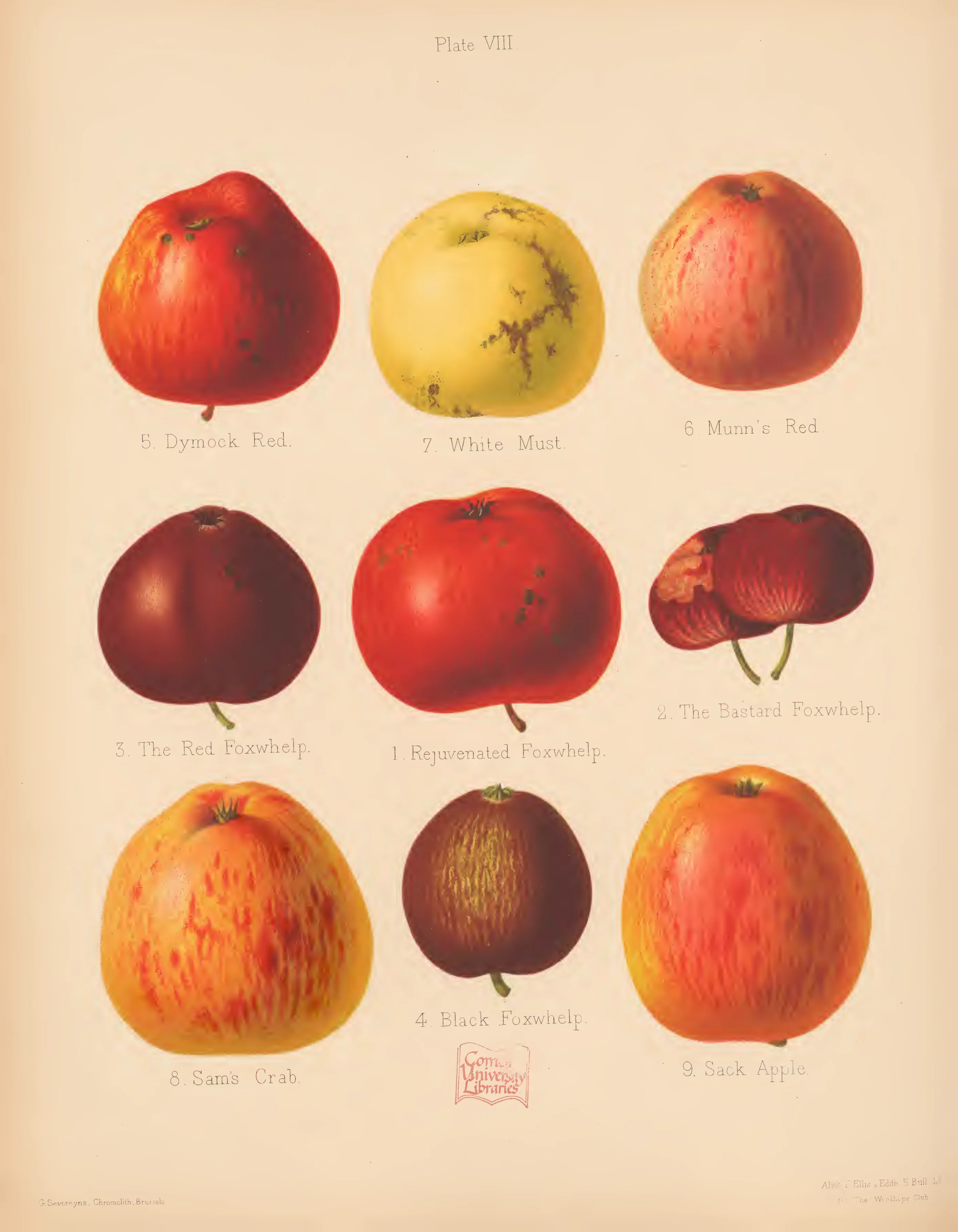
Sam's Crab
Origin / History
Lindley stated that the variety "was originated in Herefordshire, where," he adds, "it is at present but little known." It is well known in Herefordshire, widely distributed, and very highly esteemed as a very early dessert fruit. It is also used for cooking and for cider.
Tree
Under a warm soil and in a sunny situation the tree brings its fruit to perfection. In unfavorable situations the fruit could hardly be recognized as the same Apple.
Fruit
Size: Not described in source.
Form: Conical or roundish ovate, even and regular in its outline.
Stem: About an inch long and slender, inserted in a deep cavity.
Cavity: Deep, tinged with green.
Calyx: Eye closed, with connivent segments. Tube funnel-shaped. Stamens median.
Basin: Pretty deep, round, and somewhat plaited.
Skin: Beautifully streaked with crimson over yellow. The yellow shows on the side next the sun and is less overlaid with crimson there. The shaded side is more yellow.
Dots: Not described in source.
Flesh and flavor: Yellowish, tender, juicy, and sweet, with good flavor. Tinged with red at the base of the eye, at the base of the stalk, and round the carpels. When well ripened it has a rich aroma and a juicy, sweet, and piquant flavor that is seldom equaled. Mr. With's analysis, season 1878, gives a density of fresh juice of 1.037, and 1.046 after 24 hours' exposure to air. Per 100 parts by weight of the juice: sugar 10.140, tannin, mucilage, salts, &c. 4.370, and water 85.490.
Core and seeds: Cells of the core open. Cell-walls ovate.
Season
Early. The fruit is one of the most useful of all the early Apples and is grown for early dessert use.
Uses
Dessert, cooking, and cider. It is a prime favorite with Herefordshire school children and is equally attractive to birds and insects, who revel in its sweetness.
Subtypes / Variants
There are undoubtedly two varieties of this Apple, or, as was quaintly expressed by a great admirer of the fruit, "There are two sorts of Sam's Crab: a basket full of one kind is eaten the same day, but the same basket full of the other kind lasts three or four days."
Other
Figured as Plate VIII, number 8, in The Herefordshire Pomona, Woolhope Naturalists' Field Club, 1885.
Book Sources
Described in 1 period pomological work
View original book sources (1)
— Woolhope Naturalists Field Club, The Herefordshire Pomona (1885)Plate VIII. 8. SAM'S CRAB. [Syn: Longvilles Kernel] This Apple, according to Mr. Lindley, "was originated in Herefordshire, where," he adds, curiously enough and very erroneously, "it is at present but little known." It is, on the contrary, well known in Herefordshire, widely distributed, and very highly esteemed as a very early dessert fruit. It is used also for cooking, and for cider. Description.—Fruit, conical or roundish ovate, even and regular in its outline. Skin, beautifully streaked with crimson, and yellow on the side next the sun, and less so on the shaded side, where it is more yellow. Eye, closed, with connivent segments, set in a pretty deep, round, and somewhat plaited basin; tube, funnel-shaped; stamens, median. Stalk, about an inch long, slender, inserted in a deep cavity, which is tinged with green. Flesh, yellowish, tender, juicy, sweet, and of good flavour. It is tinged with red at the base of the eye, at the base of the stalk, and round the carpels. Cells of the core, open; cell-walls, ovate. Mr. With's analysis, season 1878, gives these characters:— Density of Fresh Juice ... ... ... ... 1.037 Ditto after 24 hours' exposure to air ... ... 1.046 100 parts by weight of the juice contained:— Sugar ... ... ... ... ... 10.140 Tannin, Mucilage, Salts, &c. ... ... ... 4.370 Water ... ... ... ... ... 85.490 Sam's Crab is one of the most useful of all our early Apples. It requires a warm soil and sunny situation to bring its fruit to perfection. In unfavourable situations it could hardly be recognised as the same Apple. When well ripened it has a rich aroma, and a juicy, sweet, and piquant flavour that is seldom equalled. It is a prime favourite with all Herefordshire school children (no mean judges of a good Apple), and it is equally attractive to birds and insects, who revel in its sweetness. There are undoubtedly two varieties of this Apple, or, as was quaintly expressed by a great admirer of the fruit, "There are two sorts of Sam's Crab: a basket full of one kind is eaten the same day, but the same basket full of the other kind lasts three or four days."