Saxton
Apple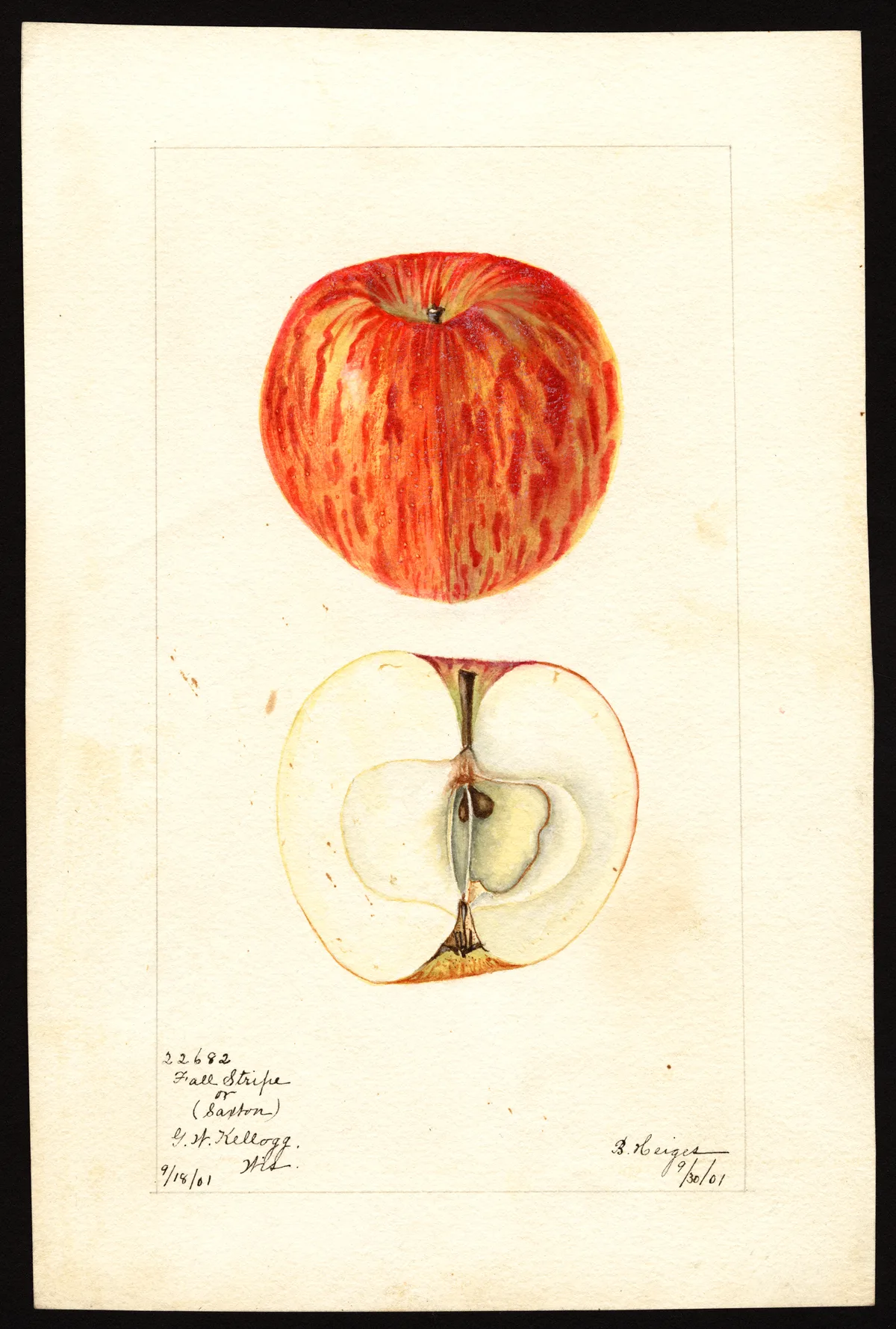
USDA Pomological Watercolor Collection
Saxton
Origin / History
An old variety of New England origin, said to have originated in Massachusetts or Connecticut (Downing; Hansen; Budd & Hansen; Beach). It is also raised in parts of the West (Hansen; Budd & Hansen). It was put upon the list of the American Pomological Society in 1871 and dropped from that list in 1897 (Beach). It was still listed by some nurserymen at the turn of the century, but so far as Beach could learn it was practically unknown among New York fruit growers (Beach). Lowther's Encyclopedia of Practical Horticulture (1914) records the variety as reported by one station in the Northern Division and one in the Central Division, with the variety reported in more than one division.
Tree
Vigorous, forming a handsome round head; an early bearer; very productive alternate years (Downing; Hansen; Budd & Hansen).
Fruit
Size
Medium (Downing; Hansen; Budd & Hansen; Lowther).
Form
Downing describes the form as roundish oblate, regular. Hansen and Budd & Hansen describe it as roundish, truncated, somewhat irregular and obscurely ribbed. Lowther gives the form as roundish oblate.
Stem / Stalk
Downing: stalk short, small. Hansen and Budd & Hansen: stem medium to long.
Cavity
Medium, slightly russeted (Downing); acute, slightly russeted (Hansen; Budd & Hansen).
Calyx
Closed (Downing; Hansen; Budd & Hansen); segments erect convergent (Hansen; Budd & Hansen).
Basin
Medium, slightly corrugated (Downing); wide, shallow, often flat, ribbed and wrinkled (Hansen; Budd & Hansen).
Skin
Downing: yellow, shaded, striped and splashed with light and dark red over the whole surface, having a few light and brown dots. Hansen and Budd & Hansen: surface greenish yellow, thinly washed with light red, with distinct dark red stripes and splashes, mixed red on sunny side; dots minute, white, obscure. Beach: yellow, shaded and splashed with light and dark red. Lowther: yellow-red.
Flesh / Flavor
Downing: yellowish, a little coarse, juicy, tender, subacid, slightly aromatic; good to very good. Hansen and Budd & Hansen: yellowish, juicy, tender, mild subacid, good to very good. Beach: a little coarse, subacid, good to very good. Lowther rates the quality as good and notes the use as family.
Core / Seeds
Downing: core small. Hansen and Budd & Hansen: core wide open, meeting or barely clasping; cells round, roomy, abaxile, slit; tube funnel-shaped; stamens median; seeds many, short, plump, easily loosened so as to rattle when shaken.
Season
September (Downing; Hansen; Beach; Budd & Hansen); autumn (Lowther).
Uses
Family use (Lowther).
Subtypes / Variants
Not described in source.
Other
Not described in source.
Book Sources
Described in 5 period pomological works
Nursery Catalog Sources
Found in 2 catalogs (1900–1904) from Illinois
- Central Experimental Farm , Dominion Department of Agriculture, Agassiz, British Columbia (under test; Bulletin No. 3, Second Series) — 1900
- Phoenix Nursery Company (W. E. Rossney , President; Sidney Tuttle, Vice-President), Bloomington , Illinois — 1904
View original book sources (5)
— A.J. Downing, The Fruits and Fruit Trees of America (1900)Fall Stripe.
Saxton.
An old variety which originated in Massachusetts or Connecticut. Tree vigorous, forming a handsome round head; very productive alternate years; an early bearer.
Fruit medium, roundish oblate, regular; skin yellow, shaded, striped and splashed with light and dark red over the whole surface, having a few light and brown dots; stalk short, small; cavity medium, slightly russeted; calyx closed; basin medium, slightly corrugated; flesh yellowish, a little coarse, juicy, tender, subacid, slightly aromatic; good to very good; core small. September.
— N.E. Hansen, A Study of Northwestern Apples (1902)Saxton (Pail Stripe)—An old variety of Massachusetts or Connecticut origin; is also raised in parts of the west; tree vigorous, round-headed, an early bearer, very productive alternate years—Fruit medium, roundish, truncated, somewhat irregular and obscurely ribbed; surface greenish yellow, thinly washed with light red, with distinct dark red stripes and splashes, mixed red on sunny side; dots minute, white, obscure; cavity acute, slightly russeted; stem medium to long; basin wide, shallow, often flat, ribbed and wrinkled; calyx closed, segments erect convergent. Core wide open, meeting or barely clasping; cells round, roomy, abaxile, slit; tube funnel-shaped; stamens median; seeds many, short, plump, easily loosened so as to rattle when shaken; flesh yellowish, juicy, tender, mild subacid, good to very good. September.
— S.A. Beach, The Apples of New York, Vol. 2 (1905)SAXTON.
REFERENCES. 1. Prairie Farmer, 1860 (cited by 9). 2. Am. Pom. Soc. Cat., 1871:8. 3. Downing, 1872:11 app. 4. Thomas, 1875:511. 5. Gibb, Montreal Hort. Soc. Rpt., 1886-7:94. 6. Bailey, An. Hort., 1892:239. 7. Ib., 1892:249. 8. Burrill and McCluer, Ill. Sta. Bul., 45:321. 1896. 9. Ragan, U. S. B. P. I. Bul., 56:107. 1905. 10. Ib., 56:275. 1905.
SYNONYMS. FALL STRIPE (3, 7, 8, 9). Fall Stripe (4, 5, 10). SAXTON (1, 2, 4, 5, 6, 10). Saxton (3, 7, 9).
An old New England variety (3). Fruit yellow, shaded and splashed with light and dark red; flesh a little coarse, subacid, good to very good; season September. It was put upon the list of the American Pomological Society in 1871 (2) and dropped from that list in 1897. It is still listed by some nurserymen (6) but so far as we can learn it is practically unknown among New York fruit growers.
— J.L. Budd & N.E. Hansen, American Horticultural Manual, Part II: Systematic Pomology (1914)Saxton (Fall Stripe). — An old variety of Massachusetts or Connecticut origin; is also raised in parts of the West; tree vigorous, round-headed, an early bearer, very productive alternate years.
Fruit medium, roundish, truncated, somewhat irregular and obscurely ribbed; surface greenish yellow, thinly washed with light red, with distinct dark red stripes and splashes, mixed red on sunny side; dots minute, white, obscure; cavity acute, slightly russeted; stem medium to long; basin wide, shallow, often flat, ribbed and wrinkled; calyx closed; segments erect convergent. Core wide open, meeting or barely clasping; cells round, roomy, abaxile, slit; tube funnel-shaped; stamens median; seeds many, short, plump, easily loosened so as to rattle when shaken; flesh yellowish, juicy, tender, mild subacid, good to very good. September.
— Granville Lowther (ed.), Encyclopedia of Practical Horticulture (1914)Saxton (21): medium in size; roundish oblate in form; yellow-red in skin color; good in quality; family use; autumn season. Northern Division: 1 station reporting (variety reported in more than one division); Central Division: 1 station reporting (variety reported in more than one division).