Schodack
Apple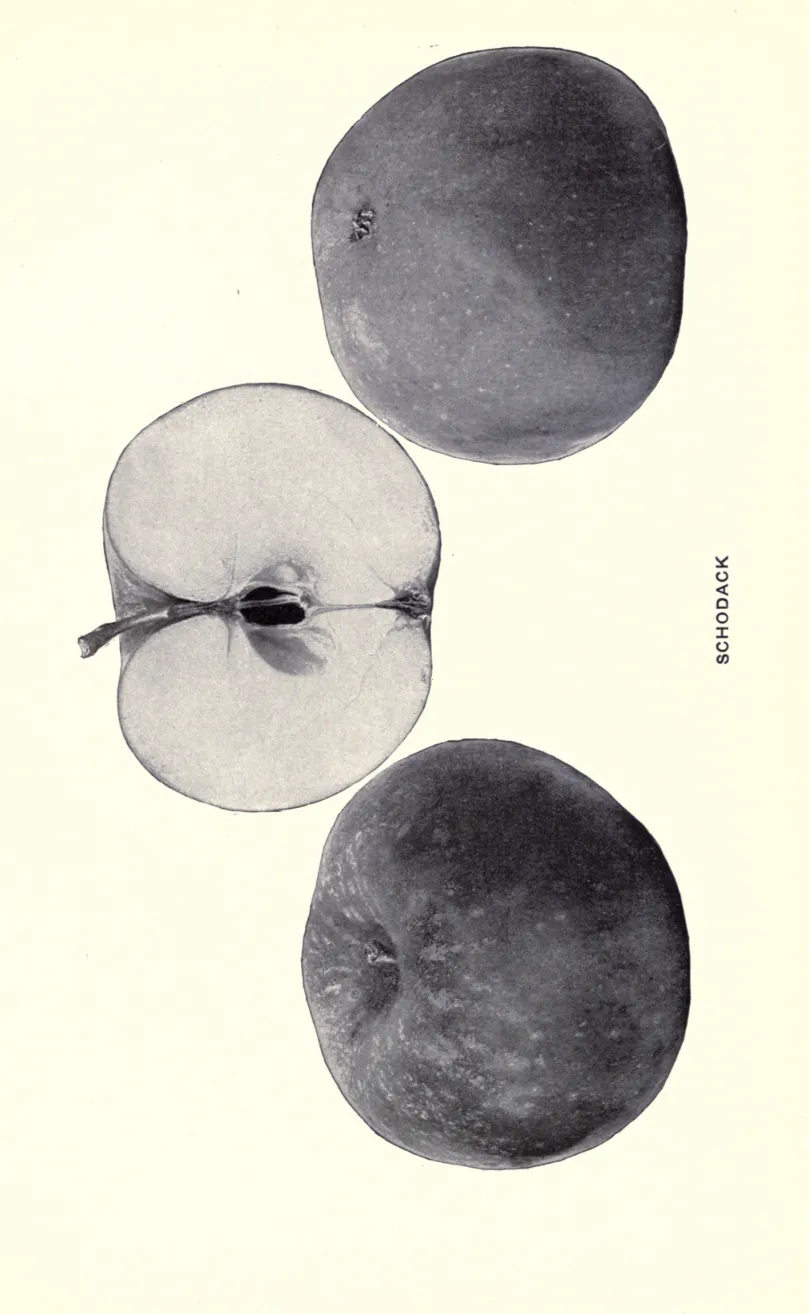
SCHODACK
Origin and History
Received for testing at the New York State Agricultural Experiment Station in 1892 from E. L. Smith, South Schodack, Rensselaer County, New York.
Tree
Moderately vigorous with long, slender branches. Form roundish to spreading, open. Twigs medium in length, slender, curved; internodes rather long. Bark dark brown tinged with red, streaked with scarf-skin, pubescent near tips. Lenticels dull, inconspicuous, scattering, medium, roundish or oval, not raised. Buds medium to below medium, prominent, plump, obtuse to acute, free or nearly so, slightly pubescent.
A pretty good grower that comes into bearing rather young and is a reliable cropper, yielding moderate to good crops almost annually.
Fruit
Size and Form: Usually medium to rather small, uniform in size and shape. Form roundish oblate varying to roundish inclined to conic, often obscurely ribbed.
Stem: Often long and slender.
Cavity: Usually acute, deep, broad, often slightly furrowed, sometimes partly russeted and marked with some large, elongated, irregular whitish dots and also with patches of whitish scarf-skin.
Calyx: Small, closed. Calyx tube deep, long, funnel-form. Stamens marginal.
Basin: Shallow, obtuse, furrowed, wrinkled.
Skin: Thick, tough, smooth. Grass-green eventually becoming tinged with yellow, blushed with rather dull pinkish-red which often deepens to a distinct red. Prevailing color green.
Dots: Scattering, very large to small, russet or irregular, whitish and areolar with russet point.
Core and Seeds: Core abaxile, medium in size; cells usually symmetrical, often wide open, sometimes closed; core lines clasping. Carpels broadly roundish, emarginate, mucronate, sometimes tufted. Seeds numerous, large, rather wide, long, plump, acute, usually smooth.
Flesh and Flavor: Whitish tinged with yellow, firm, coarse, rather tough, juicy, briskly subacid. Fair or possibly sometimes good for culinary use.
Season and Storage
Worthy of notice primarily because it keeps remarkably late. Retains good color, firm texture, and a good degree of acidity till very late in the season. Fairly acceptable for culinary purposes from March till July.
Uses
Culinary apple. Not good enough in quality to be classed as a dessert apple.
Other
As fruited at the New York State Agricultural Experiment Station, it seldom averaged above medium size. Its general appearance is good for a green apple.
Sources:
- N.Y. State Agricultural Experiment Station Annual Report, Vol. 11, p. 224 (1892)
- Beach and Clark, N.Y. State Agricultural Experiment Station Bulletin 248, p. 143 (1904)
Book Sources
Described in 1 period pomological work
View original book sources (1)
— S.A. Beach, The Apples of New York, Vol. 1 (1905)SCHODACK.
REFERENCES. 1. N. Y. Sta. An. Rpt., 11:224. 1892. 2. Beach and Clark, N. Y. Sta. Bul., 248:143. 1904.
This fruit is worthy of notice only because it keeps remarkably late. Its general appearance is good for a green apple and it retains good color, firm texture and a good degree of acidity till very late in the season. As fruited at this Station it seldom averages above medium size. It is fairly acceptable for culinary purposes from March till July but it is not good enough in quality to be classed as a dessert apple. The tree is a pretty good grower, comes into bearing rather young and is a reliable cropper, yielding moderate to good crops almost annually.
Historical. Received here for testing from E. L. Smith, South Schodack, Rensselaer county, N. Y., in 1892.
[Pages 510–511 not provided — content missing.]
TREE. Tree moderately vigorous with long, slender branches. Form roundish to spreading, open. Twigs medium in length, slender, curved; internodes rather long. Bark dark brown tinged with red, streaked with scarf-skin, pubescent near tips. Lenticels dull, inconspicuous, scattering, medium, roundish or oval, not raised. Buds medium to below medium, prominent, plump, obtuse to acute, free or nearly so, slightly pubescent.
FRUIT. Fruit usually medium to rather small, uniform in size and shape. Form roundish oblate varying to roundish inclined to conic, often obscurely ribbed. Stem often long and slender. Cavity usually acute, deep, broad, often slightly furrowed, sometimes partly russeted and marked with some large, elongated, irregular whitish dots and also with patches of whitish scarf-skin. Calyx small, closed. Basin shallow, obtuse, furrowed, wrinkled. Skin thick, tough, smooth, grass-green eventually becoming tinged with yellow, blushed with rather dull pinkish-red which often deepens to a distinct red. Dots scattering, very large to small, russet or irregular, whitish and areolar with russet point. Prevailing color green. Calyx tube deep, long, funnel-form. Stamens marginal. Core abaxile, medium in size; cells usually symmetrical, often wide open, sometimes closed; core lines clasping. Carpels broadly roundish, emarginate, mucronate, sometimes tufted. Seeds numerous, large, rather wide, long, plump, acute, usually smooth. Flesh whitish tinged with yellow, firm, coarse, rather tough, juicy, briskly subacid, fair or possibly sometimes good for culinary use.