Seneca Favorite
Apple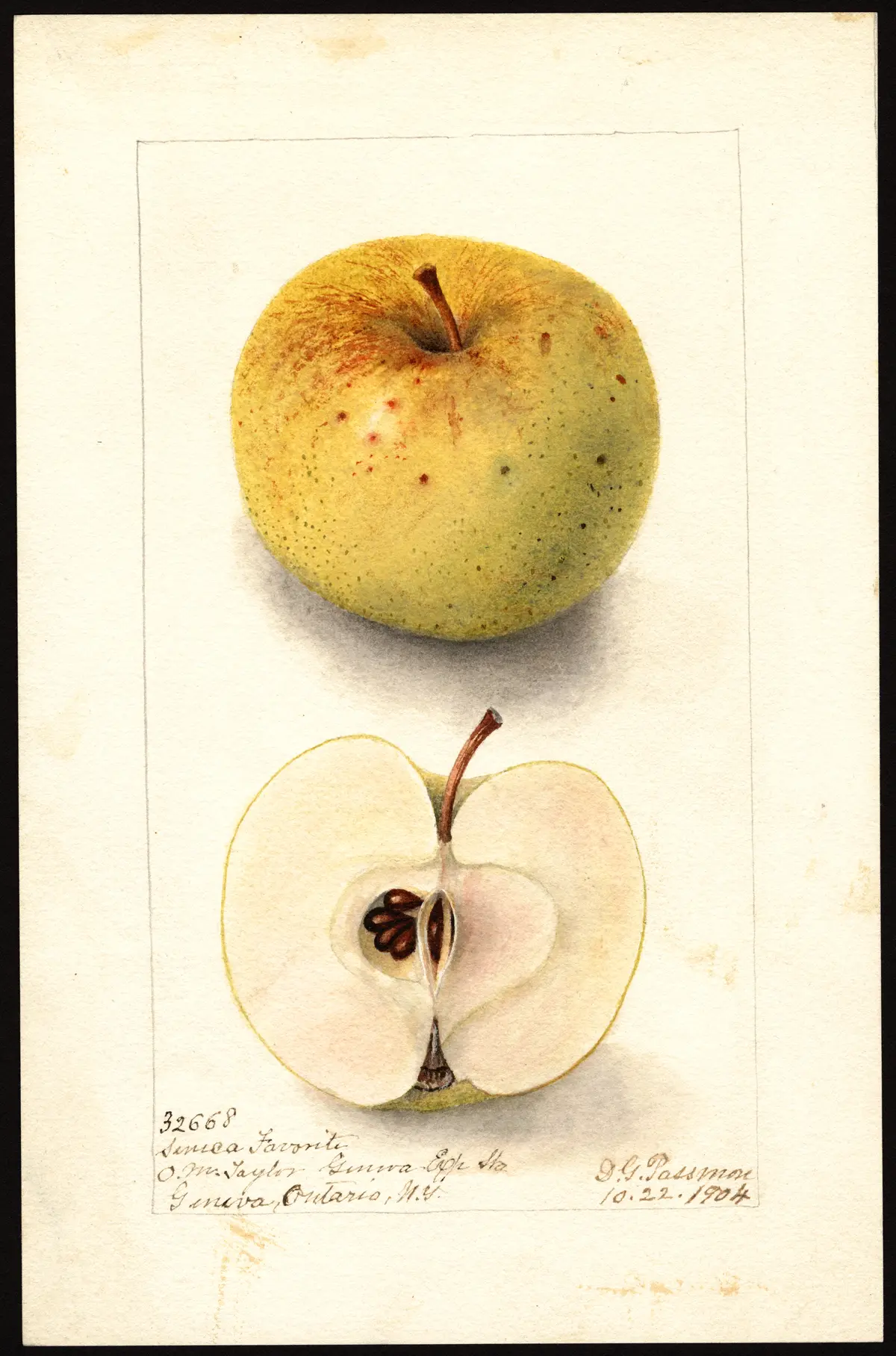
USDA Pomological Watercolor Collection
Seneca Favorite
Origin / History
The original tree of Seneca Favorite grew upon the farm of N. S. Page's father, five miles southwest of Geneva, New York. N. S. Page states that it was an old tree forty-five years before 1905. The variety is cited in Magazine of Horticulture, 19:165 (1853), and in Warder (1867), page 731. It has been grown to a limited extent as an apple for the home orchard in various localities in Ontario County.
Tree
The tree is of medium size, vigorous, and roundheaded.
Fruit
Size: Large.
Form: Not described in source.
Stem: Not described in source.
Cavity: Not described in source.
Calyx: Not described in source.
Basin: Not described in source.
Skin: Pale yellow. A large, attractive, pale yellow apple.
Dots: Not described in source.
Flesh and flavor: Texture more crisp than that of Swaar. Excellent for dessert as well as for culinary uses.
Core and seeds: Not described in source.
Season
The crop begins to ripen in early autumn and continues ripening in succession through a period of several weeks. The later fruit may be kept into early winter or midwinter.
Uses
Excellent for dessert as well as for culinary uses.
Subtypes / Variants
Not described in source.
Other
Resembles Swaar, but is earlier and larger, and its texture is more crisp. A desirable variety for the home orchard.
Sources cited: Wilson, C. S., History of the Apple in New York State, unpublished thesis, Cornell University, 1905; letter from N. S. Page, 1905.
Book Sources
Described in 1 period pomological work
View original book sources (1)
— S.A. Beach, The Apples of New York, Vol. 2 (1905)SENECA FAVORITE.
REFERENCES. 1. Mag. Hort., 19:165. 1853. 2. Warder, 1867:731. SYNONYMS. None.
A large, attractive, pale yellow apple. It resembles Swaar, but is earlier and larger, and its texture is more crisp.1 It is excellent for dessert as well as for culinary uses. The crop begins to ripen in early autumn, and continues ripening in succession through a period of several weeks. The later fruit may be kept into early winter or midwinter. The tree is of medium size, vigorous, roundheaded. It is a desirable variety for the home orchard.
Historical. N. S. Page states2 that the original tree of Seneca Favorite grew upon his father's farm, five miles southwest of Geneva, and was an old tree forty-five years ago. It has been grown to a limited extent as an apple for the home orchard in various localities in Ontario county, particu-
1 Wilson, C. S., Hist. of the Apple in N. Y. State, unpublished thesis Cornell Univ. 1905. 2 Letter, 1905.