Sheppard's Sweet
Apple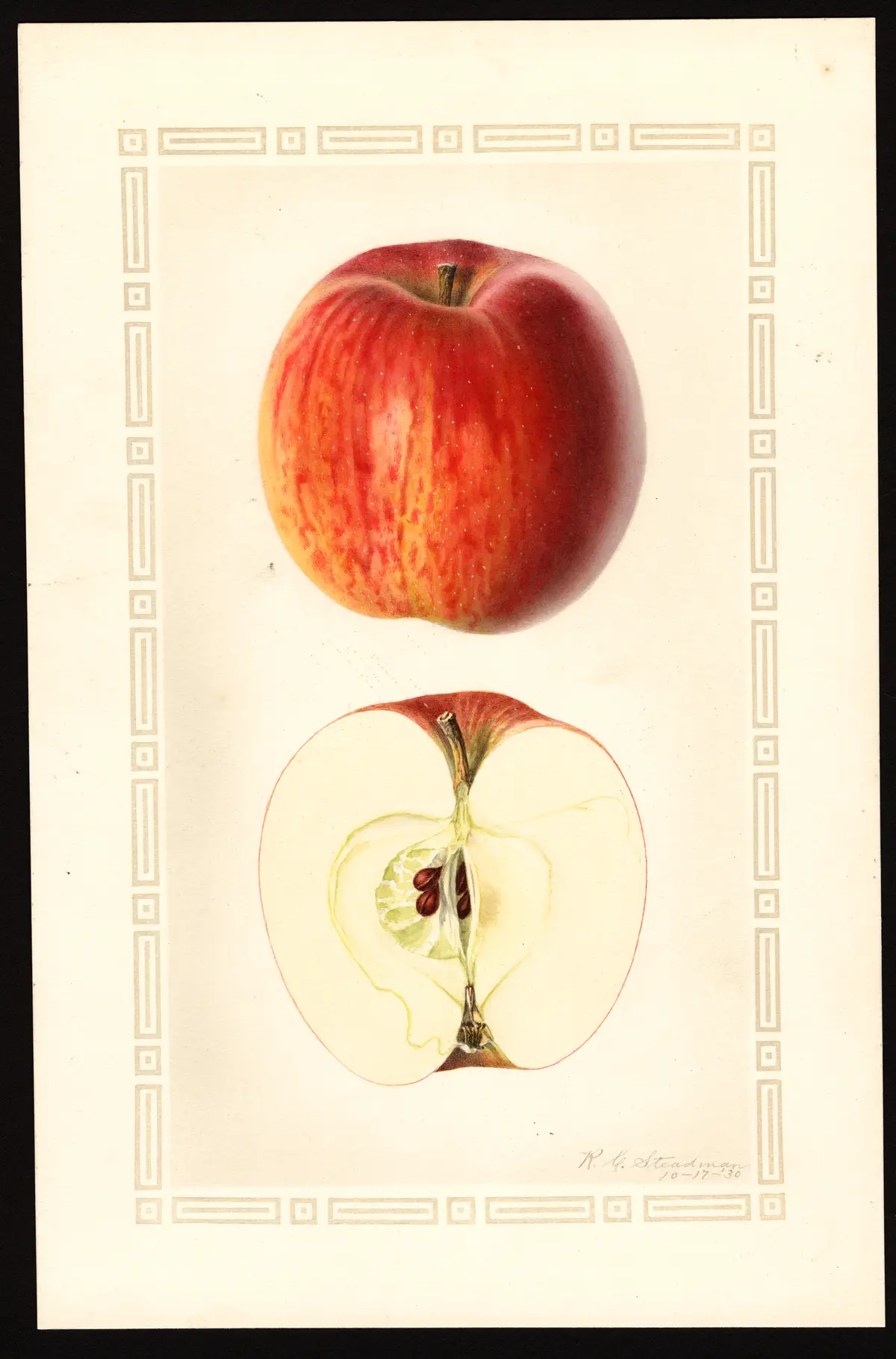
USDA Pomological Watercolor Collection
Sheppard's Sweet
Origin and History
Sheppard's Sweet originated in Windham County, Connecticut. It is documented by Downing (1900) and appears in the Encyclopedia of Practical Horticulture (1914), which classifies it as adapted to the Northern Division of the United States but not listed for the Central or Southern Divisions.
Tree
The tree is thrifty and upright in habit, and a great bearer.
Fruit
Size and Form: Medium in size. Roundish in form, approaching conic.
Skin and Color: Yellow, striped with red. (The Encyclopedia of Practical Horticulture confirms the color class as red-striped, consistent with Downing's description.)
Stem: Stalk long and slender, inserted in an acute cavity.
Calyx and Basin: Calyx firmly closed, set in a small basin.
Flesh and Flavor: Flesh white, tender, sweet, and pleasant. Rated Good.
Season
October to November. The Encyclopedia of Practical Horticulture classifies it as an autumn variety.
Uses
Suitable for fresh eating (dessert/table use per the Encyclopedia of Practical Horticulture).
Note: The Encyclopedia of Practical Horticulture entry is highly abbreviated and coded, adding no physical detail beyond what Downing provides. All substantive identification detail derives from Downing (1900).
Book Sources
Described in 2 period pomological works
View original book sources (2)
— A.J. Downing, The Fruits and Fruit Trees of America (1900)Sheppard's Sweet.
Origin, Windham Co., Conn. Tree thrifty, upright, and a great bearer.
Fruit medium, roundish, approaching conic, yellow, striped with red. Stalk long, slender, inserted in an acute cavity. Calyx firmly closed, set in a small basin. Flesh white, tender, sweet and pleasant. Good. October, November.
— Granville Lowther (ed.), Encyclopedia of Practical Horticulture (1914)Sheppard's Sweet. Size: M. Form: re. Color: rs. Quality: [blank]. Use: f. Season: a. N. Div.: a. C. Div.: .... S. Div.: ....