Springdale
Apple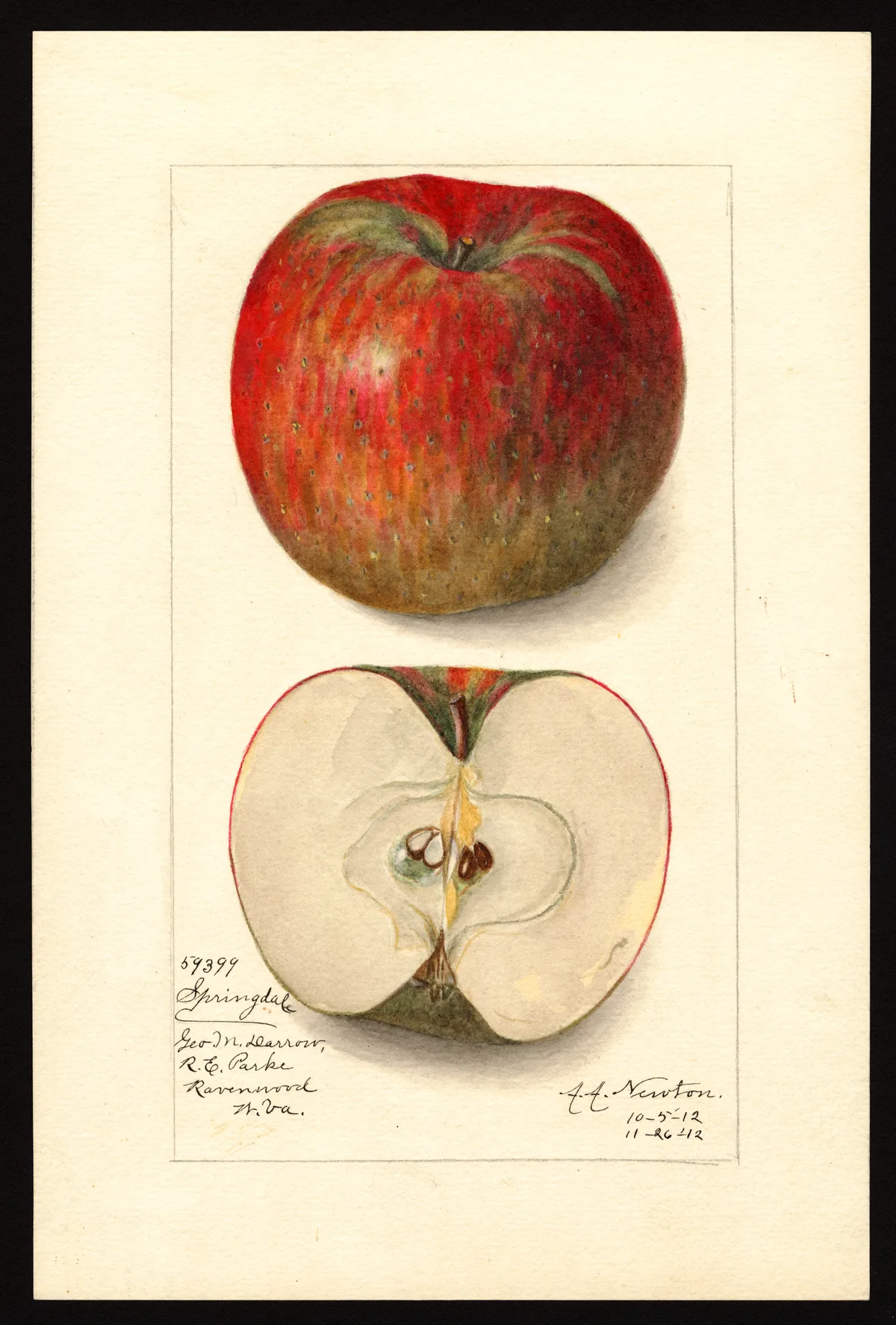
USDA Pomological Watercolor Collection
Springdale
Origin and History
Origin: Arkansas; of recent introduction.
Tree
Not described in source.
Fruit
Size and Form: Medium, roundish oblate, slightly conical, regular.
Surface: Yellow, almost or wholly covered with fine dark solid red, obscurely splashed with dark crimson; some small russet patches.
Dots: Distinct, many, russet, raised.
Stem: Medium, stout.
Cavity: Regular, medium, obtuse; lined with stellate russet.
Basin: Rather shallow, slightly corrugated.
Calyx: Open; segments small, flat, convergent.
Core: Half open, clasping; cells round; tube long, funnel-shaped; stamens marginal.
Seeds: Plump, pointed, packed closely in cells.
Flesh and Flavor: Yellowish white with greenish tinge, firm, very solid, mild, pleasant, subacid; quality good.
Season
Late winter.
Uses
Not described in source.
Subtypes and Variants
Not described in source.
Book Sources
Described in 1 period pomological work
Nursery Catalog Sources
Found in 8 catalogs (1896–1913) from Illinois, Missouri, Oregon, Washington
- Stark Bros. Nurseries & Orchards Co. , Louisiana , Missouri — 1896
- Central Experimental Farm , Dominion Department of Agriculture, Agassiz, British Columbia (under test; Bulletin No. 3, Second Series) — 1900
- Washington Nursery Co. , Toppenish , Washington — 1901
- Benjamin Buckman (personal inventory) , Farmingdale , Illinois — 1901
- Washington Nursery Company , Toppenish , Washington — 1909
- Pacific Nursery Company , Portland , Oregon — 1912
- Washington Nursery Company , Toppenish , Washington — 1912
- Benjamin Buckman (personal inventory) , Farmingdale , Illinois — 1913
View original book sources (1)
— J.L. Budd & N.E. Hansen, American Horticultural Manual, Part II: Systematic Pomology (1914)Springdale. — Origin, Arkansas; of recent introduction. Fruit medium, roundish oblate, slightly conical, regular; surface yellow almost or wholly covered with fine dark solid red, obscurely splashed dark crimson, some small russet patches; dots distinct, many, russet, raised; cavity regular, medium, obtuse, lined with stellate russet, stem medium, stout; basin rather shallow, slighly corrugated; calyx open; segments small, flat convergent. Core half open, clasping; cells round; tube long, funnel-shaped; stamens marginal; seeds plump, pointed, packed closely in cells; flesh yellowish white with greenish tinge, firm, very solid, mild pleasant subacid, good. Late winter.