Starkey
Apple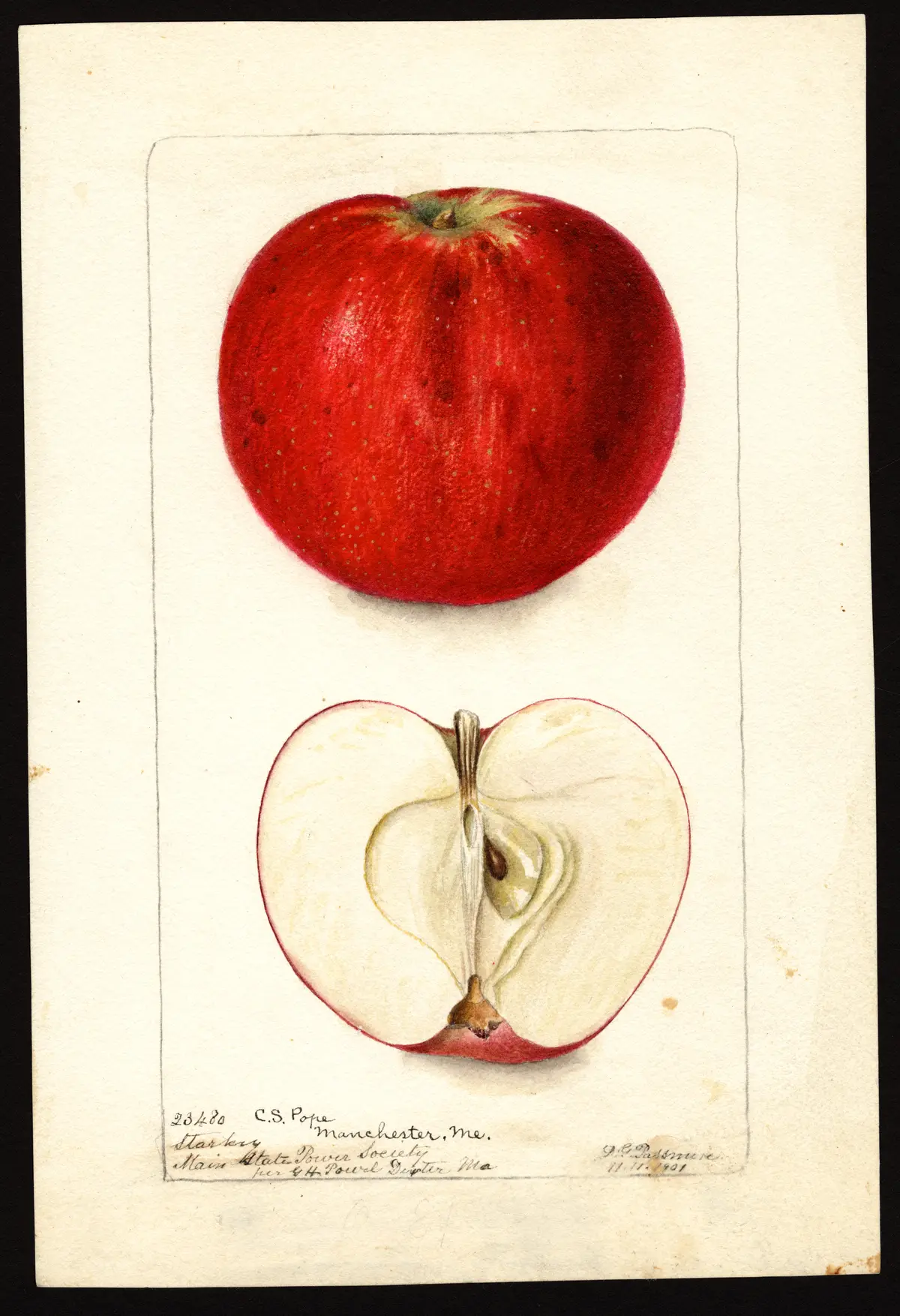
USDA Pomological Watercolor Collection
Starkey
Origin / History
Originated on the farm of Moses Starkey in the town of North Vassalboro, Kennebec county, Maine. In Maine, where it originated, it is said to be popular in market. Highly esteemed in its locality as a profitable market variety as well as for home use. References include Am. Pom. Soc. Rpt., 1875:65; Downing, 1876:69 app.; Thomas, 1885:524; Munson, Me. Sta. Rpt., 1893:133; Am. Pom. Soc. Cat., 1897:14; Budd-Hansen, 1903:179. Beach notes it had not been sufficiently tested to determine its value for New York state at the time of writing, but considered it worthy of testing.
Tree
Hardy and vigorous; a hardy and vigorous grower in the nursery, becoming rather large and spreading in the orchard. Productive and a regular good bearer; comes into bearing rather young and is a good biennial cropper (Beach), though Downing and Budd-Hansen describe it as a regular bearer.
Tree medium to rather large, moderately vigorous to vigorous, with long, moderately stout, curved branches. Form spreading or roundish, open. Twigs medium to long, stout, geniculate, often irregularly crooked; internodes long to below medium. Bark brownish-red mingled sometimes with olive-green, irregularly mottled with scarf-skin; pubescent near tips. Lenticels scattering, inconspicuous, medium size or below, round, raised. Buds medium to large, prominent, plump, acute, free, slightly pubescent.
Fruit
Size: Medium (Downing, Budd-Hansen, Thomas); medium to rather large (Beach); large (Lowther). Of good size, fair, well colored (Beach).
Form: Oblate, slightly conic, regular (Downing, Budd-Hansen); oblate or oblate conical, regular or faintly ribbed, symmetrical (Beach); roundish-oblate (Thomas); oblate-round (Lowther).
Stem: Short, small (Downing, Budd-Hansen); medium length (Beach).
Cavity: Medium, sometimes slight russet (Downing, Budd-Hansen); medium size, rather shallow, partly covered with greenish russet (Beach).
Calyx: Closed or nearly so. Calyx tube conical or somewhat funnel-form (Beach). Calyx large (Beach).
Basin: Medium, slightly corrugated (Downing, Budd-Hansen); medium size, shallow, somewhat wrinkled (Beach).
Skin: Pale yellow, shaded, striped and splashed with light and dark bright red, and moderately sprinkled with light and gray dots (Downing); surface pale yellow, shaded, striped and splashed with light and dark bright red; dots few, light and gray (Budd-Hansen); pale yellow, washed or deeply blushed with lively red, splashed and striped with carmine; dots pale gray or russet; prevailing effect red (Beach); largely striped and splashed with red (Beach summary); nearly all rich red (Thomas); yellow striped skin (Lowther).
Flesh / Flavor: Whitish, half fine, tender, juicy, mild pleasant subacid (Downing, Budd-Hansen); whitish, firm, rather fine, juicy, crisp, pleasant, lively subacid, becoming mild subacid, very good (Beach); mild sub-acid, very good (Thomas); pleasant subacid, excellent for dessert or culinary use (Beach summary).
Core / Seeds: Core small (Downing, Budd-Hansen); core rather small (Beach).
Season
October to January (Downing, Budd-Hansen, Beach); early winter (Thomas); autumn (Lowther). Season October to midwinter (Beach summary).
Uses
Excellent for dessert or culinary use; suited for market as well as home use; popular in market in Maine. Quality good; use: market (Lowther).
Subtypes / Variants
Not described in source.
Other
Not described in source.
Book Sources
Described in 5 period pomological works
Nursery Catalog Sources
Found in 1 catalog (1913) from Illinois
- Benjamin Buckman (personal inventory) , Farmingdale , Illinois — 1913
View original book sources (5)
— A.J. Downing, The Fruits and Fruit Trees of America (1900)Starkey.
Origin, town of North Vassalboro, Maine, on the farm of Moses Starkey; tree hardy, vigorous, spreading; a regular good bearer, and highly esteemed in its locality as a profitable market variety as well as for home use.
Fruit medium, oblate, slightly conic, regular; skin pale yellow, shaded, striped and splashed with light and dark bright red, and moderately sprinkled with light and gray dots; stalk short, small; cavity medium, sometimes slight russet; calyx closed or nearly so; basin medium, slightly corrugated; flesh whitish, half fine, tender, juicy, mild pleasant subacid; core small. October, January.
— S.A. Beach, The Apples of New York, Vol. 2 (1905)STARKEY.
REFERENCES. 1. Am. Pom. Soc. Rpt., 1875:65. 2. Downing, 1876:69 app. 3. Thomas, 1885:524. 4. Munson, Me. Sta. Rpt., 1893:133. 5. Am. Pom. Soc. Cat., 1897:14. 6. Budd-Hansen, 1903:179.
SYNONYMS. None.
Fruit of good size, fair, well colored, largely striped and splashed with red, pleasant subacid, excellent for dessert or culinary use. Season, October to midwinter. In Maine, where it originated, it is said to be popular in market. It has not been sufficiently tested to determine its value for this state, but it appears to be worthy of testing. Tree a hardy and vigorous grower in the nursery, becoming rather large and spreading in the orchard; comes into bearing rather young and is a good biennial cropper.
Historical. Originated on the farm of Moses Starkey, North Vassalboro, Kennebec county, Me.
TREE.
Tree medium to rather large, moderately vigorous to vigorous with long, moderately stout, curved branches. Form spreading or roundish, open. Twigs medium to long, stout, geniculate, often irregularly crooked; internodes long to below medium. Bark brownish-red mingled sometimes with olive-green, irregularly mottled with scarf-skin; pubescent near tips. Lenticels scattering, inconspicuous, medium size or below, round, raised. Buds medium to large, prominent, plump, acute, free, slightly pubescent.
FRUIT.
Fruit medium to rather large. Form oblate or oblate conical, regular or faintly ribbed, symmetrical. Stem medium length. Cavity medium size, rather shallow, partly covered with greenish russet. Calyx large, closed or nearly so. Basin medium size, shallow, somewhat wrinkled. Skin pale yellow, washed or deeply blushed with lively red, splashed and striped with carmine. Dots pale gray or russet. Prevailing effect red. Calyx tube conical or somewhat funnel-form. Core rather small. Flesh whitish, firm, rather fine, juicy, crisp, pleasant, lively subacid, becoming mild subacid, very good. Season October to January.
— Granville Lowther (ed.), Encyclopedia of Practical Horticulture (1914)Starkey is large in size, oblate-round in form, with yellow striped skin. Quality: good. Use: market. Season: autumn.
— John J. Thomas, The American Fruit Culturist (1903)Starkey. Medium, roundish-oblate, nearly all rich red, mild sub-acid, very good. Early winter. Me.
— J.L. Budd & N.E. Hansen, American Horticultural Manual, Part II: Systematic Pomology (1914)Starkey. — Origin, Maine; tree hardy, vigorous, spreading, productive, a regular bearer.
Fruit medium, oblate, slightly conic, regular; surface pale yellow, shaded, striped and splashed with light and dark bright red; dots few, light and gray; cavity medium, sometimes slight russet; stem short, small; basin medium, slightly corrugated; calyx closed or nearly so. Core small; flesh whitish, half fine, tender, juicy, mild pleasant subacid. October, January.