Starr
Apple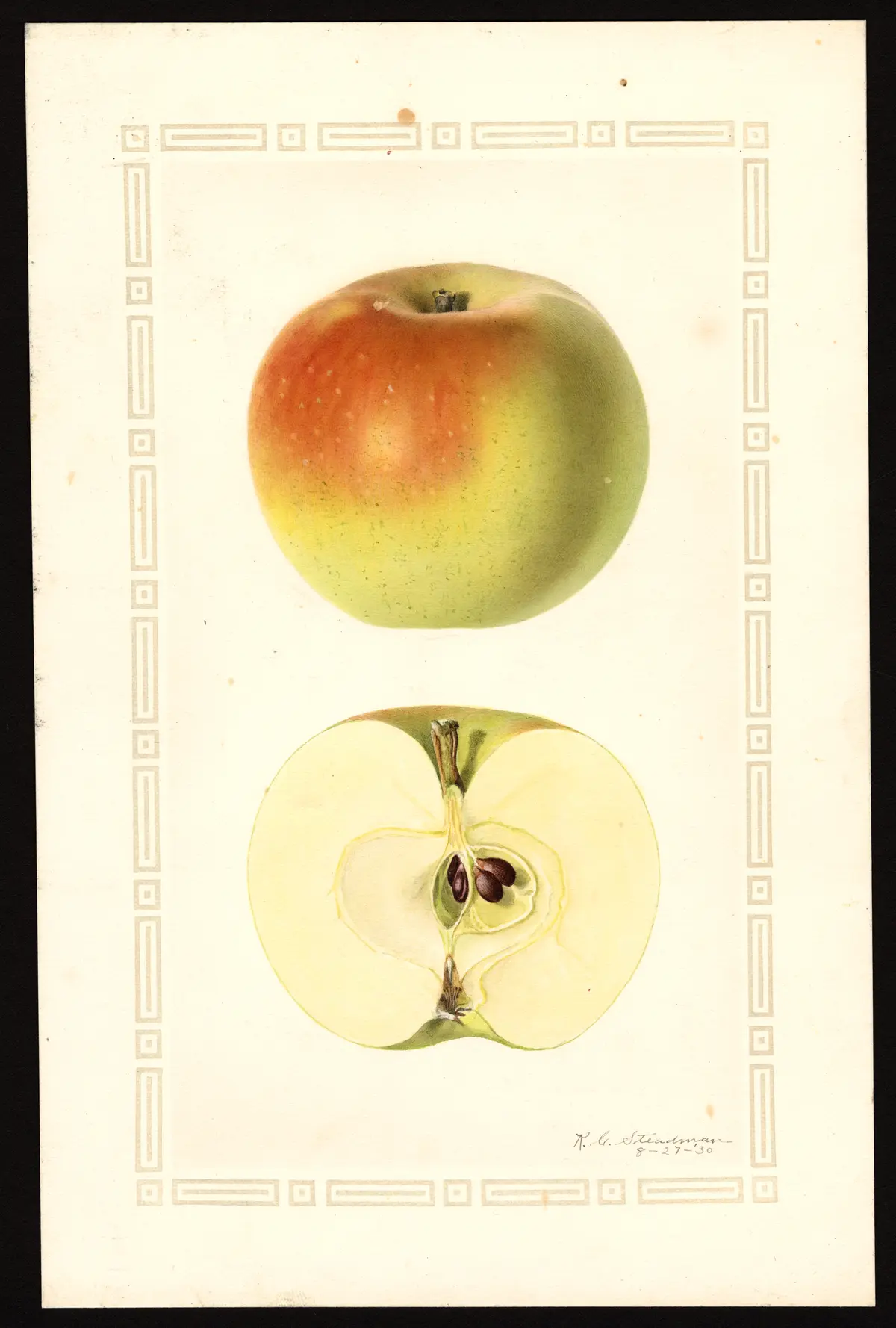
USDA Pomological Watercolor Collection
Starr
Origin / History
An accidental seedling that originated in Woodbury, New Jersey. Downing states it originated on the premises of the late John Starr of Woodbury, N. J. Beach gives a more specific account: the original tree was found on the grounds of Judge J. M. White of Woodbury, N. J., which property afterward came into the possession of Mrs. Starr. Propagation of the variety was begun by Wm. Parry in 1865 under the name of Starr. Hedrick notes that it appeared in 1865 according to Downing. Because the crop ripens at a season when competition is keen, the variety has scarcely gone further than its native state of New Jersey, and so far as Beach could learn it had been but little planted in New York.
Tree
Growth habit: Downing describes the tree as a vigorous grower, forming a round, somewhat spreading head. Beach describes it as moderately vigorous, with form upright spreading or roundish, rather dense. Hedrick gives it as vigorous, upright-spreading, dense.
Branches: short, moderately stout (Beach) to short, stout (Hedrick), curved. Downing notes branches rather slender.
Bearing: a regular and abundant bearer (Downing); comes into bearing young and gives promise of being an annual bearer (Beach).
Twigs: long, curved, stout with large terminal buds; internodes long.
Bark: brownish-red, tinged with olive-green, lightly streaked with scarf-skin; pubescent near tips. Downing describes young wood as light reddish yellow brown.
Lenticels: quite numerous, medium size, round, not raised.
Buds: prominent (Downing, Beach), large, long, broad, plump, acute, free, pubescent.
Fruit
Size: Medium to large (Downing, who also separately describes it as "large"); large (Thomas); very large to large (Beach); large (Hedrick). Pretty uniform in size and shape.
Form: Roundish oblate (Downing, Thomas); distinctly oblate to roundish oblate (Beach); oblate or round-oblate (Hedrick). Regular or faintly ribbed (Beach, Hedrick); Downing notes obscurely ribbed; Thomas gives regular, smooth.
Stem / Stalk: Slender (Downing); short to medium, moderately thick, sometimes swollen (Beach); short, thick, sometimes swollen (Hedrick).
Cavity: Acute, varying from a little obtuse to somewhat acuminate, shallow to medium, broad, smooth or gently furrowed (Beach); acute, shallow, broad, smooth or gently furrowed (Hedrick).
Calyx: Medium size, closed, lobes long to medium, rather narrow, acuminate (Beach); closed, with lobes long, narrow (Hedrick).
Basin: Medium in depth, narrow, abrupt, somewhat furrowed (Beach); medium in depth, narrow, abrupt, furrowed (Hedrick).
Skin: Greenish white (Downing); pale green, often with blush on sunny side (Thomas); rather thick, tough, nearly smooth, green becoming yellowish-green, sometimes with indications of a faint blush (Beach); thick, tough, smooth, yellowish-green, sometimes with a faint blush (Hedrick). Downing adds that at full maturity it becomes pale yellow, sometimes with a shade of light red in the sun.
Dots: Numerous, small and large, pale or russet.
Flesh / Flavor: Whitish, pleasant subacid (Downing); yellowish, firm, sub-acid, good (Thomas); tinged with yellow, moderately fine, very tender, crisp, very juicy, sprightly subacid, aromatic, very good (Beach); yellow, fine, tender, crisp, very juicy; good to very good (Hedrick). Very attractive for a green or yellowish apple, and very good in quality, especially for dessert use (Beach). Hedrick notes the fruits are attractive green or yellow, early, and well-flavored, high enough in quality for dessert.
Core / Seeds: Calyx tube long, very wide to moderately wide, conical to cylindrical and large, extending to the core (Beach); calyx-tube long, conical, large, extending to the core (Hedrick). Stamens nearly marginal (Beach); stamens marginal (Hedrick). Core medium to rather large, abaxile to nearly axile (Beach); core large, abaxile (Hedrick). Cells closed or slightly open (Beach); cells closed (Hedrick). Core lines clasping. Carpels obovate, sometimes tufted. Seeds dark brown, medium to large (Beach) / large (Hedrick), rather wide / wide, plump, acute to nearly acuminate (Beach) / acute (Hedrick).
Season
July to September (Downing); summer (Thomas); August and September (Beach, Hedrick).
Uses
Cooking only (Downing), who also calls it valuable as an early market sort and for culinary uses. Beach rates it very good in quality, especially for dessert use, and worthy of testing where a fruit of this type is desired. Hedrick notes the fruit is high enough in quality for dessert.
Subtypes / Variants
Not described in source.
Other
Not described in source.
Book Sources
Described in 4 period pomological works
Nursery Catalog Sources
Found in 2 catalogs (1901–1913) from Illinois
- Benjamin Buckman (personal inventory) , Farmingdale , Illinois — 1901
- Benjamin Buckman (personal inventory) , Farmingdale , Illinois — 1913
View original book sources (4)
— A.J. Downing, The Fruits and Fruit Trees of America (1900)Starr.
From New Jersey Fruit medium to large, roundish oblate, greenish white. Stalk slender. Flesh whitish, pleasant subacid. July to September. Cooking only.
This large early apple was an accidental seedling on the premises of the late John Starr, of Woodbury, N. J. The tree is said to be a vigorous grower, forming a round, somewhat spreading head; branches rather slender; a regular and abundant bearer; valuable as an early market sort, and for culinary uses; young wood light reddish yellow brown, buds prominent.
Fruit large, roundish oblate, obscurely ribbed; skin greenish white, or pale yellow at full maturity, sometimes a shade of light red in the sun
— S.A. Beach, The Apples of New York, Vol. 2 (1905)STARR.
References. 1. Downing, Tilt. Jour. Hort., 6:347. 1869. fig. 2. Downing, 1869:360. 3. Thomas, 1875:512. 4. Hexamer, Am. Pom. Soc. Rpt., 1895:70. 5. Rural N. Y., 54:587. 1895. 6. Parry, Wm., Parry, N. J., Cat., 1896.
Synonyms. None.
Fruit large, very attractive for a green or yellowish apple, and very good in quality, especially for dessert use. Season, August and September. The tree is a pretty good grower, comes into bearing young and as tested at this Station gives promise of being an annual bearer. Starr appears to be worthy of testing where a fruit of this type is desired.
Historical. The original tree was found on the grounds of Judge J. M. White, Woodbury, N. J., which property afterward came into the possession of Mrs. Starr. The propagation of the variety was begun by Wm. Parry in 1865 under the name of Starr (6). So far as we can learn it has been but little planted in New York.
Tree.
Tree moderately vigorous with short, moderately stout, curved branches. Form upright spreading or roundish, rather dense. Twigs long, curved, stout with large terminal buds; internodes long. Bark brownish-red, tinged with olive-green, lightly streaked with scarf-skin; pubescent near tips. Lenticels quite numerous, medium size, round, not raised. Buds prominent, large, long, broad, plump, acute, free, pubescent.
Fruit.
Fruit very large to large, pretty uniform in size and shape. Form distinctly oblate to roundish oblate, regular or faintly ribbed. Stem short to medium, moderately thick, sometimes swollen. Cavity acute, varying from a little obtuse to somewhat acuminate, shallow to medium, broad, smooth or gently furrowed. Calyx medium size, closed, lobes long to medium, rather narrow, acuminate. Basin medium in depth, narrow, abrupt, somewhat furrowed. Skin rather thick, tough, nearly smooth, green becoming yellowish-green, sometimes with indications of a faint blush. Dots numerous, small and large, pale or russet. Calyx tube long, very wide to moderately wide, conical to cylindrical and large, extending to the core. Stamens nearly marginal. Core medium to rather large, abaxile to nearly axile; cells closed or slightly open; core lines clasping. Carpels obovate, sometimes tufted. Seeds dark brown, medium to large, rather wide, plump, acute to nearly acuminate. Flesh tinged with yellow, moderately fine, very tender, crisp, very juicy, sprightly subacid, aromatic, very good. Season August and September.
— John J. Thomas, The American Fruit Culturist (1903)Starr. Large, roundish oblate, regular, smooth; pale green, often with blush on sunny side; flesh yellowish, firm, sub-acid, good. Summer. New Jersey. Fig. 368.
— U.P. Hedrick, Cyclopedia of Hardy Fruits (1922)STARR.
The fruits of Starr are attractive green or yellow, early, and well-flavored high enough in quality for dessert. The crop ripens at a season when competition is keen, and the variety has, therefore, scarcely gone further than its native state, New Jersey, where, according to Downing, it appeared in 1865.
Tree vigorous, upright-spreading, dense, with short, stout, curved branches. Fruit large, uniform in size and shape, oblate or round-oblate, regular or faintly ribbed; stem short, thick, sometimes swollen; cavity acute, shallow, broad, smooth or gently furrowed; calyx closed; lobes long, narrow; basin medium in depth, narrow, abrupt, furrowed; skin thick, tough, smooth, yellowish-green, sometimes with a faint blush; dots numerous, small and large, pale or russet; calyx-tube long, conical, large, extending to the core; stamens marginal; core large, abaxile; cells closed; core-lines clasping; carpels obovate, sometimes tufted; seeds dark brown, large, wide, plump, acute; flesh yellow, fine, tender, crisp, very juicy; good to very good; August and September.