Strode's Birmingham
Apple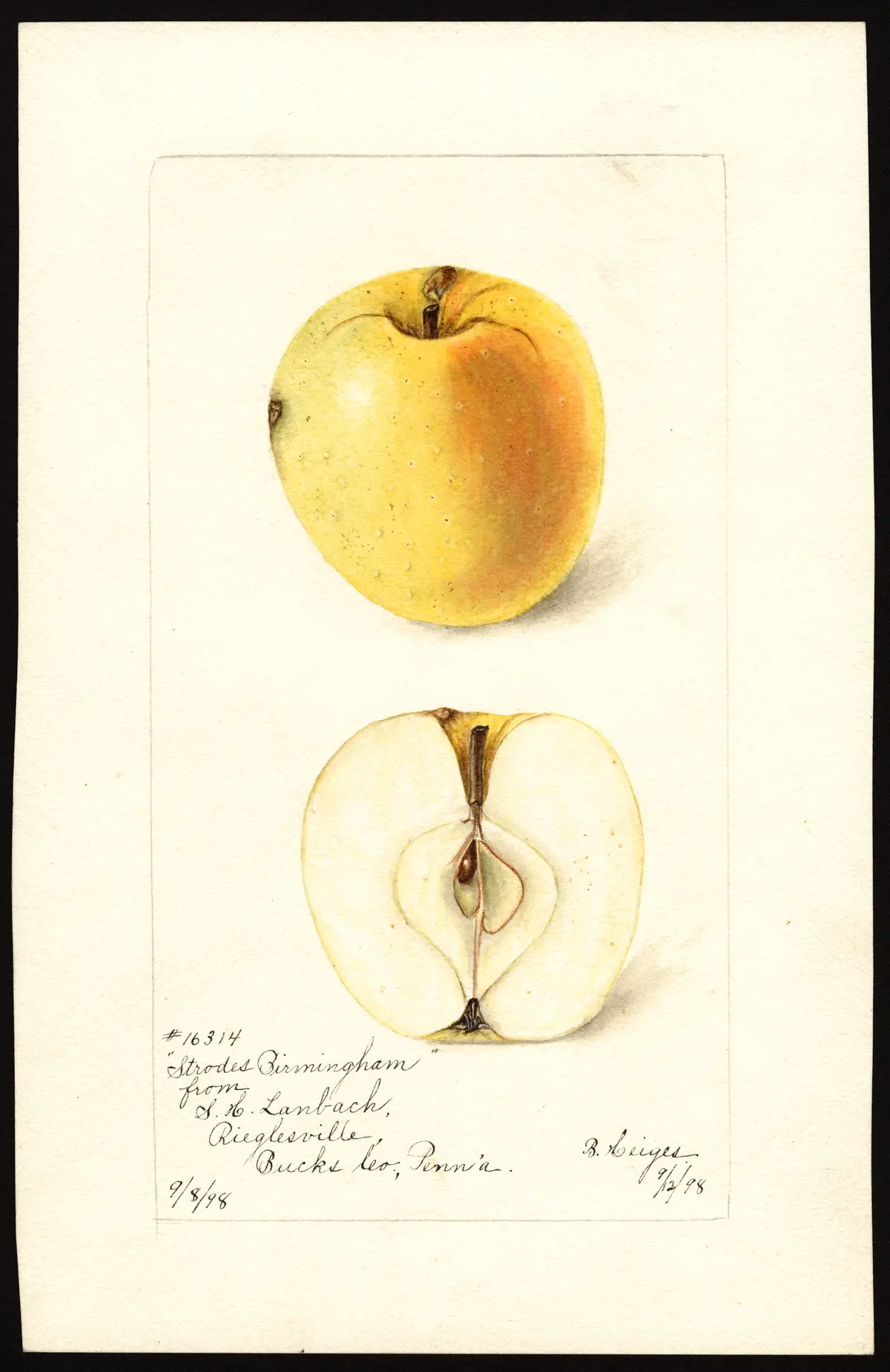
USDA Pomological Watercolor Collection
Strode's Birmingham
Origin/History
Origin in Chester County, Pennsylvania. First referenced in Downing (1857) and subsequently in Warder (1867), the Pennsylvania State Horticultural Association Report (1886), Powell and Fulton's U.S. P.B.I. Bulletin 48 (1903), and Beach and Clark's New York Station Bulletin 248 (1904). The variety has appeared under several names in the literature, including Strade's and Strobe's Birmingham (Downing, 1857; Warder, 1867; Pa. Sta. Hort. Assn., 1886), Strode (Powell and Fulton; Beach and Clark), and Dumpling (Pa. Sta. Hort. Assn., 1886). Reported as a desirable variety for market and general purposes in Pennsylvania (Pa. Sta. Hort. Assn. Rpt., 1886). As compared with standard varieties of its season, Strode's Birmingham does not appear to be worthy of the attention of New York fruit growers (Beach and Clark, 1904).
Tree
A vigorous, upright grower (Downing). The tree comes into bearing rather young and is productive, yielding moderate to good crops nearly annually (Beach).
Fruit
Size and Form
The two sources differ slightly on size: Downing describes the fruit as rather below medium, while Beach describes it as medium-sized and uniform in size and shape. Form roundish conic or inclined to oblong (Beach), also described as oblong oval or conic (Downing); regular or faintly ribbed; sides unequal (Beach).
Stem
Stem long and slender (Beach); set in a deep, narrow cavity (Downing; see Cavity below). Downing also describes the stalk itself as slender.
Cavity
Acute to almost acuminate, usually rather deep, medium in width, symmetrical, russeted (Beach). Downing describes it as deep and narrow.
Calyx
Medium to small, closed or partly open; lobes medium in length and width, acute, reflexed (Beach).
Basin
Shallow, narrow to medium in width, obtuse, furrowed and wrinkled (Beach). Downing describes the basin as broad and shallow, corrugated — a slight discrepancy in width characterization between the two sources.
Skin
Thin, tender, smooth, clear yellow or greenish, often with a faint blush, and marked with russet flecks (Beach). Downing describes the color simply as yellow, sprinkled with a few gray dots.
Dots
Scattering, very minute, submerged, inconspicuous, red or russet (Beach). Downing describes them as a few gray dots.
Flesh and Flavor
Yellowish, rather firm, fine, rather crisp, tender, juicy; brisk subacid becoming mild and pleasant when fully mature; good to very good (Beach). Downing describes the flesh as yellow, moderately juicy, subacid, and good to very good.
Core and Seeds
Core medium to small, axile; cells almost closed; core lines meeting. Carpels broadly ovate to oblong, narrowing toward either end, deeply emarginate. Seeds dark dull brown, medium to large, wide, plump, broadly acute, tufted (Beach).
Internal Structure (Calyx Tube)
Calyx tube short, wide, urn-shape to broadly conical. Stamens nearly basal (Beach).
Season
September (Downing). Beach places the commercial limit in September, and for home use the season extends through September and October, with a few specimens keeping until January.
Uses
Reported as desirable for market and general purposes in Pennsylvania (Pa. Sta. Hort. Assn. Rpt., 1886). Suitable for home use through early winter (Beach).
Subtypes/Variants
Not described in source.
Other
Not described in source.
Book Sources
Described in 2 period pomological works
- Beach, The Apples of New York Vol. 2 (1905) — listed as Strode Birmingham
- Downing, Fruits and Fruit Trees of America (1900)
View original book sources (2)
— A.J. Downing, The Fruits and Fruit Trees of America (1900)Strode's Birmingham.
Strode's.
Origin, Chester Co., Pa. A vigorous, upright grower, very productive.
Fruit rather below medium, oblong oval or conic, yellow, sprinkled with a few gray dots. Stalk slender, set in a deep, narrow cavity. Basin broad, shallow, corrugated. Flesh yellow, moderately juicy, subacid. Good to very good. September.
— S.A. Beach, The Apples of New York, Vol. 2 (1905)STRODE BIRMINGHAM.
REFERENCES. 1. Downing, 1857:193. 2. Warder, 1867:733. 3. Pa. Sta. Hort. Assn. Rpt., 1886:50. 4. Powell and Fulton, U. S. P. B. I. Bul. 48:57. 1903. 5. Beach and Clark, N. Y. Sta. Bul., 248:145. 1904.
SYNONYMS. Dumpling (3). STRODE (4, 5). Strade's (1). STROBE'S BIRMINGHAM (1, 2, 3). Strode's Birmingham (4, 5).
A medium-sized yellow apple of mild subacid flavor and good quality. Commercial limit September. For home use it is in season in September and October and a few specimens may be kept till January (5). It is reported as a desirable variety for market and general purposes in Pennsylvania (3). The tree comes into bearing rather young and is productive yielding moderate to good crops nearly annually. As compared with standard varieties of its season it does not appear to be worthy of the attention of New York fruit growers.
FRUIT.
Fruit of medium size; uniform in size and shape. Form roundish conic or inclined to oblong, regular or faintly ribbed; sides unequal. Stem long, slender. Cavity acute to almost acuminate, usually rather deep, medium in width, symmetrical, russeted. Calyx medium to small, closed or partly open; lobes medium in length and width, acute, reflexed. Basin shallow, narrow to medium in width, obtuse, furrowed and wrinkled.
Skin thin, tender, smooth, clear yellow or greenish, often with faint blush and marked with russet flecks. Dots scattering, very minute, submerged, inconspicuous, red or russet.
Calyx tube short, wide, urn-shape to broadly conical. Stamens nearly basal.
Core medium to small, axile; cells almost closed; core lines meeting. Carpels broadly ovate to oblong narrowing toward either end, deeply emarginate. Seeds dark dull brown, medium to large, wide, plump, broadly acute, tufted.
Flesh yellowish, rather firm, fine, rather crisp, tender, juicy, brisk subacid becoming mild and pleasant when fully mature, good to very good.
Season September to early winter.